
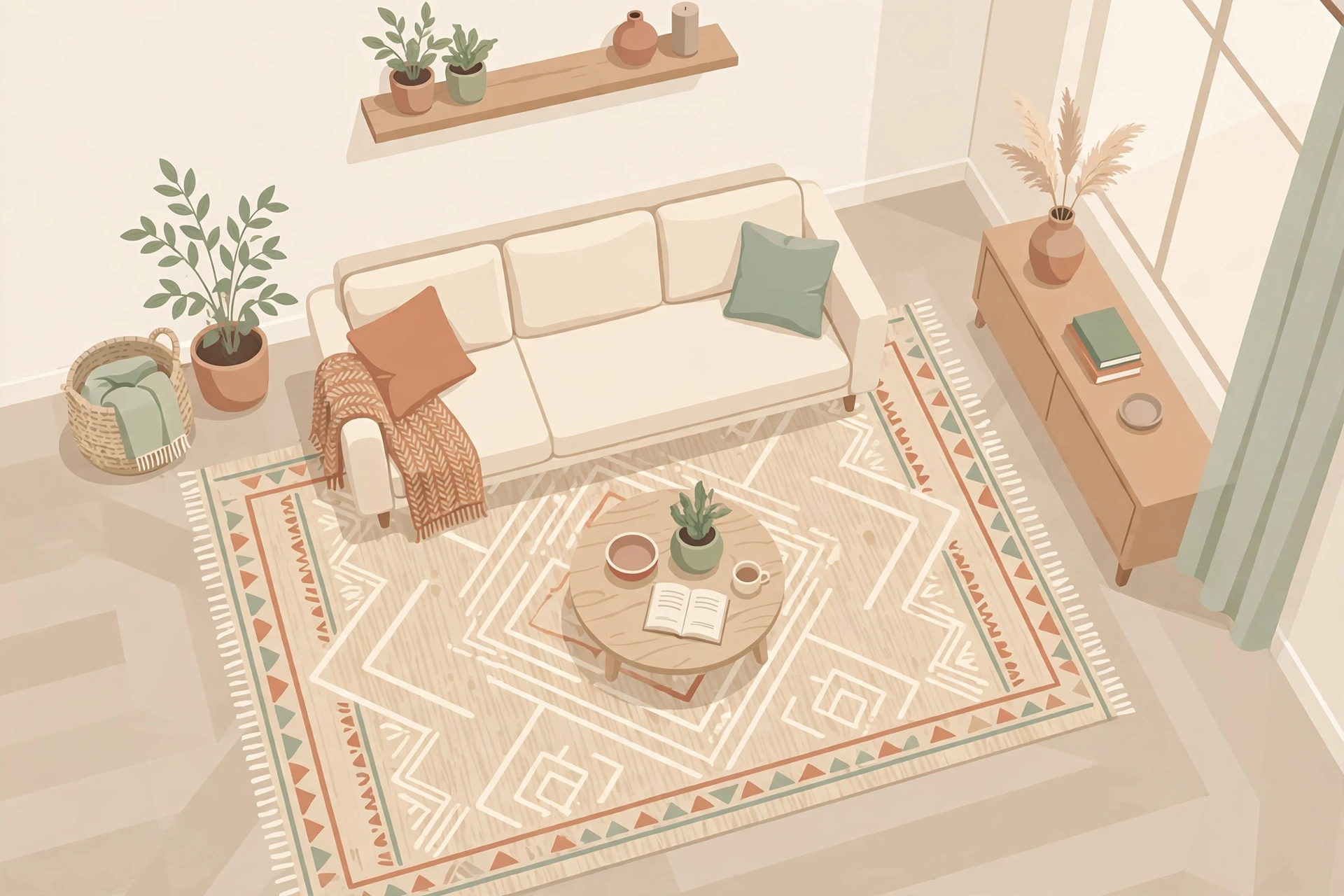
Nothing throws off a living room faster than the wrong rug size. Too small, and your sofa looks like it is floating on a postage stamp; too big, and the room feels swallowed up. Professional designers follow a handful of standard rug dimensions and placement rules that work in almost any living room. This guide lays out the exact measurements — which standard sizes fit which sofas, how far the rug should run under your furniture, and what you should expect to pay — so you can measure once and buy with confidence.
Quick answer: For most living rooms, an 8×10 ft rug is the safest choice — it fits a standard three-seat sofa with the front legs on the rug while leaving 18–24 inches of bare floor at the edges. Compact rooms work with a 6×9 ft rug; large rooms and sectionals need 9×12 ft or bigger.
What Size Rug Fits a Living Room? The Standard Sizes
Area rugs come in standard dimensions, and knowing them narrows your search instantly. Here is how each common size maps to real living rooms:
• 5×7 ft — best for small accent zones: under a coffee table in a studio, or a reading nook with one chair. Rarely enough for a full sofa setup.
• 6×9 ft — the sweet spot for compact living rooms (roughly 11×13 ft and under). Fits a loveseat or apartment-size sofa (60–72 in wide) with the front legs on the rug.
• 8×10 ft — the most popular living room rug size in the US. Suits standard three-seat sofas (72–90 in wide) in rooms around 12×16 to 14×18 ft; the size designers reach for by default.
• 9×12 ft — the right call for sectionals and larger rooms (14 ft wide and up).
• 10×14 ft — for great rooms and open-plan spaces where the living area needs defining within a bigger footprint.
When in doubt between two sizes, size up. A slightly larger rug almost always looks better than a slightly smaller one — the number-one rug regret is buying too small.
The 3 Rug Placement Rules That Actually Matter
You only need three rules, and they cover nearly every layout:
1. Front legs on the rug. At minimum, the front legs of the sofa and chairs should rest on the rug — aim for 6–8 inches of rug under each front leg. This visually connects the furniture instead of letting pieces drift apart.
2. Leave a border of bare floor. Keep 18–24 inches between the rug’s edge and the walls. This frame of flooring makes the room feel larger; pushing the rug wall-to-wall reads as wall-to-wall carpet and shrinks the space visually.
3. Center the coffee table fully on the rug. All four legs of the coffee table should sit on the rug, with roughly 14–18 inches between the sofa’s front edge and the table so there is comfortable legroom.
What Size Rug for a Sectional Sofa?
Sectionals change the math because of their L-shape. A standard L-shaped sectional (about 100–120 inches wide) needs at least a 9×12 ft rug so both the main sofa run and the chaise section sit on it. If the room cannot take a 9×12, an 8×10 can work with a smaller apartment sectional (under 100 inches wide) — just keep the front legs of the longest section on the rug.
For corner-placed sectionals, align the rug with the longest side and keep the 18-inch floor border on the two exposed sides. If you are working with a tricky corner layout, these small living room layout ideas with exact measurements show how to plan clearances around sectionals without blocking walkways.
How Far Should a Rug Go Under the Sofa?
The honest answer: at least 6–8 inches under the front legs for the standard “front-legs-on” look most living rooms use. Two alternatives are worth knowing: all legs on (rug runs 12–24 inches past the back legs — most polished, but needs a bigger, pricier rug, usually 9×12) or front legs only (the budget-friendly standard that can save $150–$400 versus sizing up).
What never works is the sofa sitting entirely off the rug with a small rug floating in front of it — that is the “postage stamp” mistake. Measure your sofa’s depth, add 8 inches, and that tells you where the rug’s near edge must start.
Rug Budgets: What You Should Expect to Pay
Rug prices scale with size and material. For the popular 8×10 size, realistic US price bands are:
• Polypropylene/synthetic: $90–$250. Stain-resistant, kid- and pet-friendly — the best value for high-traffic family rooms, though flatter in look and feel.
• Cotton flatweave: $150–$350. Casual texture and easy to shake out, but shows wear faster.
• Washable rugs (two-piece systems): $250–$600. The top layer goes straight in the washing machine — a genuine upgrade for homes with pets or toddlers.
• Wool: $450–$1,200+. Naturally stain-resistant, soft underfoot, lasts decades. Worth it for a rug you will keep 10+ years.
Save on trendy patterns you will tire of in three years (go synthetic). Splurge on the main living room rug in wool if the budget allows — the cost per year beats replacing a $120 rug every two years.
Rug Sizing Mistakes to Avoid
1. Buying too small. The rug should be at least as wide as your sofa plus 24 inches.
2. Skipping the floor border. A rug that nearly touches the walls makes the room feel smaller, not cozier.
3. Blocking the door swing. Leave 24–30 inches of clearance where doors open over the rug, or choose low-pile.
4. Wrong shape for the room. Rectangular rooms want rectangular rugs; round rugs suit round coffee tables or square nooks only.
5. Ignoring the fireplace wall. In rooms with a corner fireplace and TV, center the rug on the seating arrangement, not the fireplace — the furniture grouping is what the rug anchors. This guide to decorating a living room with a corner fireplace and TV shows how the pieces fit together.
Rug sizing stops being stressful the moment you measure instead of guess. Pick your standard size from the list, check the 18-inch border and the front-legs rule, and buy the biggest quality rug your budget allows. Your living room will look instantly more intentional — no designer required.
Should the front legs of my sofa be on the rug?
Yes — at minimum. Resting the front legs 6–8 inches onto the rug visually connects the sofa to the seating area. A sofa sitting fully off the rug with a small rug floating in front is the most common rug mistake and makes furniture look disconnected.
What size rug fits a 10×12 living room?
A 6×9 ft rug is the practical pick for a 10×12 room — it fits a loveseat or apartment sofa with the front legs on, while keeping the recommended 18-inch floor border. An 8×10 can work if the room has minimal extra furniture, but measure first.
Is a 5×7 rug too small for a living room?
For most living rooms, yes. A 5×7 suits accent zones — under a coffee table in a studio or beside a single reading chair. Any setup with a three-seat sofa needs at least a 6×9, and 8×10 is the safer default.
How much space should be between the rug and the wall?
Leave 18–24 inches of bare floor between the rug edge and the walls. This border frames the rug and makes the room feel larger. In very small rooms you can go down to 12 inches, but avoid pushing the rug wall-to-wall.
Can I layer rugs instead of buying one large rug?
Yes — layering a smaller patterned rug (5×7 or 6×9) over a large natural-fiber rug like jute (8×10 or 9×12) is a popular budget trick. The base rug provides the correct scale while the top rug adds pattern, and the combination often costs less than one large patterned rug.

10 Comments