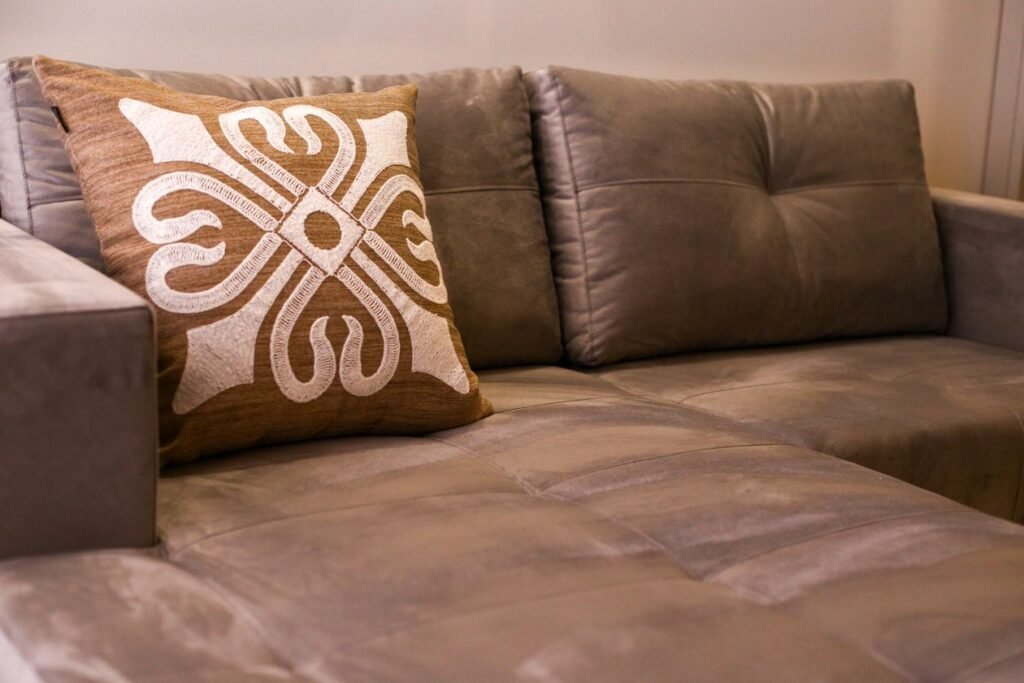
This upholstery fabric durability guide answers the question every sofa buyer asks too late: will this fabric still look good in five years? The frame and springs decide whether a sofa lasts, but the fabric decides whether you still like looking at it. A beautiful linen that pills in six months or a pale velvet that fades by the window costs far more than the price tag suggests, because reupholstering a three-seat sofa runs into four figures. The good news is that durability is measurable. One number, the Martindale rub count, tells you how much friction a fabric can take, and a few more checks cover stains, fading and pet claws. This guide explains the numbers, compares fabrics by price and household, and ends with a five-minute swatch test you can do at home before spending anything.
| Martindale rubs | Use level | Best for |
|---|---|---|
| Under 15,000 | Decorative | Occasional chairs, headboards, cushions |
| 15,000–20,000 | Light domestic | Reading chairs, formal living rooms |
| 20,000–25,000 | General domestic | Everyday sofas in adult households |
| 25,000–30,000 | Heavy domestic | Main family sofa, dining chairs |
| 30,000 and above | Very heavy / contract | Busy family rooms, homes with pets, rentals |
What the Martindale Test Actually Measures
The Martindale test is the standard abrasion test used in Europe and increasingly quoted by US retailers. A machine rubs a fabric sample against a standard wool cloth in a figure-of-eight motion, under a fixed weight, until the fabric shows visible wear. The result is a number of cycles, or rubs. A fabric rated 25,000 Martindale survived 25,000 rubbing cycles before wearing through. Higher means more resistant to the friction of sitting, shifting and daily use.
In the US you will also see Wyzenbeek ratings, quoted in double rubs. The Wyzenbeek machine rubs back and forth along the warp and weft rather than in a figure of eight, and the two scales cannot be converted into each other. As a rough guide, 15,000 Wyzenbeek double rubs suits light use and 30,000 double rubs suits heavy use. If a retailer quotes only one scale, judge the fabric on that scale and do not try to translate it.
Just as important is what the number does not measure. Martindale says nothing about pilling, fading in sunlight, stain resistance or claw damage. A fabric can score 40,000 rubs and still pill badly, fade in a sunny window, or snag the first time a cat kneads it. Treat the rub count as the first filter, not the whole decision. Pilling is rated separately on a 1 to 5 scale, where 5 means no pilling and 4 to 5 is the range to ask for on a main sofa. Colourfastness to light is rated 1 to 8, and a rating of 5 or above is worth asking for if the sofa will sit in direct sun.
How Many Rubs Does Your Sofa Need?
Match the number to the piece, not to the catalogue. An occasional chair in a bedroom that gets sat on twice a week is fine at 15,000 rubs. The main sofa in a living room where two adults sit every evening needs 20,000 to 25,000. Add children, a dog that sleeps on the cushions, or daily entertaining, and the target rises to 30,000 or more. Dining chairs take surprising abuse from sliding in and out, so 25,000 is a sensible minimum there even though nobody lounges on them.
Do not overbuy the number either. A 100,000-rub commercial fabric on a formal sofa is money spent on durability nobody will use, and very high rub counts often come with a stiffer hand feel. The sweet spot for most family living rooms is 25,000 to 40,000 Martindale: durable enough for real life, with enough fabric choices to still find a colour and texture you like. When a retailer cannot give you a rub count at all, treat that as information. Reputable upholstery fabric suppliers publish the number on the spec sheet, and a seller who will not share it is usually selling a decorative fabric at a domestic price.
Fabric by Fabric: What Lasts and What Does Not
Cotton is soft, breathable and takes colour beautifully, but it stains easily and wears faster than blends unless it is a tight canvas or duck weave. Pure linen looks relaxed and expensive, creases gracefully, and handles heat well, but it is less abrasion-resistant than blended linen and can shrink if washed wrongly. Both are better blended with synthetics, which add strength and stain resistance without changing the look much.
Velvet reads luxurious because its dense pile catches light, and modern synthetic velvets are surprisingly hard-wearing, often testing above 30,000 Martindale. The trade-off is crushing: the pile flattens where people sit most, and while regular brushing and steaming lift it, a crushed seat is part of living with velvet. Boucle, with its looped yarns, hides marks well and feels cosy, but the loops snag on claws, jewellery and rough zips, so it is a poor choice for cat owners.
Wool is one of the strongest natural options. A tight upholstery-weight wool, often blended with 10 to 30 per cent nylon, commonly tests at 50,000 Martindale or more, resists soiling naturally, and recovers well from compression, so seat fronts keep their shape. Performance fabrics are the practical pick for busy households: solution-dyed synthetics or treated blends engineered to resist stains, fading and abrasion, usually testing at 30,000 to 100,000 Martindale, with spills beading on the surface long enough to blot away. Ask what makes a fabric performance, because the protection can come from the fibre itself, which lasts, or from a surface coating, which wears off over the years.
What a Yard of Upholstery Fabric Costs
Neither of the big fabric guides publishes prices, yet price decides most purchases. The table below shows typical US retail prices per yard for upholstery-weight fabric. Designer and imported fabrics cost roughly double, and leather is sold by the hide, not the yard, at roughly 100 to 250 dollars per hide, with a three-seat sofa taking four to six hides.
| Fabric | Typical price per yard | Martindale range |
|---|---|---|
| Cotton canvas or duck | 15 to 35 dollars | 15,000–25,000 |
| Linen and linen blends | 25 to 55 dollars | 15,000–30,000 |
| Polyester velvet | 25 to 60 dollars | 30,000–50,000 |
| Wool and wool blends | 40 to 90 dollars | 40,000–100,000 |
| Performance fabric | 35 to 80 dollars | 30,000–100,000 |
| Boucle | 30 to 70 dollars | 15,000–30,000 |
The worked example shows why the per-yard price matters less than the total. Reupholstering a standard three-seat sofa takes 14 to 18 yards of fabric, so the fabric alone costs 350 to 1,080 dollars at the prices above, and professional labour adds 800 to 1,500 dollars. The full job lands between 1,150 and 2,580 dollars, which is often more than a new mid-range sofa at 900 to 2,500 dollars. That maths changes the decision: if the frame and springs are solid hardwood and eight-way hand-tied, reupholstering is worth it; if the frame is pine or particleboard, the money is better spent on a new sofa with the right fabric from the start. A ready-made slipcover at 60 to 200 dollars is the budget fix when the frame is fine but the fabric is tired.
Cleaning Codes: Read the Label Before the First Spill
Every upholstery fabric carries a cleaning code, usually on a tag under a seat cushion, and it decides what you can safely use on a spill. W means clean with water-based cleaners only. S means solvent-based cleaners only, which usually means dry cleaning. WS means either water-based or solvent-based cleaners are safe, and this is the most forgiving code to live with. X means vacuum only, no liquid cleaners at all, which is common on delicate silks and some velvets.
Check the code before buying, not after the first glass of red wine. A WS fabric in a pale colour is far easier to live with than a W-only linen in the same shade, even if the linen looks better in the shop. For pet households, a WS code plus removable, washable cushion covers is the combination that actually survives accidents, because a cover can be cleaned properly instead of just spot-cleaned. Harsh solvents can strip the protective finish from performance fabrics, so even on a WS fabric, start with mild soap and water and test any cleaner on a hidden spot first.
The 5-Minute Swatch Test
Order a swatch before ordering the sofa, and test it at home. Most retailers send swatches free or for a few dollars, and five minutes with one tells you more than a showroom visit. First, rub the swatch hard with your palm for thirty seconds, then look for surface fuzz or pilling. Second, scratch it lightly with a fingernail to see whether the weave catches, which is what a cat claw will do. Third, drop a spoonful of water on it and watch whether it beads or soaks straight in. Fourth, hold it in the sunniest spot in the room and check the colour at midday and at dusk, because fabric that looks warm in shop lighting can turn grey in your living room. Fifth, fold it hard and crease it, then see whether the crease falls out or stays.
A swatch that pills under your palm, snags under a nail, or drinks water instantly will not improve once it is stretched over a sofa. Send it back and try the next one. The test costs nothing, takes five minutes, and prevents the most common upholstery regret, which is discovering a fabric’s weakness after it is already on the furniture.
Upholstery Fabric Durability FAQs
What is the most durable sofa fabric?
For everyday family use, tightly woven performance fabrics, dense wool blends and tight synthetic velvets are the most durable, typically testing at 30,000 Martindale cycles or more. Pigmented leather is also very durable and wipes clean. No fabric is claw-proof, so tight weaves with no loops are the safest choice with pets.
What Martindale rating do I need for a family sofa?
Aim for 25,000 to 30,000 Martindale cycles as a minimum for a main family sofa, and 30,000 or more if you have young children or pets. Occasional chairs are fine at 15,000, and anything above 40,000 is commercial grade. Ask for a pilling rating of 4 or 5 as well, because rub count alone does not predict pilling.
Is performance fabric worth the extra cost?
For families, rentals and pale colours, usually yes. Performance fabrics resist stains and fading, and spills bead on the surface so you can blot them up. Check whether the protection comes from the fibre itself, such as solution-dyed yarn, or from a surface coating. Built-in fibre properties last for the life of the fabric, while coatings can wear off over the years.
How do I keep upholstery fabric from fading?
Keep the sofa out of direct sun where you can, ask for a colourfastness-to-light rating of 5 or above on the 1 to 8 scale, and rotate the cushions so fading stays even. A do-it-yourself UV window film kit costs 25 to 60 dollars per window and cuts the fading that ruins pale fabrics in sunny rooms.
Pick the Number, Then Pick the Fabric
Durable upholstery is a decision made in numbers before it is made in colour. Start with the Martindale target for the piece, 25,000 to 30,000 for a family sofa, then check the pilling rating, the cleaning code and the lightfastness. Compare the per-yard price against the real total, whether that is a new sofa or a reupholstery job, and test a swatch at home before committing. A fabric that passes those checks will still look like the fabric you fell in love with five years from now. For the frame underneath it, see our sofa frame quality guide, and if an old piece is worth saving, see our thrift store decor flips for budget-friendly transformations.