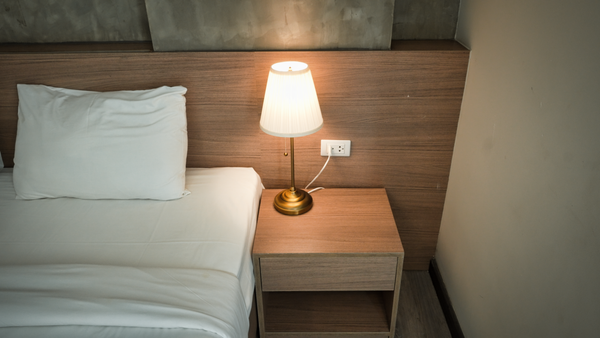
This bedside table size guide starts with a tape measure, not a shopping trip, because a nightstand is used more than almost any other piece of furniture and bought by eye more often than any other. The wrong height means reaching up or down for a glass of water at 3 a.m. The wrong width means a lamp that hangs over the edge or a table that swallows the wall. The wrong depth means bruised hips on the way to the bathroom. Ten minutes with a tape measure fixes all three, and this guide gives you the exact numbers: height matched to your mattress, width matched to your bed, depth and gap matched to your walkway, plus what actually fits on top and what each size costs.
Quick answer: A standard bedside table is 23 to 28 inches tall, 21 to 28 inches wide and 16 to 20 inches deep. The top should sit level with your mattress, or up to 4 inches above it. Width follows the bed: under 21 inches for a twin, 21 to 28 for a full or queen, over 29 for a king.
The Height Rule: Level With Your Mattress
Height is the one measurement that cannot be fudged, because it decides how the table feels every night. Measure from the floor to the top of your mattress, with the bedding on and the mattress compressed as it is when you lie on it, and choose a table within 3 inches of that number. A table up to 4 inches above the mattress top is still comfortable. Beyond that, reaching for a phone or a glass becomes a stretch, and the table starts to tower over the bed and look wrong.
Standard nightstands run 23 to 28 inches tall, which suits most beds with a mattress top between 24 and 28 inches. Low platform beds often need a table under 23 inches, while tall beds with a box spring and a thick topper can push the mattress top past 30 inches and need a tall nightstand of 30 to 35 inches. Measure the mattress, not the frame, and measure both sides of the bed if you are buying a pair, because a split mattress or an uneven floor can leave the two sides an inch apart. If you are between sizes, go slightly lower rather than higher: a table an inch below the mattress is easier to reach across than a table an inch above it.
How Wide Should a Bedside Table Be?
Width follows the bed, because the table has to look like it belongs to the bed rather than borrowed from another room. A narrow table beside a king bed reads like an afterthought, and a wide table beside a twin crowds the wall. Use the bed-size table below as the starting point, then check it against the wall space you actually have.
| Bed size | Bed width | Table width | Table height |
|---|---|---|---|
| Twin / Twin XL | 38 inches | Under 21 inches | 24–26 inches |
| Full / Double | 54 inches | 21–28 inches | 24–27 inches |
| Queen | 60 inches | 21–28 inches | 25–28 inches |
| King | 76 inches | Over 29 inches | 26–29 inches |
| California king | 72 inches | Over 29 inches | 26–29 inches |
Two more rules help when the wall space is tight. First, the table should take up roughly two-thirds of the space between the bed and the wall or the next piece of furniture, which keeps the proportions calm. Second, a pair of tables should match in height even if the widths differ, because mismatched heights are what the eye notices first. Two identical tables flanking a queen bed or larger read calm and hotel-like, and a pair is worth buying when you have at least 21 inches of free space on each side. For a twin bed or a cramped corner with less than 21 inches per side, one table is enough.
Depth, Gap and Walkway: The Forgotten Numbers
Depth is the measurement people skip, and it is the one that decides whether you can walk past the bed. Standard depth is 16 to 20 inches, which holds a lamp, a book and a glass without crowding. Shallow tables of 12 to 16 inches suit tight rooms and narrow walkways, while deep tables of 20 to 30 inches hold serious storage but eat floor space fast. Anything deeper than 20 inches beside a bed in a small room will narrow the walkway below the 24 inches needed to pass comfortably, so measure the walkway after the table is in place, not before.
Leave a gap of 3 to 6 inches between the table and the bed. Closer than 3 inches leaves no room for bedding to drape, and the table can catch the duvet every time the bed is made. Farther than 6 inches puts the lamp switch and the phone out of comfortable reach from a lying position. The gap also matters for drawers: check that the top drawer opens fully without hitting the bed frame or the mattress, and that a drawer with a protruding knob clears the bedding. A table pushed flush against the bed looks tidy in a photo and works badly in real life.
Will Your Lamp, Book and Phone Actually Fit?
A bedside table is a working surface, so size it for what lives on it. A typical table lamp has a base 6 to 8 inches across, a paperback book is about 6 by 9 inches, a phone is 3 by 6 inches, and a glass is about 3.5 inches across. On a 22-inch-wide table, the lamp takes the back corner, the book lies flat beside it, and the phone and glass share the front edge, with roughly 2 inches to spare. On an 18-inch-wide table, the same four items fit only if the lamp base is 6 inches or less and the book stands upright or lives in the drawer.
Lamp height matters as much as lamp width. A bedside lamp 24 to 27 inches tall, standing on a 24 to 28 inch table, puts the bottom of the shade at about eye level when you are lying down, which keeps the bulb out of your eyes while giving enough light to read by. A lamp shorter than 20 inches leaves the light pooling on the table instead of the page, and a lamp taller than 30 inches throws glare across the pillow. Before buying, set the lamp on the table and sit on the bed: if you can see the bare bulb, the lamp is too tall or the table is too low.
A Worked Example: Sizing a Table for a Queen Bed
A queen bed is 60 inches wide, and in this example the mattress top sits 25 inches off the floor with 30 inches of free wall on each side. The numbers point to one size: a table 24 to 26 inches wide, 25 inches tall, and 18 inches deep, set 3 inches from the bed. That leaves 6 inches of wall on the outer side, a walkway of more than 24 inches past the foot of the table, and a surface big enough for a lamp, a book, a phone and a glass with room to spare.
The budget for that setup, at typical US prices, is 140 to 220 dollars for a solid two-drawer nightstand, 40 to 80 dollars for a 24 to 27 inch table lamp, and nothing else, which comes to 180 to 300 dollars for the finished bedside. The table below shows what the same money buys at other sizes, so the example can be scaled up or down.
| Table type | Typical size | Typical price |
|---|---|---|
| One-drawer nightstand | 18–22 in wide | 60 to 150 dollars |
| Two-drawer nightstand | 22–26 in wide | 120 to 300 dollars |
| Three-drawer nightstand | 24–30 in wide | 200 to 450 dollars |
| Floating wall-mounted table | 16–24 in wide | 80 to 250 dollars |
| Thrift or vintage nightstand | Varies | 20 to 80 dollars |
Small bedrooms get the same rules with smaller numbers. A floating wall-mounted table 12 to 16 inches deep frees the floor underneath and can be hung at exactly the mattress height, which is useful when no standard table matches a low platform bed. A narrow 14-inch-wide table suits a wall with less than 21 inches free, and a C-shaped side table that slides partly under the bed works when there is no wall space at all. All three cost less than a standard two-drawer table, and all three beat a stack of books, which is the fallback that guarantees a knocked-over glass.
Common Mistakes When Sizing a Bedside Table
The most common mistake is buying the table before measuring the mattress. Mattress tops vary by 6 inches or more between a low platform bed and a tall bed with a box spring, so a table that looked right in the shop can sit 4 inches above the mattress at home. The second mistake is choosing depth by storage instead of by walkway: a 24-inch-deep table with three drawers is useless if it leaves 18 inches to walk past the bed. The third is ignoring the drawer: a drawer that hits the bed frame when opened, or a knob that catches the duvet, turns storage into a daily annoyance.
The fourth mistake is buying a pair that does not match in height, which the eye catches immediately even when the widths differ. The fifth is forgetting the outlet. A table with no nearby socket means a phone charging cable stretched across the walkway, so check the outlet position before choosing a side, and look for tables with a built-in USB port or a cable hole if the socket is behind the bed. A 6-foot charging cable is the minimum that reaches comfortably from a floor outlet to a tabletop.
Measure the Mattress First
The right bedside table is decided by three numbers taken in order: the height of the mattress top, the width of the bed, and the depth of the walkway. Measure the mattress first, pick a table within 3 inches of that height, match the width to the bed size, and check that the depth leaves 24 inches to walk past. Then test the surface with the real lamp, book and phone before the return window closes. Do that, and the table disappears into the routine of the room, which is exactly what a good bedside table should do. For the rest of the bedroom, see our bedroom design for better sleep, and for the walkway around the bed, see our bedroom walkway clearance guide.