
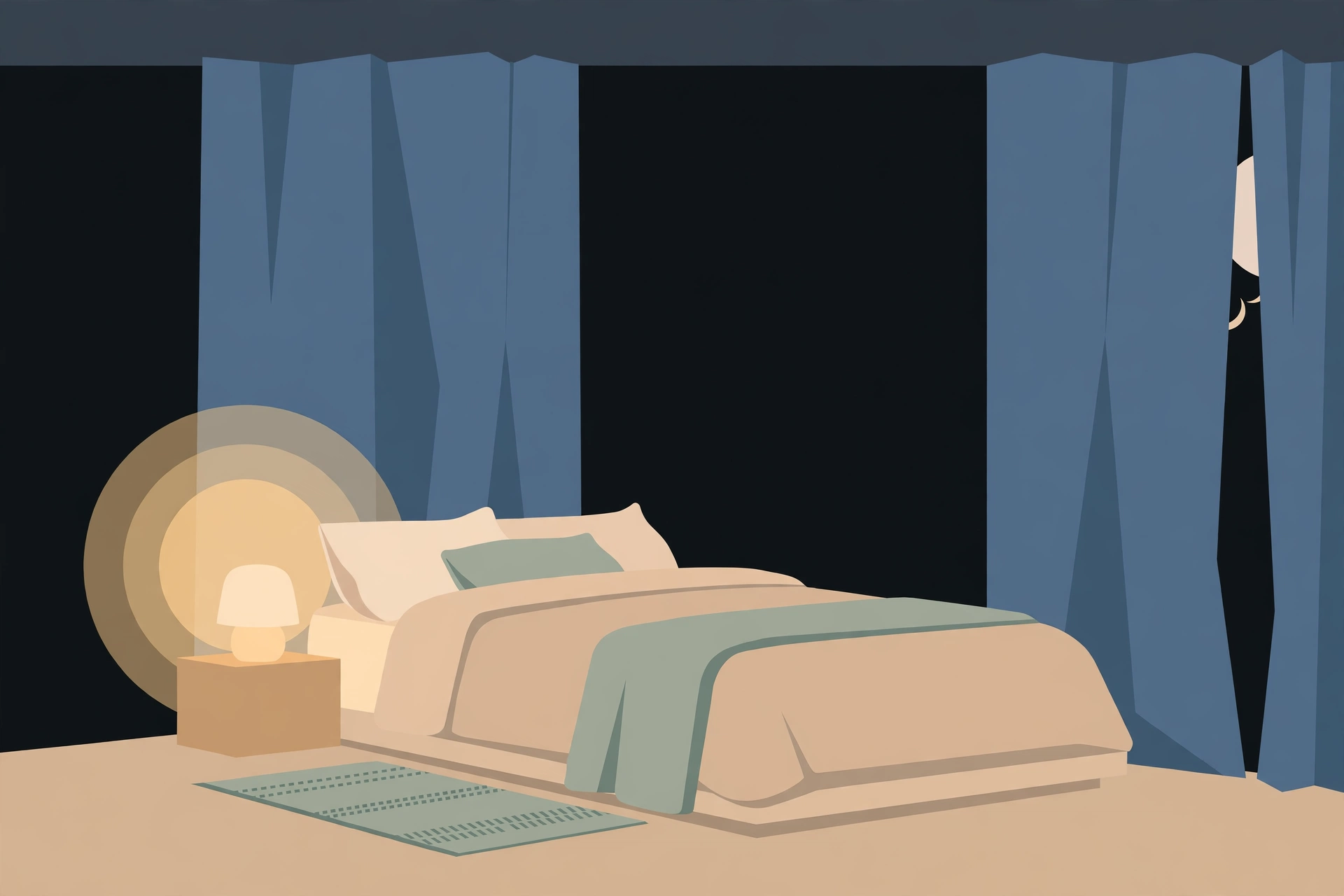
Most sleep advice starts with what you should do: no screens after nine, no caffeine after noon, a fixed bedtime. All of it is good advice, and all of it is harder than it sounds when your bedroom is working against you. A streetlight shining past thin curtains, a desk you can see from the pillow, a room that stays at 76 degrees all night — these are design problems, and design problems have design solutions.
A sleep-friendly bedroom is not a spa, and it does not need an expensive mattress or a drawer full of gadgets. It needs control over four things: light, temperature, noise, and visual clutter. Get those four right and the room starts doing half the work of winding down for you. The seven changes below are ordered by impact, and most of them cost less than a single month of sleep aids.
Quick answer: Design your bedroom for sleep by making it dark, cool, and quiet. Block outside light with blackout curtains or shades, keep evening light warm and below 50 lumens per lamp, hold the room at 65 to 68 degrees Fahrenheit, move the desk out of sight from the bed, and keep the nightstand to three items. One change per night for seven nights is enough to find what actually helps you sleep.
How Dark Is Dark Enough? The Light Audit
Light is the strongest signal your body uses to decide whether to stay awake, and even small amounts of it at night suppress melatonin, the hormone that helps you fall asleep. A proper light audit takes five minutes and costs nothing. Stand at the foot of the bed after dark with the lights off and look around. Every glowing point you can see — the streetlight through a curtain gap, the blue standby dot on the television, the charger light, the alarm clock — is a small alarm going off all night.
Start with the windows, because they are the biggest leak. Blackout curtains work only if they are wide enough: the rod should extend 4 to 6 inches past the window frame on each side, and the curtains should hang 2 to 3 inches below the sill or to the floor, so light cannot sneak in around the edges. A blackout roller shade fitted inside the frame, layered under curtains, seals the gap almost completely. For the small lights, cover standby LEDs with small light-blocking stickers, which cost about $6 for a pack, or turn devices to face the wall. Swap the bedside bulb for a warm 2700K bulb at 40 watts or less, and keep the overhead light off after 9 p.m. — a single ceiling fixture at 800 lumens is roughly ten times brighter than a bedside lamp, and brightness is the enemy of drowsiness.
Where Should the Bed Go?
Bed placement shapes how the room feels at 2 a.m., when you wake up and need to fall back asleep. The best position is usually against a solid wall, with the headboard on the wall and clear space on at least one side — 24 to 30 inches of clearance on each side of a queen bed is the comfortable minimum, and 36 inches is better if the room allows it. A solid wall behind the headboard feels more secure than a floating bed in the middle of the room, and it keeps drafts from the window off your head.
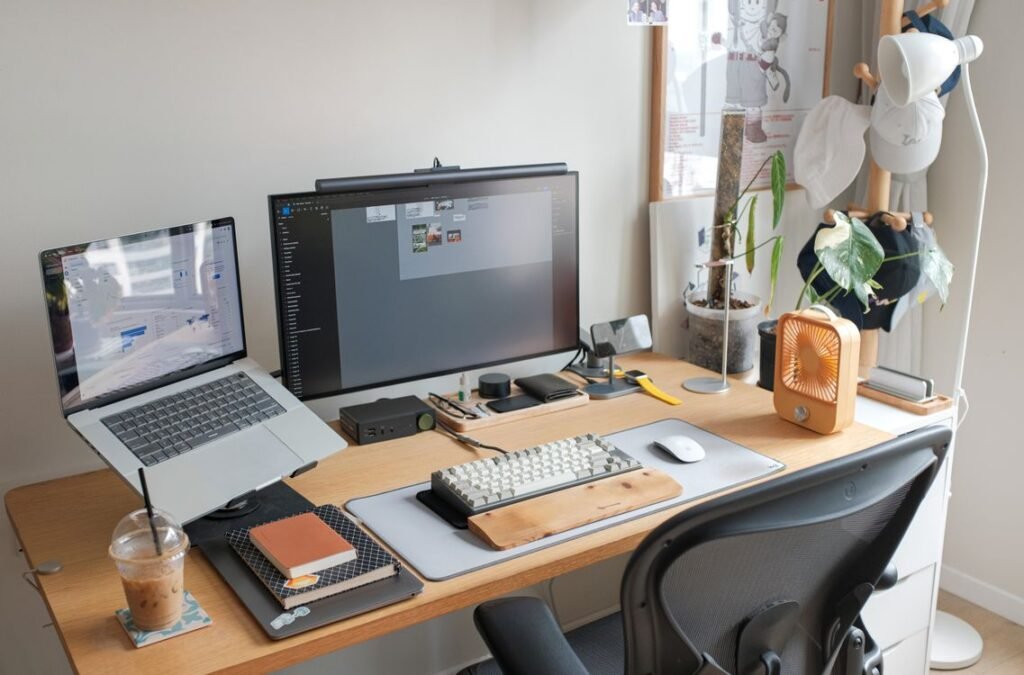
Two placements to avoid: with the foot of the bed facing a bright doorway or hallway light, which turns every midnight bathroom trip into a full wake-up, and with the head of the bed under a window, where cold air and street noise land directly on your pillow. If a desk must stay in the bedroom, turn it so it is not the first thing you see from the bed, and close the laptop and clear the papers at the end of the day. Work that stays visible stays on your mind. For more on arranging small rooms, our small bedroom layout ideas guide covers six floor plans with exact measurements.
What Temperature Helps You Sleep?
Your body needs to cool down to fall asleep, which is why a warm bedroom is one of the most common and most fixable sleep problems. The Sleep Foundation recommends a bedroom temperature between 60 and 71 degrees Fahrenheit, and most sleep researchers put the sweet spot at 65 to 68 degrees. That feels cooler than a living room, and it should — a cool room with warm bedding sleeps better than a warm room with light bedding.
Layer the bedding so you can adjust without waking fully. A light cotton sheet, a medium-weight duvet or blanket, and a second throw folded at the foot of the bed give you three temperature settings you can change half-asleep. Breathable natural fibres — cotton, linen, bamboo — release heat better than polyester, which traps it. If you share a bed with someone who sleeps at a different temperature, two separate twin duvets on one queen or king bed solve the nightly blanket war without a word. A fan helps even when the room is already cool: moving air carries heat away from the skin and adds a steady background sound at the same time.
Quiet Without Total Silence
A bedroom does not need to be silent. Sudden, unpredictable noise — a car horn, a barking dog, a slamming door — is what wakes you, while steady background sound is easy to sleep through. That is why the goal is to block the sudden sounds first and mask what remains, rather than chasing total silence.
Soft surfaces are the cheapest sound treatment there is. A rug beside the bed, heavy curtains, and an upholstered headboard all absorb hard reflections that make a room feel echoey and sharp. If street noise is the problem, check the window seals first: a gap around a window frame lets in more sound than a thin wall does, and a $10 tube of acoustic sealant or a draft stopper can make a noticeable difference. For what remains, a white noise machine or a fan set on low gives your brain a steady sound to ignore, which is far more effective than earplugs for most people. Keep the volume low — about 50 decibels, roughly the level of a quiet conversation — so the masking sound itself does not become a disturbance.
Which Colors Actually Help You Sleep?
Color does not put you to sleep, but the wrong color keeps you alert. Bright, saturated walls — vivid red, electric blue, lime green — raise visual stimulation at exactly the hour you want it to fall. Calm bedrooms use muted, low-saturation colors: soft sage green, dusty blue, warm greige, pale taupe, or a warm off-white. These shades reflect less light from lamps, which keeps the room dimmer in the evening without feeling dark during the day.
Finish matters as much as color. A matte or flat paint sheen absorbs lamplight instead of bouncing glare into your eyes, while a semi-gloss sheen on bedroom walls turns every lamp into a bright spot. If you are repainting, a low-VOC paint keeps fumes out of the room you sleep in — our low-VOC paint guide explains the real numbers and the tinting trap to watch for. Keep the ceiling white or very pale, since a dark ceiling makes a small bedroom feel smaller and heavier at night.
Common Mistakes That Keep Bedrooms Awake
The same five mistakes show up in bedroom after bedroom, and none of them requires a purchase to fix. First, the television facing the bed. A TV in the bedroom turns the place you sleep into the place you watch, and the blue-white light of a screen is the opposite of a wind-down signal. If the TV stays, watch from a chair, not from under the covers. Second, the phone on the pillow. Charging the phone across the room, or at least on a dresser, removes the one-tap temptation at 1 a.m. and takes a glowing screen out of your line of sight.
Third, the cluttered nightstand. A nightstand crowded with books, bottles, chargers, and yesterday’s mail is a to-do list at eye level. Keep three things within arm’s reach — a lamp, water, and one small tray — and move everything else two steps away. Fourth, the wrong lampshade. A bare bulb or a white shade throws hard light at eye level; a linen or fabric shade in a warm tone softens it. Fifth, the bed as a daytime sofa. Reading, working, and scrolling in bed teach your brain that the bed is an all-purpose chair, and the association sticks. Use the bed for sleep, and give reading a chair with its own small lamp.
A Worked Budget: A Sleep-Friendly Bedroom for $185
Here is a realistic plan for a standard bedroom, using the highest-impact changes first. Prices are typical US discount-retailer prices.
| Item | What to buy | Typical cost |
|---|---|---|
| Blackout curtains | One pair, rod extended 4–6 in past frame | $40–$60 |
| Warm bulbs | 2 x 2700K LED, 40W equivalent | $8–$12 |
| LED stickers | Pack of light-blocking stickers | $5–$7 |
| Bedside rug | 2×3 ft low-pile rug with pad | $25–$40 |
| Fan | Quiet oscillating fan or white-noise machine | $25–$40 |
| Nightstand tray | One small tray to corral clutter | $10–$15 |
| Throw blanket | One medium-weight layer for the foot of the bed | $20–$30 |
| Total | $133–$204 |
The curtains are the biggest single item because light control is the biggest single factor. If the budget is tight, start with the curtains and the bulbs — about $50 together — and add the rest over the following weeks. A fan you already own costs nothing and covers both temperature and noise, which makes it the best free upgrade on the list.
The 7-Night Test: Find What Actually Helps You
Changing everything at once feels productive, but it teaches you nothing, because you will never know which change mattered. The better approach is one change per night for seven nights, in order of impact. Night one: blackout the windows. Night two: switch to warm, dim bedside light and turn off the overhead. Night three: set the thermostat to 66 degrees. Night four: move the phone across the room. Night five: clear the nightstand to three items. Night six: add the fan or white noise. Night seven: move the desk out of sight from the bed.
Keep a one-line note each morning — a simple 1-to-10 rating of how rested you feel is enough. After seven nights, keep the changes that moved your number and drop the ones that did not. Most people find that two or three changes do almost all the work, and those are usually the ones they would have guessed last. Sleep is personal, and a bedroom designed around your own test results beats any list of generic tips, including this one.

2 Comments