An entryway bench earns its place by doing one simple job well: giving you somewhere to sit while you put on shoes, without blocking the way in or out of the house. Get the size wrong and it does the opposite. A bench two inches too deep turns a hallway into a squeeze. A bench two inches too low is a perch nobody wants to sit on. And a bench six inches too long can stop a door from opening fully, which is the kind of mistake you discover the day after delivery.
The good news is that bench sizing is settled science, not taste. Interior designers and furniture makers agree on the same handful of numbers, and this guide collects them in one place — with a measure-first worksheet so you order the right size the first time, and a DIY build option if retail prices make you wince.
Quick answer: A standard entryway bench is 17 to 19 inches high, 14 to 16 inches deep, and 36 to 48 inches long, with 36 inches of clear walkway in front of it. Allow about 20 to 24 inches of length per seated person. In a narrow hall, choose a 12- to 14-inch-deep bench; in a wide mudroom, 16 to 18 inches is more comfortable. Measure your wall, your door swing, and your walkway before you buy — those three numbers decide the size, not the catalog photo.
What Size Entryway Bench Do You Need?
Start with the four numbers that matter. Seat height decides comfort. Depth decides whether the bench fits the hall. Length decides how many people can sit. Clearance decides whether anyone can walk past. Here they are at a glance, with the ranges most designers and manufacturers use.
| Measurement | Standard range | What it means in practice |
|---|---|---|
| Seat height | 17–19 in | Same as a dining chair; easy to sit on and stand up from |
| Seat depth | 14–16 in | Deep enough to sit, shallow enough to keep the hall open |
| Length | 36–48 in | Seats two people; 24–36 in seats one, 48–60 in seats three |
| Walkway in front | 36 in minimum | Enough for someone to pass while another person sits |
| Space per person | 20–24 in of length | A 40-inch bench seats two comfortably, not three |
Height is the least flexible of the four. Below 16 inches, a bench becomes a low perch that is hard to rise from with an armful of bags. Above 20 inches, shorter family members dangle their feet. The 17- to 19-inch range works for most adults and older children, and it matches the height of a dining chair, which is why the same number keeps appearing. For a household with older adults, lean toward 19 to 21 inches — the extra inch makes standing up noticeably easier on the knees.
Measure First: The 3-Number Worksheet
Most bench-buying mistakes happen before the bench arrives, because the buyer measured the wall and nothing else. Three numbers decide whether a bench fits: the wall length, the door swing, and the walkway. Measure all three before you shop, and write them down — a phone note works fine.
First, the wall. Measure the full wall where the bench will sit, then subtract 6 inches — 3 inches of breathing room on each side — and that is your maximum bench length. A bench that runs wall to wall looks squeezed in, and it leaves nowhere for a door frame, a baseboard heater, or a light switch to live. A 48-inch bench on a 54-inch wall is right; a 48-inch bench on a 48-inch wall is a mistake you will notice every day.
Second, the door swing. Open the front door fully and measure from the wall to the edge of the door’s swing arc. The bench must sit outside that arc, or the door will hit it. If the door swings inward and the bench is in its path, the fix is either a shallower bench or a door stop that limits the swing — and a door stop is the cheaper fix. Measure this one twice, because it is the number most people forget and the one that causes returns.
Third, the walkway. Measure from the front edge of where the bench will sit to the opposite wall or the nearest obstacle, and confirm at least 36 inches remain. That is the minimum for one person to pass while another sits and ties a shoe. In a busy household entry, 42 inches is more comfortable. If 36 inches is impossible, choose a shallower bench rather than a shorter one — a 12-inch-deep bench with a full 36-inch walkway beats a 16-inch-deep bench that leaves 30 inches, because a blocked walkway is felt every time someone comes home.
How Deep Should an Entryway Bench Be?
Depth is the measurement people underestimate, and it is the one that causes the most regret. A 12-inch-deep bench is really a plant stand, not a seat — there is not enough room to sit back and put on a shoe without perching on the edge. Give the seat at least 14 inches of depth, and 15 to 16 inches if you want room to set a tote bag beside you.
The right depth depends on the hall. In a narrow hallway, 12 to 14 inches keeps the path open and is fine for quick sits like changing shoes. In a standard entry, 14 to 16 inches is the sweet spot: comfortable seating without eating into the walkway. In a wide mudroom or foyer, 16 to 18 inches feels more like a real seat, and it leaves room for a cushion and a bag. The trade is always the same — every inch of depth is an inch taken from the walkway, so decide which one your entry needs more.
Cushions change the math slightly. A 2- to 3-inch cushion adds comfort but also adds height, so a bench that measures 18 inches to the seat top will sit at 20 to 21 inches once the cushion is on. If you plan to use a cushion, buy the bench an inch shorter than your target height, or choose a cushion no thicker than 2 inches.
What Goes Above the Bench: Hooks and Mirrors
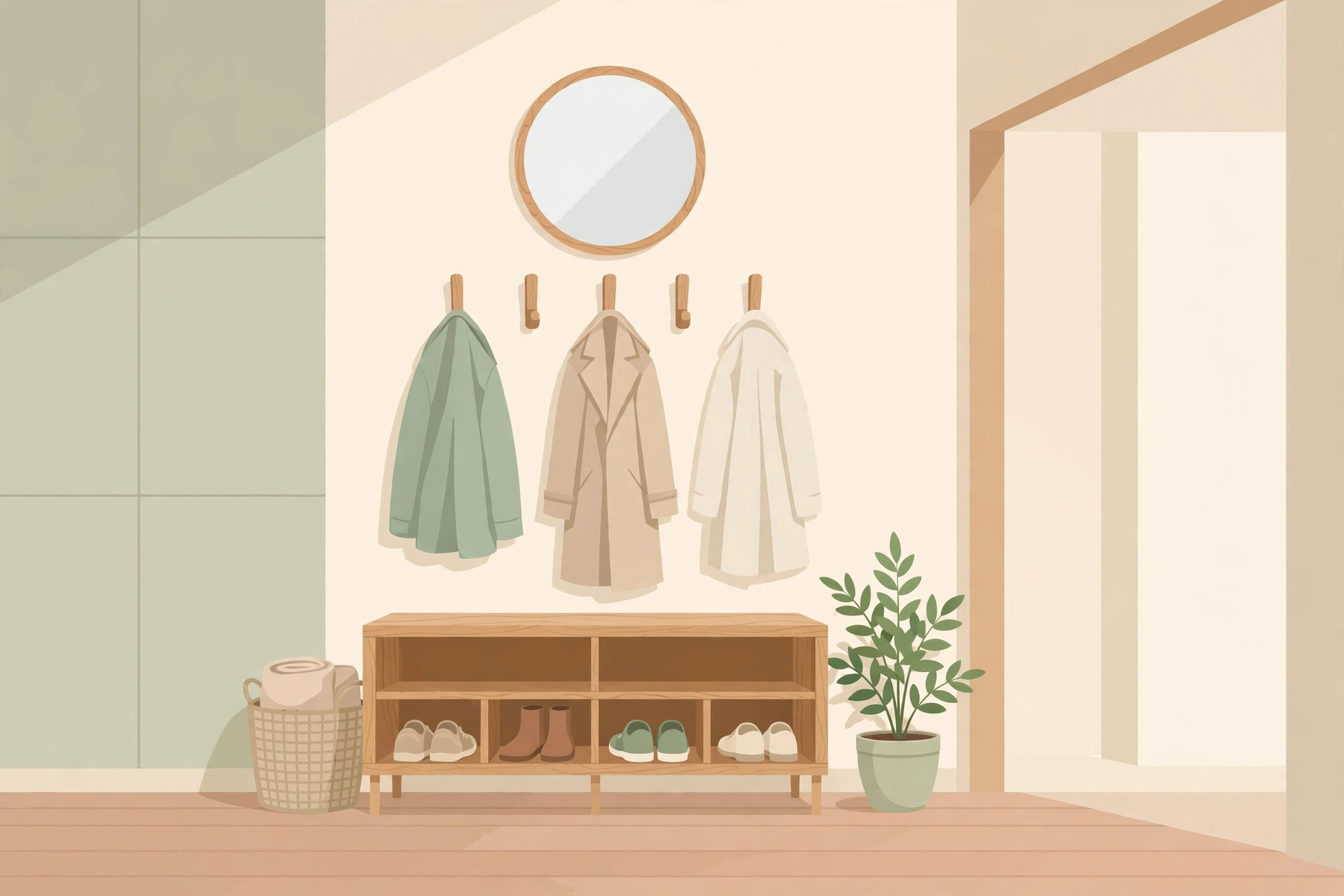
A bench rarely stands alone. Hooks above it hold the coats, and a mirror above it gives the last look before leaving. Both have their own height rules, and getting them wrong makes the bench harder to use. Adult coat hooks work best at 60 to 66 inches from the floor, with 12 to 18 inches of clearance between the top of the bench and the bottom of the hooks, so coats and bags hang free without dragging on the seat. Add a lower row at 36 to 48 inches if children need hooks of their own.
A mirror over the bench should have its center at roughly 57 to 60 inches off the floor — average eye level — with 6 to 12 inches of clearance between the top of the bench and the bottom of the mirror. That gap is what makes the bench and the mirror read as one grouping instead of two unrelated pieces stacked on a wall. A mirror that is too wide for the bench looks top-heavy; keep the mirror narrower than the bench by at least a few inches on each side. For more on choosing and placing mirrors, our entryway mirror ideas guide covers size, placement, and style by entry type.
Storage Inside the Bench: Cubby Math That Works
Open storage under a bench looks tidy in photos and turns into a pile in real life, because shoes do not stack themselves. Cubbies fix that, but only if they are sized for actual footwear. Size each shoe slot about 12 inches wide and 7 to 8 inches tall, which clears most shoes including low boots. Tall boots need a separate open section, not a cubby — plan one 14-inch-tall open bay at one end for boots and umbrellas.
Count pairs honestly before you choose a bench. A family of four with two pairs of everyday shoes each needs eight cubbies, which is more than most 36-inch benches offer. That is the point where a 48-inch bench, or a bench plus a slim shoe cabinet, stops being a luxury and becomes the plan. Baskets underneath handle the soft stuff — hats, gloves, scarves, dog leashes — and one basket per person keeps the system working without a daily tidy-up. If your hallway needs more storage ideas, our hallway decor ideas guide covers nine ways to make a narrow space work harder.
Build vs Buy: A $75 DIY Bench
Retail entryway benches with storage start around $150 and climb past $400 for solid wood, which is a lot for what is essentially a box with a lid. A simple DIY bench costs a fraction of that, takes one weekend afternoon, and lets you set the exact length your wall needs instead of choosing from the three sizes a store stocks. Here is a realistic budget for a 48-inch bench with two cubbies, using standard US lumber-yard prices.
| Item | What to buy | Typical cost |
|---|---|---|
| Lumber | 3 x 2×4 studs (8 ft), 1 sheet 3/4-in plywood | $28–$36 |
| Hardware | Wood screws, wood glue, 2-in brad nails | $8–$12 |
| Paint or stain | 1 quart paint or stain + brush | $12–$18 |
| Cushion | 2-in foam cut to size + cotton cover | $15–$22 |
| Total | $63–$88 |
The build is straightforward: a rectangular frame from the 2x4s, a plywood top, a center divider that creates two cubbies, and a plywood back panel for rigidity. Sand every edge before painting, and add felt pads under the legs so the bench does not scratch the floor. The one measurement to get right is the seat height — build the frame so the finished top, including the cushion, lands at 17 to 19 inches. If you would rather buy, the same worksheet still applies: take your three numbers to the store and reject any bench that fails them, however good it looks in the photo.
Frequently Asked Questions
What is the standard height for an entryway bench?
17 to 19 inches from the floor to the top of the seat, the same range as a dining chair. Below 16 inches it is hard to stand up from, and above 20 inches shorter people dangle their feet. If you add a cushion, subtract its thickness from the bench height so the finished seat still lands in the 17- to 19-inch range.
How deep should an entryway bench be?
14 to 16 inches for a standard entry, 12 to 14 inches in a narrow hallway, and 16 to 18 inches in a wide mudroom. A bench under 14 inches deep works for quick sits but not for sitting back comfortably. Always check the walkway first — keep 36 inches clear in front of the bench.
How long should an entryway bench be?
Take your wall length, subtract 6 inches for breathing room, and that is your maximum. A 36- to 48-inch bench suits most entries and seats one to two people. Allow 20 to 24 inches of length per seated person, so a 40-inch bench seats two comfortably.
How much clearance do you need in front of an entryway bench?
At least 36 inches of open floor, so someone can pass while another person sits and puts on shoes. In a busy household entry, 42 inches is more comfortable. If the door swings inward, make sure the bench sits outside the door’s swing arc as well.
Should an entryway bench have storage?
Yes, if it is the household’s main shoe spot — cubbies sized 12 inches wide and 7 to 8 inches tall keep shoes from becoming a pile. Count pairs honestly first: a family of four needs about eight cubbies. If the bench is mainly decorative or the shoes live in a closet, open space underneath is fine.
The right bench is the one that fits your three numbers — wall, door swing, and walkway — and then disappears into the routine of coming and going. Measure first, choose the depth your hall can actually spare, and leave the 36-inch walkway alone. A bench that respects those numbers gets used every day; one that does not becomes the piece of furniture everyone walks around and nobody sits on.