
Hallways get walked through dozens of times a day and decorated almost never. The result is usually the same: bare walls, a scuffed runner or no rug at all, and a space that feels like a gap between real rooms. Yet a hallway is often the first space guests see and the last one you pass before bed, so a little attention pays off out of proportion to its size. This guide starts with measurements, because hallway decor fails when furniture is too deep or art hangs too low, then gives you nine practical ideas that work even in a narrow, windowless hall.
First, Measure What You Are Working With
Before buying anything, measure three things: the hallway’s width wall to wall, its length, and the height of the ceiling. Also note where doors swing into the hall, where light switches sit, and whether there is a natural focal point such as a bend, a window at the end, or a staircase. A console table that looks slim in a shop can block a door swing at home, and a gallery wall planned around a light switch ends up looking awkward. Five minutes with a tape measure prevents most hallway mistakes.
What Width Does a Hallway Need to Stay Walkable?
The clear walking width — the space left after furniture — should never drop below 36 inches, which is the standard minimum for comfortable passage and for carrying laundry baskets and furniture through. A width of 42 to 48 inches feels comfortable for everyday use. That gives you a simple rule: in a 48-inch hallway, furniture can be at most 12 inches deep; in a 42-inch hallway, keep it to 10 inches or skip furniture entirely and decorate the walls instead. Wall-mounted pieces such as slim shelves, picture ledges, and sconces are the safest choice in any hall under 44 inches wide.
A Decision Guide by Hallway Type
Not every hallway wants the same treatment. Use this decision guide to match the decor to the hall you actually have, rather than copying a wide, bright hallway from a photo into a narrow, dark one.
| Hallway type | Best treatment |
| Narrow (under 42 inches) | Walls only: mirror, art, slim ledge; no floor furniture |
| Standard (42 to 48 inches) | Slim console up to 10 inches deep plus a runner rug |
| Wide (over 48 inches) | Console, bench, or small bookcase; a chair or plant |
| Windowless or dark | Light paint, a large mirror, warm sconces every 8 to 10 feet |
| Many doors | One continuous gallery line above door height; keep floors clear |
Should I put furniture in a narrow hallway? Only if at least 36 inches of clear walking space remains after it is in place. In most halls under 42 inches wide, the honest answer is no — wall decor, lighting, and a runner rug will do more than a console that everyone brushes past.
How do I brighten a windowless hallway? Combine three things: warm white or pale greige paint to reflect light, a mirror opposite or near the brightest doorway, and wall sconces spaced 8 to 10 feet apart on a warm white bulb. One of these alone helps a little; together they change the whole feel.
What size mirror works in a hallway? A mirror 24 to 36 inches wide suits most halls, hung so its centre sits at about 57 to 60 inches from the floor — standard eye level. A mirror much smaller than that reads as decoration rather than a light-bouncing feature, and one hung too high reflects only the ceiling.
9 Ways to Style a Forgotten Hallway
- 1. Lay a runner that fits. Choose a runner 4 to 6 inches narrower than the hallway on each side, and 18 to 24 inches shorter than the hall’s length so flooring shows at both ends. A rug that touches both walls looks like wall-to-wall carpet; a correctly sized runner frames the walkway.
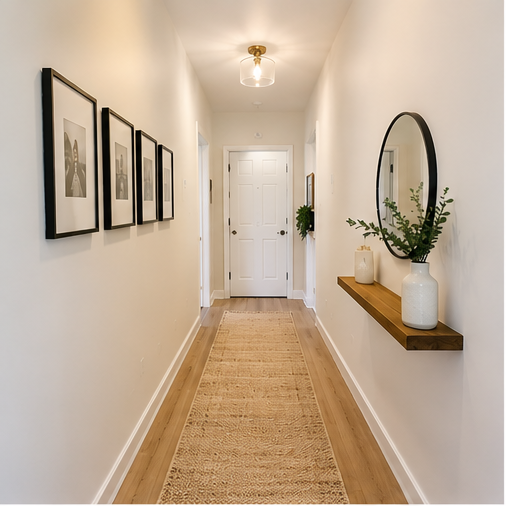
- 2. Hang one large mirror. A single 24 to 36 inch mirror near the entrance end of the hall bounces light and makes the space feel twice as wide. Avoid a cluster of small mirrors, which reads as clutter in a narrow space.
- 3. Build a gallery wall with a rule. Keep frames in one finish, hang centres at 57 to 60 inches from the floor, and leave a consistent 2 to 3 inches between frames. For spacing and layout templates, see the gallery wall layout guide.
- 4. Add a slim console where width allows. In halls 44 inches or wider, a console 10 to 12 inches deep gives you a drop spot for keys and a surface for a lamp, without stealing walking space. Anchor it with a mirror or art above it.
- 5. Paint the end wall a shade deeper. Painting just the far end wall one or two shades darker than the side walls shortens a long, tunnel-like hall visually and gives the eye a destination. Keep side walls light so the hall does not feel closed in.
- 6. Upgrade the lighting. Replace a single ceiling fixture with two or three flush-mount lights or sconces spaced evenly along the hall. Warm white bulbs (2700 to 3000 Kelvin) flatter skin tones and wood far better than harsh daylight bulbs.
- 7. Use a picture ledge instead of nails everywhere. A ledge 48 to 60 inches long lets you swap art seasonally without new holes, and leaning frames at slightly varied heights looks intentionally casual rather than unfinished.
- 8. Add one plant that tolerates low light. A snake plant or pothos in a tall, narrow pot softens a hallway corner without needing floor space. One healthy plant beats three struggling ones, and artificial plants are a fair fallback in a truly dark hall.
- 9. Finish with a bench or hooks at the entry end. Where the hall meets the front door, a small bench or three wall hooks turn dead space into a landing spot for bags and coats. Keep hooks at 60 to 66 inches high so coats hang clear of the floor.
How Much Should You Budget?
A hallway refresh does not need a renovation budget. Typical US prices: a washable runner rug $45 to $90, a round or rectangular mirror $60 to $120, a slim console table $80 to $160, a set of matching frames $40 to $75, and flush-mount or sconce lighting $50 to $110. A starter combination of rug, mirror, and frames comes to $145 to $285, and adding a console takes it to $225 to $445. Buy the rug and mirror first — they change light and warmth immediately — and add furniture only if your hallway width genuinely allows it.
Paint is the other low-cost lever. If your hall is dark, the same warm, light-reflecting shades recommended in the guide to paint colours that make small rooms look bigger work just as well in a hallway, where light is usually the scarcest resource.
Key Takeaways
- Keep at least 36 inches of clear walking width — furniture deeper than 10 to 12 inches rarely fits a standard hall.
- Match the decor to the hallway type: walls only in narrow halls, a slim console in wider ones.
- Hang art and mirrors with centres at 57 to 60 inches from the floor for a professional look.
- Start with a runner, a mirror, and better lighting — the three changes with the biggest impact per dollar.
Conclusion
A hallway does not need much to feel finished — it needs the right few things, sized to its width and hung at the right height. Measure first, choose from the nine ideas above based on your hallway type, and start with the runner, mirror, and lighting. Once those are in place, the hall stops feeling like a gap between rooms and starts feeling like part of the home.