A kids play zone living room setup fails for one reason more than any other: the floor space was never measured. The rug is too small, the table sits in the walkway, and the toys have nowhere to go at the end of the day, so they spread across the whole room. A zone that works starts with square feet, not with shopping. Measure the floor first, give each age the space it actually uses, put storage where a child can reach it and an adult can close a door on it, and the living room stays a living room while the children still have a place that is theirs. This guide gives the exact numbers: floor space by age, rug and furniture sizes, storage that hides in five minutes, safety rules, and three setups priced from $150 to $1,200.
How Much Floor Space Does a Play Zone Need?
Floor space is the first decision because everything else hangs off it. A toddler plays sitting down and needs a small, soft patch. A school-age child builds, draws and spreads out, and needs nearly three times as much floor. The table below gives the minimum that works in real rooms, measured from the edge of the rug or mat to the nearest adult furniture.
| Age | Minimum zone | Square feet | What happens there |
|---|---|---|---|
| Toddler, 1 to 3 | 4 by 4 feet | 16 | Floor play, soft blocks, push toys |
| Preschool, 3 to 5 | 5 by 7 feet | 35 | Table play, building, dress-up |
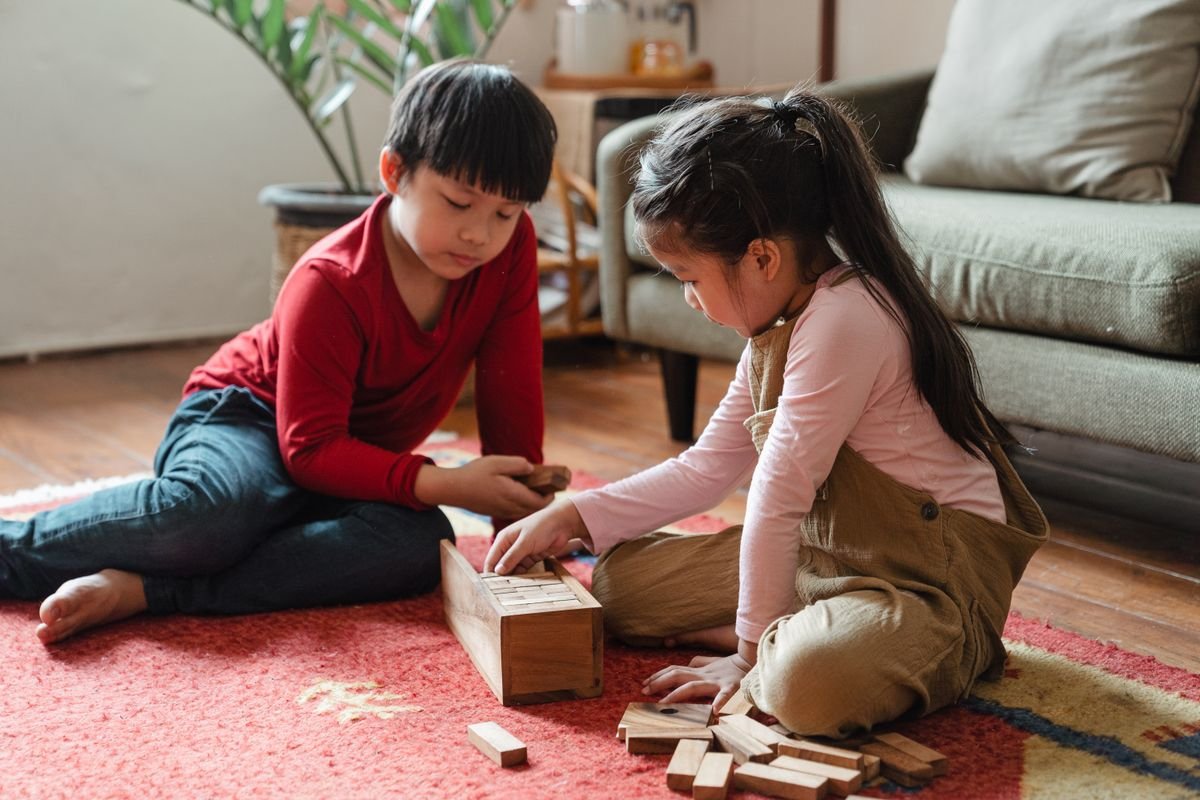
| School-age, 6 to 9 | 6 by 8 feet | 48 | Building sets, art, board games |
| Two children sharing | 6 by 9 feet | 54 | One builds, one draws, without collisions |
Those are minimums, and two clearances sit on top of them. Leave at least 24 inches between the edge of the play rug and the sofa or coffee table, so an adult can walk past without stepping on the zone, and keep 30 to 36 inches of walkway clear around the zone itself. If the play table pinches a doorway, the corner will feel cluttered no matter how tidy it is. A roll of painter’s tape on the floor is the cheapest test available: tape the rectangle, live with it for two days, and move it before buying anything. A 5 by 7 foot rug in an 11 by 11 foot room leaves a workable adult seating area; the same rug in a 10 by 12 foot room with a full-size sofa and a coffee table will not, and the zone belongs in the corner instead of the middle.
Where to Put the Zone: The Three Spots That Work
Most living rooms offer three realistic spots, and each suits a different room shape. The corner is the best default: two walls contain the mess, a rug defines the boundary, and the rest of the room stays untouched. Put the low storage unit against one wall and the table against the other, and the corner holds a 5 by 7 foot zone without touching the seating area.
The space behind a floating sofa is the second option, and it suits open-plan rooms. Pull the sofa 30 inches off the wall and the dead space behind it becomes a play strip with a low console or a small table, hidden from the seating area by the sofa back. The third option is the wall beside a window or fireplace, which works when the corner is taken by a TV or a door. Whichever spot is chosen, the zone needs one thing the others do not: it must not sit on the main path from the front door to the kitchen. A play zone on a traffic path gets walked through, tripped over and resented, and no storage system fixes that.
What Size Rug Defines the Zone?
The rug is the boundary line, and it only works if it is big enough. A 5 by 7 foot rug is the minimum for a real play zone: two children can sit side by side on it, a small table fits on it, and a building project stays on it. Anything smaller reads as a doormat and children ignore it. A round 5-foot rug works the same way in a corner, and a 4 by 6 foot rug suits a toddler-only zone.
Choose flat-weave cotton or a low-pile rug with a pile height of 0.25 to 0.5 inches. Shag and deep pile swallow small pieces, wobble block towers and trap crumbs. A pattern that hides crumbs and small marks, such as a check, a geometric or a multicolour design, looks clean far longer than a solid pale rug. Put a heavy-duty rug pad underneath: it stops the rug sliding during active play and adds the cushioning a hard floor lacks. Budget $40 to $150 for a washable flat-weave rug in the 5 by 7 size, and wash it on a gentle cycle when it needs it, which most flat-weaves tolerate.
Storage That Hides in Five Minutes
Storage decides whether the zone survives past the first week. The rule is simple: open storage for the child, closed storage for the room. A low shelf at 18 to 24 inches off the floor holds 6 to 10 items on display, which is the number children actually play with, and everything else lives behind closed doors. A sideboard, a credenza or a media console 15 to 18 inches deep is the best hiding place in a living room: it holds standard 11-inch storage cubes, matches adult furniture, and closes the chaos away at the end of the day.
The five-minute reset is what makes the system stick. Keep two large woven baskets in the zone, one for hard toys such as blocks and cars, and one for soft toys such as stuffed animals and dress-up clothes. When it is tidy-up time, everything on the floor goes into one of the two baskets, the baskets slide into the console, and the doors close. No sorting by colour, no labelling session, no system that takes longer than the play did. Toy rotation does the rest: keep about 20 percent of the toys out in the living room and store the rest in a closet, swapping them every two weeks. Fewer visible toys means each one gets played with, and the stored ones feel new when they return.
Three Play Zone Setups, Priced
Every budget below is priced at typical US store prices and covers the whole zone, not one piece of it. The starter setup suits a toddler in a small room. The mid-range setup is the one most families land on. The full setup adds a reading nook and a proper art station for a school-age child.
| Setup | What it includes | Total |
|---|---|---|
| Starter | 5 by 7 flat-weave rug $40–$90, two woven baskets $30–$50, low cube shelf $60–$120, 4 by 4 foam mat $25–$40 | $150–$300 |
| Mid-range | Rug $90–$150, storage console with doors $180–$300, small table and two chairs $80–$150, three fabric bins $45–$75, wall shelf $25–$40 | $400–$700 |
| Full | Rug $150–$250, quality credenza $300–$450, table set $120–$200, book rail and floor cushion $80–$150, art station $60–$120, plug-in sconce $40–$80 | $800–$1,200 |
Two numbers in that table deserve attention. First, the console is the single biggest line in every setup above starter, and it is the piece worth spending on, because it is the one that hides the mess and survives as adult furniture later. Second, a thrifted solid-wood sideboard at $40 to $80 does the same job as a new console at $300, and a coat of paint in the room’s palette makes it look intentional. Spend the saving on the rug, which is the piece children touch every day.
Child-Sized Furniture That Matches the Room
Bright plastic tables in primary colours are the fastest way to make a living room look like a classroom. Child-sized furniture that copies the adult pieces keeps the room calm: a small wooden table with tapered legs beside a mid-century sofa, a painted white table in a farmhouse room, a clear acrylic table that takes up no visual weight at all and wipes clean after markers. The dimensions matter more than the style. A toddler table is 18 to 20 inches high with a seat height of 10 to 12 inches, and there should be at least 7 inches between the chair seat and the table apron so little legs fit underneath. Buy the table after the rug, not before, and check that the table and two chairs fit on the rug with 12 inches to spare on each side.
Safety First: Anchoring, Cords and Small Parts
A play zone in a shared room needs three safety checks that a dedicated playroom usually gets by default. First, anchor it. Any storage unit taller than 24 inches, including a bookshelf or a cube unit, must be fixed to a wall stud with furniture straps, because children climb and pull drawers open as steps. Second, manage the cords. Keep lamp and charger cords behind furniture or inside a cord cover, and use a plug-in wall sconce over the table instead of a floor lamp, which is both a tipping hazard and a cord in the walkway. Third, mind the small parts. When a toddler shares the zone with an older child, anything smaller than a golf ball stays on a shelf at least 48 inches off the floor, and the older child’s building sets live in closed bins the toddler cannot open alone. A washable paint finish in eggshell or satin on the play-corner wall lets crayon and scuffs wipe off without burnishing the paint.
When Two Children Share One Zone
Two children of different ages need a split, not a bigger pile of toys. Use height as the divider: toddler-safe toys in the bottom baskets and on the floor, and the older child’s sets on a floating shelf at least 48 inches off the ground, where a small child cannot reach them. Give each child a defined patch inside the zone, such as the left half of the rug for building and the right half for drawing, and give each their own basket so tidy-up has an owner. The shared table works if it is big enough for two chairs side by side, which means at least 36 inches wide, and the zone needs the full 6 by 9 foot footprint from the table above rather than the 5 by 7 minimum.
How big should a play zone be in a small living room?
A 4 by 6 foot corner works for one toddler, and a 5 by 7 foot zone is the minimum for a preschooler. In a room under 12 by 12 feet, use a storage ottoman instead of a coffee table, keep the rug to one corner, and let the zone borrow the floor in front of the sofa during play and give it back at tidy-up time.
How do I stop toys spreading across the whole living room?
Give the zone a hard edge, a rug the child can see, and a rule the child can repeat: toys stay on the rug. Keep only 8 to 12 toys visible, store the rest, and run the two-basket reset every evening. The spreading usually means there are too many toys out, not too little storage.
What age can a child use a play zone on their own?
Most children play independently in a zone from around age 2, in short stretches of 15 to 20 minutes, once everything is within 24 inches of the floor and nothing needs climbing. Stay in the room for toddlers, and keep small parts on the high shelf until the youngest child is past 3.
Can a play zone work in a rental?
Yes, and it suits rentals well because nothing here needs a drill. A rug, a freestanding console, baskets and a plug-in sconce create the whole zone without touching a wall. Use removable hooks for the book rail, and skip wall-mounted shelves in favour of a low freestanding unit.
Key takeaways: Size the zone by age, starting at 4 by 4 feet for a toddler and 5 by 7 feet for a preschooler, with 24 inches of buffer to the sofa. Define it with a flat-weave rug, hide the storage behind closed doors, and keep only 8 to 12 toys visible. Anchor anything taller than 24 inches, and run the two-basket reset every evening so the living room is an adult room again by bedtime.
A kids play zone in the living room is not a compromise between a beautiful room and a child’s room. It is a measured patch of floor with a rug, a table and a console, sized to the child and priced to the budget, that disappears behind closed doors at the end of the day. Tape the rectangle, buy the rug, and let the zone earn its floor space. For the wider room, see our family room zoning guide, and for toy storage beyond the living room, see our kids room storage ideas.