
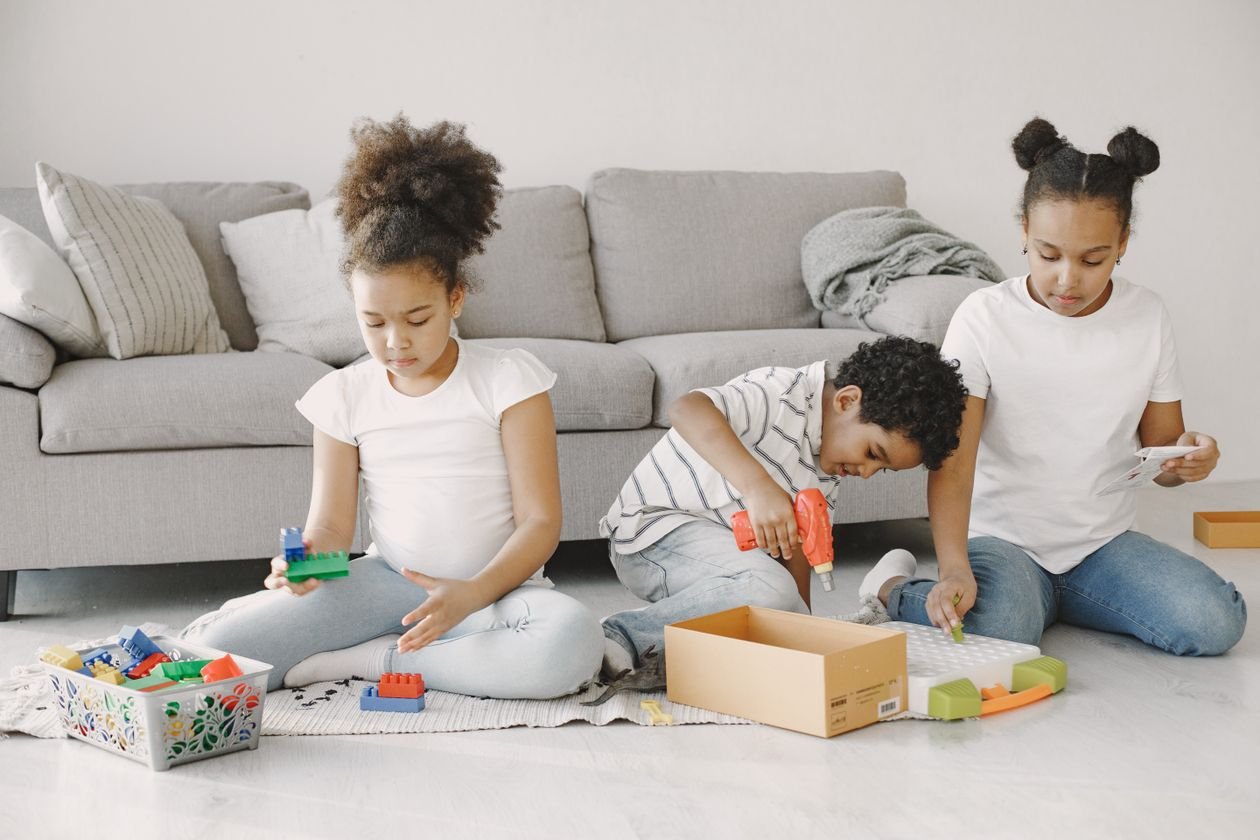
Family room activity zoning is the difference between one room that does three jobs badly and one room that does three jobs well. Without zones, the TV seating creeps into the play space, the toys spread across the rug where everyone walks, and the only quiet corner for reading ends up being the stairs. With zones, each activity gets a defined patch of floor, its own light and its own storage, and the room still feels like one room instead of three cramped ones. No walls are needed. A rug, a low bookcase and a lamp do the dividing, and the whole job can be done in a weekend for under $450.
| Room size | TV zone | Play zone | Reading nook | Walkways |
|---|---|---|---|---|
| 12 x 14 ft (168 sq ft) | 7 x 9 ft, sofa + TV wall | 5 x 7 ft rug, low bins | 3 x 4 ft chair by the window | 30 in minimum |
| 14 x 18 ft (252 sq ft) | 9 x 11 ft, sectional + media console | 6 x 8 ft rug, cube shelves | 3.5 x 4.5 ft chair + floor lamp | 30-36 in |
| 16 x 20 ft (320 sq ft) | 10 x 12 ft, sofa + two chairs | 8 x 10 ft rug, table + storage | 4 x 5 ft chair + side table | 36 in |
Start With an Activity Audit, Not a Furniture Catalogue
Before moving a single piece of furniture, list what actually happens in the room during a normal week and how much time each activity takes. A family that watches TV for two hours every evening, has a toddler playing on the floor most of the day and reads for twenty minutes before bed needs a very different split from a family whose teenagers use the room for homework and gaming. Write the three or four biggest activities down, then give each one a rough share of the room. TV usually takes the largest share because the sofa and the screen need the most floor, play takes the second largest because children need open floor, and reading takes the smallest because one chair and a lamp fit almost anywhere. The point of the audit is to stop the loudest activity from swallowing the room by default. When the split is decided on paper first, the play zone does not end up as whatever floor is left over after the sofa goes in.
Measure the room before buying anything. Length, width, door swings, window positions and the location of every outlet matter more than any layout photo. A sofa that fits the wall but blocks the only outlet for the reading lamp has still failed. Tape the outline of each zone on the floor with painter’s tape and live with the outlines for a day, walking the normal routes through the room, before committing to furniture placement.
How Much Space Does Each Zone Actually Need?
The TV zone is governed by viewing distance. Sit 1.5 to 2.5 times the screen’s diagonal size away from the screen: a 55-inch TV wants 7 to 11.5 feet, a 65-inch TV wants 8 to 13.5 feet, and a 75-inch TV wants 9.5 to 15.5 feet. Closer than that and the picture fills too much of the field of vision; further and the screen feels small. The sofa should face the screen squarely, with the centre of the screen at seated eye level, roughly 42 inches from the floor. Leave 14 to 18 inches between the sofa and the coffee table so legs stretch without the table crowding knees. If the room is too short for the ideal distance, a smaller screen is a better answer than a sofa pressed against the back wall.
The play zone needs open floor more than it needs furniture. A minimum of 6 by 8 feet of clear, rug-covered floor gives a toddler room to build and a school-age child room to spread out a board game, and a 5 by 7 foot washable rug is the smallest that works for a single child. Put the play zone where it can be seen from the sofa, not hidden behind it, so an adult can watch the children while watching TV. Keep it away from the main walkway through the room: toys on a traffic path get stepped on, and the path gets blocked. A low storage unit, no taller than 24 inches, marks the edge of the play zone and holds the bins, and children can reach everything in it without climbing.
The reading nook needs the least floor and the best light. A comfortable chair, a floor lamp and a small side table fit in a 3 by 4 foot patch, and the best spot is beside a window for daylight, or in the corner the sofa cannot reach. The lamp matters more than the chair: a reading light should deliver 300 to 500 lumens at the page, in warm white at 2700 to 3000K, positioned behind the reader’s shoulder so the page is lit and the bulb is out of the line of sight. A basket or a narrow shelf beside the chair holds the current book and nothing else, which keeps the nook from becoming a second toy shelf.
The Three Zones, Laid Out Step by Step
Place the TV zone first, because the screen and the sofa are the heaviest and least movable pieces. Put the sofa on the longest uninterrupted wall, or floating 12 to 18 inches off the wall if the room is deep enough, and mount or place the TV on the opposite wall. A media console 58 to 72 inches wide suits a 55 to 65 inch TV and hides the console, the router and the charging station in one place. Run cables through a cord cover or behind the console; loose cables across a play zone are a tripping hazard and a toddler magnet.
Set the play zone second, on the floor the TV zone does not use, ideally along a side wall or in the corner nearest the window. Lay the washable rug down first, then the low storage unit along the rug’s outer edge as a soft boundary, then the bins. One bin per toy type, labelled with a picture for children who cannot read yet, keeps cleanup to a sorting game instead of a hunt. A small child-size table and two chairs, 18 to 20 inches high, fit on an 8 by 10 foot rug and turn the play zone into a craft station as well, and they fold flat against the wall when the room needs to host adults.
Finish with the reading nook in the leftover corner, which is usually the best corner in the room precisely because it was left over: it is the one with the window and the quiet. Angle the chair 30 to 45 degrees toward the room rather than facing the wall, so the reader is part of the family room instead of turned away from it, and put the floor lamp behind the chair’s outer shoulder. A throw blanket over one arm and a single cushion make the chair look occupied and inviting rather than like spare furniture.
What Should Separate the Zones?
The best dividers are low, movable and useful. A rug is the simplest divider of all: the TV zone sits on the large rug, the play zone sits on its own smaller rug, and the reading nook sits on bare floor or a small 3 by 5 foot rug. The eye reads each rug as a separate room, and the floor stays open above knee height so light and conversation travel across the whole space. A low bookcase, 24 to 30 inches tall, works as a divider that also stores books and toys, and it should run parallel to the boundary it marks, not across the middle of the room where it blocks the view.
A sectional sofa does the same job for free: its back forms a wall between the TV zone and the play zone behind it, and the chaise end can mark the edge of the reading nook. Avoid tall bookcases, curtains hung across the room and freestanding screens taller than 48 inches as dividers in a family room. They cut the light, make the room feel smaller, and turn one shared room into three small ones, which defeats the point. Every divider should be something a child can see over and an adult can step around.
A Worked Budget: Zoning a 14 by 18 Foot Family Room for Under $450
Zoning costs far less than most people expect because most of the work is moving furniture that already exists. For a typical 14 by 18 foot room, the new purchases are: a washable 6 by 8 foot play rug at $90 to $130, a low cube storage unit with six bins at $80 to $120, a floor lamp for the reading nook at $40 to $70, a small side table at $30 to $50, and a set of cord covers plus painter’s tape at $15 to $25. That totals $255 to $395, leaving room in a $450 budget for a secondhand armchair at $60 to $100 from a thrift store or marketplace listing, re-covered with a $25 washable slipcover if the fabric is tired.
The expensive mistakes are buying a new sectional to force a layout, or buying matching storage furniture before taping the zones on the floor. Spend the tape-and-live-with-it day first: it costs $5 and it is the step that stops a $400 bookcase from landing in the wrong place. If the budget is tighter, the rug can wait. Painter’s tape outlines and the storage unit alone will hold the zones for a month while the rug is saved for, because the boundaries are the idea, and the rug is only the prettiest way to mark them.
The 10-Minute Evening Reset That Keeps Zones Working
Zones fail without a reset routine, and the routine has to be short enough that a tired family actually does it. Set a timer for ten minutes after dinner, or before the evening TV hour, and run the same three steps every night. First, everything on the floor goes back to its zone’s storage: toys to the play bins, books to the reading basket, blankets folded over the sofa arm. Second, the play rug gets a quick shake or vacuum pass if the day was messy, and the coffee table is cleared to a single tray holding the remotes. Third, the reading chair’s blanket is refolded and the lamp is switched off, which signals that the nook is ready for the morning rather than buried under the day’s clutter.
Children can run the reset themselves once the rule is simple: nothing sleeps outside its own zone. One labelled bin per toy type makes the sorting obvious, and a small reward for a reset finished before the timer ends works better than any lecture about tidiness. The reset is also the daily test of the layout. If the same toy keeps ending up in the TV zone every night, the play storage is in the wrong place or too small, and the layout needs a small adjustment, not a bigger lecture.
Family Room Activity Zoning FAQs
Can family room activity zoning work in a small 12 by 14 foot room?
Yes, and small rooms benefit the most, because every square foot is contested. Use the table at the top of this guide: a 7 by 9 foot TV zone, a 5 by 7 foot play rug and a 3 by 4 foot reading chair fit a 12 by 14 foot room with 30-inch walkways. Choose a loveseat instead of a full sofa, skip the coffee table in favour of a slim side table, and let the low storage unit do double duty as the divider and the toy store.
Where should the TV go when the room has a fireplace?
Put the TV on the wall beside the fireplace, not above it, whenever the room allows. A TV above a fireplace usually sits too high, with the centre of the screen well above the 42-inch seated eye level, and it forces the sofa to face the fireplace wall, which leaves no wall for the play zone. If the fireplace wall is the only option, a pull-down TV mount that lowers the screen to eye level when in use is worth the $150 to $250.
How do I keep the play zone from taking over the whole room?
Cap it with a hard edge and a hard rule. The hard edge is the rug: toys live on the rug, and anything that does not fit on the rug does not stay out. The hard rule is the evening reset: nothing sleeps outside its own zone. Add one labelled bin per toy type so cleanup is sorting, not deciding, and rotate half the toys into a closet every month so the visible set stays small.
What lighting does each zone need?
Each zone needs its own switchable light. The TV zone wants dimmable overhead light at 2700 to 3000K so the room can go dark for a film and bright for cleanup. The play zone wants bright, even light at 3000 to 4000K so small parts are visible and the floor is easy to scan. The reading nook wants a single focused lamp at 300 to 500 lumens, warm white, behind the reader’s shoulder. Three lights on three controls beat one bright ceiling light for every activity.
Do I need to buy new furniture to zone a family room?
Usually not. Most family rooms already contain a sofa, a rug, a bookcase and a lamp, and zoning is mostly a matter of moving them into the right places and adding one low storage unit. The only purchase most rooms genuinely need is storage the children can reach, because the play zone fails without it. Tape the zones on the floor first, live with them for a week, and only then buy the pieces the tape proves are missing.
The Room Should Still Feel Like One Room
The test of a zoned family room is simple: stand in the doorway and check that the eye can travel across the whole space without hitting a wall of furniture. If it can, the zones are working. The TV zone holds the evening, the play zone holds the daytime, the reading nook holds the quiet hour, and the walkways between them stay clear. For the seating distances that make the TV zone comfortable, see the sofa to coffee table distance guide, and for the conversation layout the TV zone sits inside, see the living room conversation area layout. Toy storage that survives the evening reset starts with the kids room storage ideas that work in any room, not just a bedroom.

One Comment