Kids room storage fails in a predictable pattern: a big beautiful bin system goes in, everything gets tossed in together, and within a month the floor is covered again while the bins sit half-empty. The problem is rarely the furniture. It is that the system asks a child to sort, decide, and put away — three skills that develop at very different ages. The fixes below work because they match the storage to the child: open bins for toddlers, labels for early readers, zones for older kids, and one weekly reset that keeps the whole thing honest.
Quick answer: Start with zones, not bins: one zone for sleep, one for play, one for reading and schoolwork. Give every toy a visible home a child can reach without help, rotate out half the toys every few weeks, and cap total toy volume at what fits in the bins you own. A system a child can use alone is the only one that survives contact with a real week.
Start With Zones, Not Bins
Before buying anything, divide the room into three zones and keep them separate. The sleep zone is the bed and one bedside surface, kept deliberately boring — no toys live here. The play zone is the floor space with the toy storage, ideally near a wall rather than in the middle of the room so play has a boundary. The read-and-work zone is a small desk or reading corner with the bookshelf beside it. Zones matter because they answer the question children actually ask — “where does this go?” — with a place, not a lecture.
Put the zones where the room already wants them: the bed against the longest wall, play storage along the wall nearest the door (so toys travel the shortest distance home), and reading near the window for daylight. If the room is shared, give each child one zone edge of their own — a labeled bin column each — because shared storage with no ownership is the fastest route back to the floor. For shared small bedrooms generally, our small bedroom layout ideas show how to fit two sleep zones into one room without losing floor space.
10 Storage Fixes That Last
1. Open cubby shelves at child height
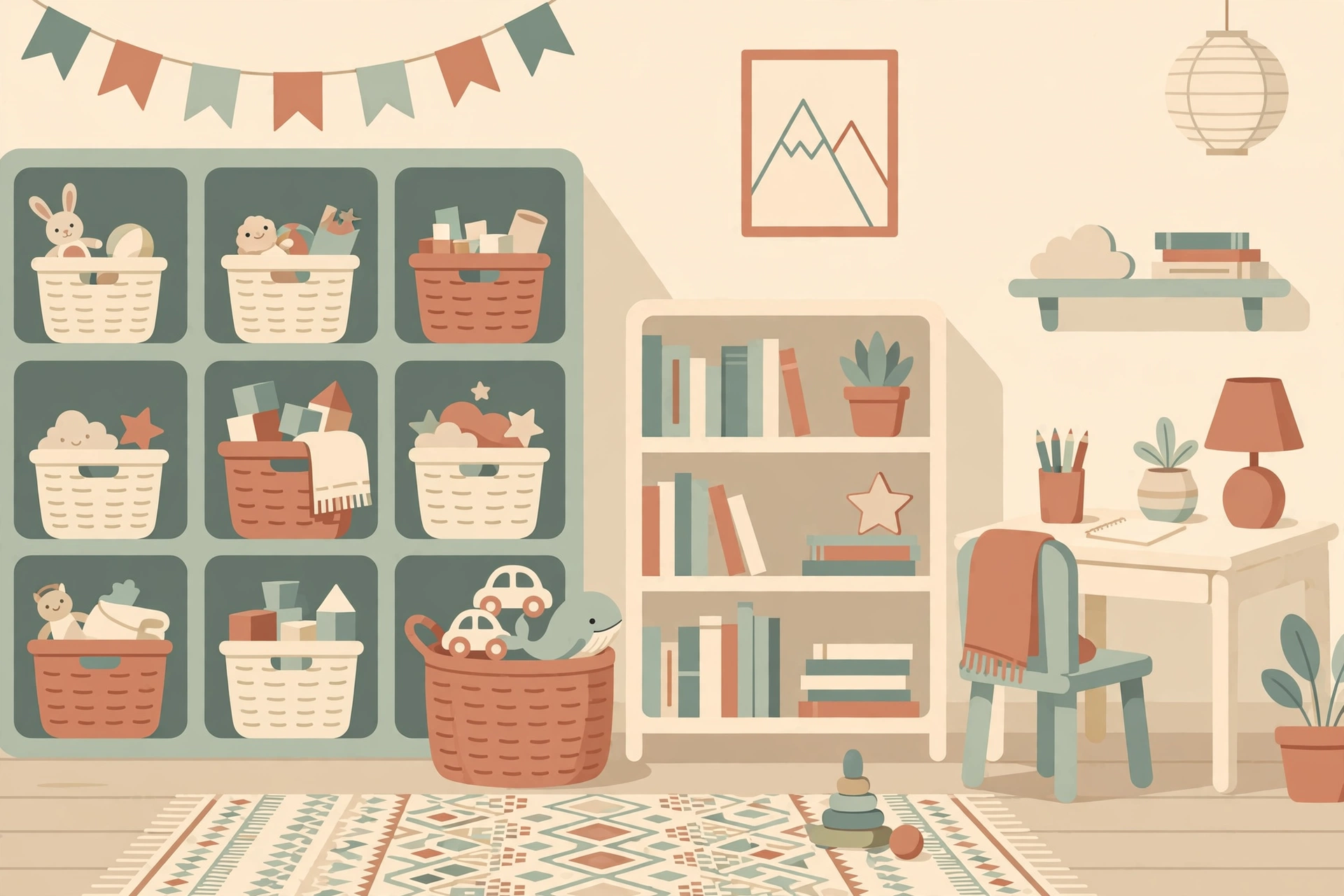
A 6-cube or 9-cube shelf unit with the top row at the child’s shoulder height beats a tall bookcase every time. Children use what they can see and reach; anything above eye level becomes adult-only storage by default. Anchor the unit to the wall — freestanding cubbies tip, and this is a safety step, not an optional extra.
2. One bin per category, never one bin per toy
Sort by broad category — blocks, dolls, vehicles, art supplies — not by individual toy type. Four to six categories is the sweet spot: fewer, and everything mixes into one junk bin; more, and no child remembers the system. Bins should be open-topped or front-opening, so putting away is a drop, not a lid-lifting project.
3. Picture labels for pre-readers, word labels after
Photograph the contents of each bin, print the photo, and tape it to the bin front. Pre-readers match picture to toy; early readers get the word underneath the picture, which quietly builds reading. Label the shelf position too, so a bin that gets carried across the room has a visible home to return to.
4. A rolling cart for art supplies
Art supplies are the category that spreads fastest, because they are small and numerous. A three-tier rolling cart corrals them in one movable unit: paper on top, markers and crayons in the middle, paint and glue below. When art time ends, the cart rolls to its wall spot in ten seconds, which is the actual cleanup standard a child can meet.
5. Book slings instead of deep shelves
Books stored spine-out on deep shelves are invisible to young children, who choose by cover. A forward-facing book sling or a low picture ledge shows covers, and children pick books the way they pick toys — by what they can see. Keep the sling to 10 to 15 books and rotate the selection monthly from a larger stash elsewhere.
6. A “one in, one out” rule at birthdays and holidays
New toys arrive in waves, and storage does not grow to match. The rule that prevents the annual overflow: for every new toy that enters, one existing toy leaves — donated, stored in rotation, or passed on. Make the child part of the choice, and schedule the swap for the same weekend as the gift event, before the new toys dissolve into the general pile.
7. Stuffed animals in a hanging net or beanbag chair
Stuffed animals defeat bins because they are bulky and light — a bin holds five and looks full. A corner hanging net holds 20-plus, and a stuffed-animal beanbag chair stores them inside a seat the child actually uses. Either option beats the floor, and both make the collection visible instead of buried.
8. A landing strip by the door
Backpacks, shoes, and jackets need a home at room-entry height: two wall hooks at the child’s shoulder height plus one small basket for shoes. Without a landing strip, the door area becomes a permanent pile that migrates inward daily. Hooks beat a coat rack because there is no decision about where to hang what — one hook, one child.
9. Under-bed rolling bins for outgrown and seasonal items
The space under the bed is the room’s hidden third of storage. Flat rolling bins there hold outgrown clothes, seasonal bedding, and the rotation stash (see below) without touching the daily system. Measure the clearance first — most beds offer 6 to 8 inches, so buy bins 5 inches tall or shorter, not standard 10-inch boxes that will never fit.
10. A weekly 10-minute reset, owned by the child
No system survives without maintenance, and the honest maintenance interval for a kids room is weekly, not daily. Set a 10-minute reset every Sunday: everything back to its labeled home, broken toys out, one rotation swap. Ten minutes is short enough to hold a child’s attention, and a weekly rhythm beats a daily battle that nobody wins.
The Toy Rotation System, Done Properly
Rotation is the fix most often recommended and most often abandoned, usually because it is run as a vague “put some toys away.” Run it as a system instead: divide all toys into two equal sets, keep one set in the room and one in the under-bed rotation bin, and swap every two to three weeks. Children play longer with “new” rotated toys, the room holds half the volume at any time, and the swap itself is the weekly reset’s easiest task.
Two rules keep rotation working. First, rotate whole categories, not individual toys — swap the entire vehicle set, not three cars. Second, never rotate a child’s current favorite out of the room; the system collapses the first time a beloved toy disappears. Favorites stay permanent, everything else rotates. Closet space helps enormously here: our closet organization DIY guide shows how to zone a reach-in closet so the rotation stash has a real home instead of a hallway pile.
A $148 Starter Kit That Covers a Whole Room
Here is what a complete starter system actually costs, using widely available pieces:
– 6-cube shelf unit, wall-anchored: $58.00
– Six fabric storage bins: $36.00
– Printable picture labels and a label holder set: $9.00
– Forward-facing book sling: $24.00
– Three-tier rolling art cart: $21.00
Total: $148.00. The shelf unit is the one place worth spending properly — a wobbly unit is a safety problem, not a bargain. The bins are where the budget flexes: start with four bins ($24) and add two more once the categories settle, bringing the starter total to $136. Under-stair and hallway nooks can absorb the overflow a kids room generates; our under-stairs storage ideas cover eight ways to use that dead space for family storage.
Kids Room Storage FAQs
How many toys should a child actually have out?
As many as fit in the bins you own, with room to put each one away without stacking. For most rooms that means 20 to 30 toys accessible at once, with the rest in rotation storage. If putting away requires balancing or cramming, the volume is too high, not the child’s effort too low.
At what age can a child tidy their own room?
Toddlers can put a toy in an open bin with prompting from about age two; independent tidying of a whole room is realistic from around age five to six, and only when every item has a labeled, reachable home. Systems that demand sorting by adults’ standards fail younger children — match the task to the age, not the other way around.
Are open bins or lidded boxes better for kids rooms?
Open bins for daily toys, lidded boxes for rotation and seasonal storage. Lids slow down daily cleanup and hide contents from children, which means toys in lidded boxes get forgotten. Use lids only where the contents are not needed weekly.
How do you store toys in a room shared by two kids?
Give each child a labeled bin column and a personal shelf section, and keep shared toys (blocks, art supplies) in neutral bins between them. Shared storage without ownership turns tidying into an argument about whose mess it is; a visible split ends that argument before it starts.
What is the first thing to buy for a messy kids room?
The shelf unit, anchored to the wall. Bins without a shelf become floor clutter with handles, and labels without bins are decoration. Buy the shelf first, sort into categories second, and label last — in that order.
The Bottom Line
Kids room storage lasts when it matches the child: zones that answer “where does this go,” open bins with picture labels, half the toys in rotation, and a 10-minute weekly reset. A $148 starter kit covers the whole system, and the real test is simple — if a child can put everything away without help, the system works.