
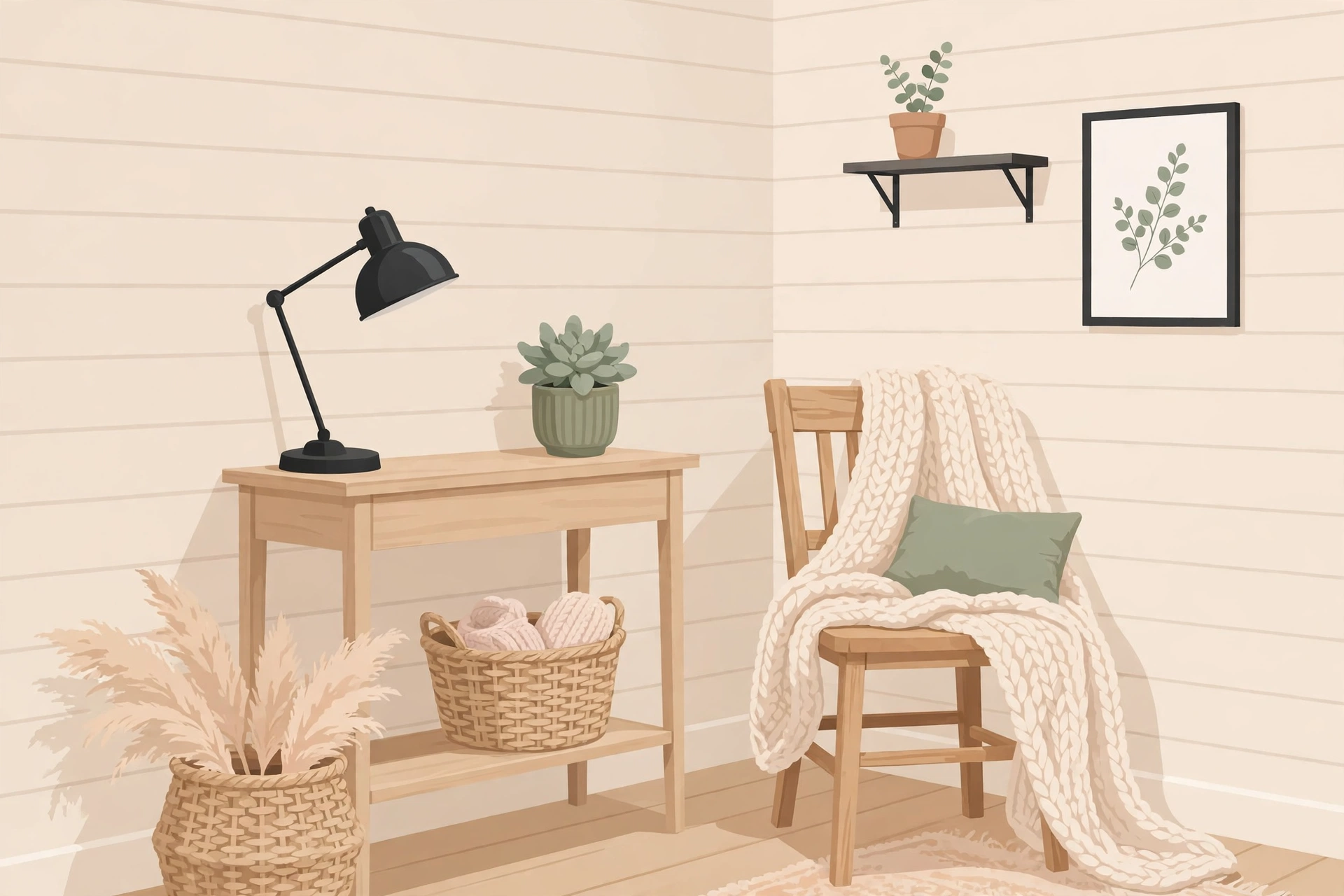
Farmhouse style has a reputation for being expensive — reclaimed beams, custom cabinetry, a $400 light fixture over the table. The truth is quieter: most of what reads as “farmhouse” in a room comes from a handful of small, visible choices. Swap the hardware, warm up the light, soften the textiles, and add a little honest wood, and a builder-grade room starts to feel like a farmhouse. This guide walks through 12 swaps that cost little individually and add up to a full transformation for about $314.
Start With Hardware and Lighting
Hardware is the jewelry of a room: small, everywhere, and impossible to ignore once you notice it. A standard kitchen has 15 to 25 pulls and knobs, so changing them changes the whole room for the price of one dinner out. Measure the center-to-center distance of your existing pulls before ordering — 3¾ inches is the most common size — so the new ones fit the existing holes.
- Swap 1 — Matte black bar pulls. About $3 each; 18 pulls for a typical kitchen comes to $54. Matte black reads instantly as farmhouse, especially against white or warm wood cabinets.
- Swap 2 — Warm light bulbs. Replace cool white bulbs with warm 2700K LEDs, about $12 for a 4-pack. This single change does more for warmth than almost any decor purchase.
- Swap 3 — One statement pendant. A woven or black metal pendant over the dining table, $60 to $90, hung 30 to 36 inches above the tabletop. One good fixture beats three mediocre ones.
- Swap 4 — Metal switch plates. Replace yellowed plastic plates with plain metal ones, about $3 each; 8 plates in the main rooms costs roughly $24 and quietly upgrades every wall.
What Size Budget Do You Actually Need?
Here is a worked budget for a living room and kitchen refresh using the swaps in this guide. Paint assumes one gallon of warm white for an accent wall; textiles covers curtains plus a throw; lighting covers one pendant plus bulbs.
| Hardware (pulls, plates) | $54 |
| Lighting (pendant + bulbs) | $75 |
| Paint (one gallon, warm white) | $45 |
| Textiles (curtains + throw) | $80 |
| Thrifted wood accents | $45 |
| Greenery (stems + crock) | $15 |
| Total | $314 |
That total assumes you already own basic tools and that you thrift the wood pieces. If you skip the paint, the refresh drops to $269; if you add a second pendant, budget another $60 to $90. The point is not the exact number — it is that a room transformation is a series of $25 to $90 decisions, not one $2,000 decision.
Soften Every Room With Textiles and Wood
Farmhouse rooms feel soft because they layer natural fibers over hard surfaces. Bare windows, bare sofas, and bare floors read as a showroom; linen, knit, and wood read as a home. Hang curtain rods 4 to 6 inches above the window frame and let panels reach the floor — short curtains are the most common reason a room feels unfinished.
- Swap 5 — Linen-look curtains. About $25 per panel in warm white or natural flax. Two panels per window is the standard for a finished look.
- Swap 6 — A chunky knit throw. Around $30, draped over a sofa arm or chair back. It adds texture in seconds and actually gets used on cold evenings.
- Swap 7 — Wooden cutting boards on display. Lean two or three boards against the kitchen backsplash. Free if you already own them, about $20 for a new one, and they add instant warmth to a tiled wall.
- Swap 8 — A jute runner in the entry. About $35 for a 2-by-6-foot runner. It anchors the space, protects the floor, and sets the farmhouse tone the moment someone walks in.
Shop Secondhand First
The best farmhouse pieces are old by definition, so thrift stores and garage sales are the right first stop, not a compromise. For more secondhand strategies, see our guide to thrift store decor flips. Go with measurements written down — a crate that does not fit its spot is clutter, not decor.
- Swap 9 — Wooden crates. About $8 each secondhand. Stack two as a side table or use one for book storage beside the sofa.
- Swap 10 — Mason jars. $1 to $2 each at thrift stores. Use them as vases for grocery-store flowers or as open pantry organizers.
- Swap 11 — A wooden blanket ladder. Around $15 secondhand versus $60 or more new. Lean it against a wall near the sofa and hang two throws from it.
- Swap 12 — Faux greenery in a thrifted crock. About $12 total: $8 for stems and $4 for the crock. One arrangement on a console or mantel adds life without the watering schedule.
One caution on secondhand wood: check for a musty smell and wobbly joints before buying. A quick sand and a coat of clear wax revives most pieces in under an hour, and it is worth doing before the piece comes inside. If your walls also need a refresh, our guide to paint colors that make small rooms look bigger covers warm whites that suit farmhouse rooms.
Common Farmhouse Mistakes to Avoid
- Too many word signs. One “gather” sign is a nod to the style; five is a gift shop. Let wood, texture, and light do the talking.
- All-gray everything. Gray walls plus gray furniture plus gray floors read as cold, not farmhouse. Warm whites and wood tones are what make the style feel welcoming.
- Perfectly matching sets. A dining set where every piece matches reads as a showroom. Mix wood tones deliberately — a darker table with lighter chairs looks collected over time, not bought in one afternoon.
- Ignoring scale. An oversized clock above a tiny sofa, or a miniature rug under a large table, throws the whole room off. Measure first, buy second.
Key Takeaways
- Start with hardware and warm bulbs — the cheapest changes with the biggest visual return.
- A full living room and kitchen farmhouse refresh runs about $314 using the swaps in this guide.
- Thrift wood pieces first; farmhouse style suits old wood better than new.
- Keep word signs to one, warm whites over gray, and measure before buying anything large.
Farmhouse style rewards patience more than spending. Make one swap a weekend, starting with hardware, and by the end of a month the room will feel like a different place — without a renovation loan or a single power tool.

One Comment