
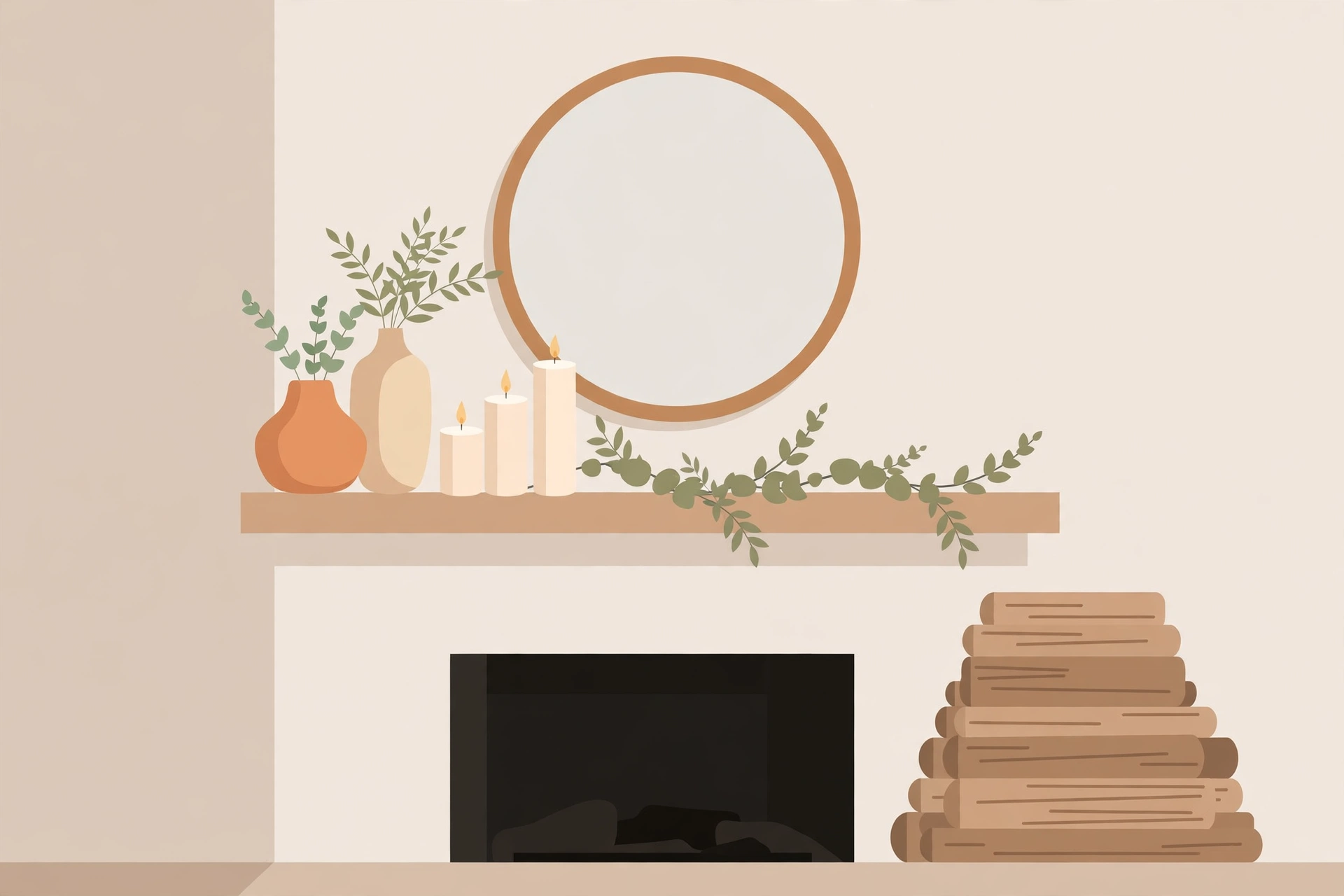
A fireplace mantel is the closest thing most living rooms have to a stage. It sits at eye level, it frames the fire, and guests look at it whether you want them to or not. That is why mantels go wrong so often: they collect whatever has nowhere else to live — a clock, a photograph, a candle from three Christmases ago — and the result is a shelf that looks accidental rather than arranged.
Styling a mantel well is not about buying a matching set or copying one photograph from a magazine. It comes down to a few measurable rules — height, width, balance — plus one decision about the look you want, and a short list of pieces you can swap when the seasons change. This guide covers all three, with a worked $120 budget at the end.
Mantel Styles at a Glance
Before buying anything, pick a style direction. Every style below uses the same sizing rules; what changes is the anchor piece and how formal the arrangement feels. Choose the one that matches the rest of the room, not the one that looks best in a photograph.
| Style | Anchor piece | Best for |
|---|---|---|
| Classic symmetric | Matching pair of candlesticks or vases | Formal living rooms, wide mantels |
| Collected | One large mirror or artwork, layered objects | Rooms with mixed furniture styles |
| Minimal | A single tall vase or one piece of art | Small mantels, busy rooms |
| Seasonal rotating | Fixed anchor plus a tray of seasonal pieces | Anyone who likes changing decor often |
How High Should Decor Sit Above a Mantel?
Hang a mirror or artwork so its bottom edge sits 6 to 8 inches above the mantel shelf. Any higher and it floats away from the arrangement; any lower and it crowds the objects below it. For a standard mantel shelf at about 54 inches from the floor, that puts the bottom of the mirror around 60 to 62 inches high — roughly eye level for most adults, which is exactly where an anchor piece should sit.
Keep the tallest object on the mantel under about 24 inches tall unless the wall above it is very high. Oversized pieces make the mantel feel top-heavy and block the mirror or art behind them. If you love tall branches or candlesticks, place them at the ends, where they frame the arrangement, instead of in the middle, where they compete with it.
One safety rule matters more than any styling rule: keep anything flammable at least 12 inches from the firebox opening, and use battery-operated candles if your firebox throws real heat up the wall. Mantel shelves absorb more warmth than most people expect, and dried stems placed too close to a working fire are a genuine hazard.
The Layering Formula That Works on Any Mantel
Think in three layers: back, middle, front. The back layer is the anchor — mirror or art, leaning or hung. The middle layer adds height at the sides — vases, candlesticks, a stack of books. The front layer is small and low — a tiny plant, a short candle, a decorative bowl. Three layers give depth; one flat row of same-height objects looks like a lineup, not an arrangement.
Work from the anchor outward: place the anchor first, then the tallest side pieces, then fill the middle with medium pieces, and add the small front pieces last. Step back after each layer. If the mantel looks finished after two layers, stop — a mantel that looks unfinished usually needs one thing removed, not one thing added.
Odd numbers help. Groups of three or five read as arranged, while even pairs read as formal. Use pairs only when you want symmetry — for example, matching candlesticks flanking a mirror. If you are styling a mantel on a budget, the same restraint pays off elsewhere too: the farmhouse decor on a budget guide shows how a few high-impact swaps beat a full-room overhaul.
Sizing Rules: Mirror, Art and Object Heights
The width rule: the anchor piece should span roughly two-thirds of the mantel’s width. On a 60-inch mantel, that means art or a mirror around 40 inches wide. A piece much narrower looks lost; one that spans the full width leaves no room for side objects and makes the whole shelf feel cramped.
The depth rule: most mantel shelves are 8 to 12 inches deep. Keep the deepest objects — vases, lanterns — toward the back, and let nothing overhang the front edge. A good test is to run a hand along the front edge without knocking anything; if you cannot, something needs to move back or come off entirely.
The weight rule: heavy mirrors and framed art should hang on a wall stud or with properly rated wall anchors, not lean, if they weigh more than about 15 pounds. A leaning mirror that slides is a broken mirror waiting to happen, especially in a house with children or pets. For hanging hardware and spacing, see the gallery wall layout guide.
Season by Season: What to Swap and What to Keep
Keep the anchor and the tallest side pieces fixed all year. Swapping everything every season is expensive and exhausting. Change only the front layer and one middle piece: the garland, the candle colours, a small tray of seasonal objects. That is the whole trick behind mantels that always look current without constant shopping.
- Spring: fresh greenery or faux eucalyptus, light ceramic, one soft colour accent.
- Summer: a bowl of shells or a wooden bead garland, lighter candles, nothing heavy.
- Autumn: warm amber glass, dried stems, a small pumpkin or two at the ends — not a row of them.
- Winter: evergreen garland, white or gold candles, one metallic accent, and nothing more.
A seasonal swap should take under 15 minutes and cost under $25 if you reuse the anchors. Store the seasonal pieces in one labelled box so the swap is a pleasure, not a hunt through the attic each time.
A Worked Budget: Styling a Mantel for $120
Here is a complete mantel, priced honestly, using the rules above. The mirror is the biggest single spend because it sets the whole arrangement; everything else supports it.
| Piece | Cost |
|---|---|
| Thrifted round mirror | $35 |
| Two ceramic vases | $24 |
| Set of three pillar candles | $18 |
| Faux eucalyptus garland | $16 |
| Brass candle holders (pair) | $14 |
| Small framed print | $13 |
| Total | $120 |
Where to save: thrift stores and end-of-season sales are the best source for mirrors and vases, and candles are cheapest in multi-packs. Where not to save: wall fixings. A $5 pack of proper anchors protects a $35 mirror and the floor below it. Restraint is the same principle behind the minimalist living room guide — fewer, better pieces, chosen on purpose.
Fireplace Mantel FAQs
How do I style a mantel if a television hangs above the fireplace?
Treat the television as the anchor and keep everything on the mantel low and simple. Nothing should stand taller than about 12 inches, or it will compete with the screen and block the view. Matching low pieces at each end — small plants, short candle holders — frame the television without fighting it.
What should I put on a mantel if the fire is never lit?
An unused fireplace is still a focal point, so style the mantel exactly as you would a working one, with one bonus: battery candles inside the firebox give a warm glow with no heat or smoke. Books, plants and art all work, and the depth rule still applies — nothing overhanging the front edge.
How often should mantel decor change?
The anchors should stay put for years, while the front layer can change with the seasons or whenever it stops pleasing you. A quarterly swap of one garland, one candle colour and one small object is plenty; redecorating the whole mantel every month usually means the anchor was never right in the first place.
Can I hang a heavy mirror above a mantel safely?
Yes, provided it hangs on a wall stud or on anchors rated for its weight — check the rating on the packet, not the size of the screw. Pieces under about 15 pounds can lean safely against the wall; anything heavier should be fixed. If the wall is brick or plaster, use masonry fixings rather than standard picture hooks.
A Mantel That Works All Year
A good mantel is not a display case. It is one anchor at the right height, two or three supporting pieces sized to the shelf, and a front layer you can change in fifteen minutes when the season turns. Get those three things right, and the mantel stops being the shelf where clutter gathers — and starts being the part of the room people actually notice.

One Comment