
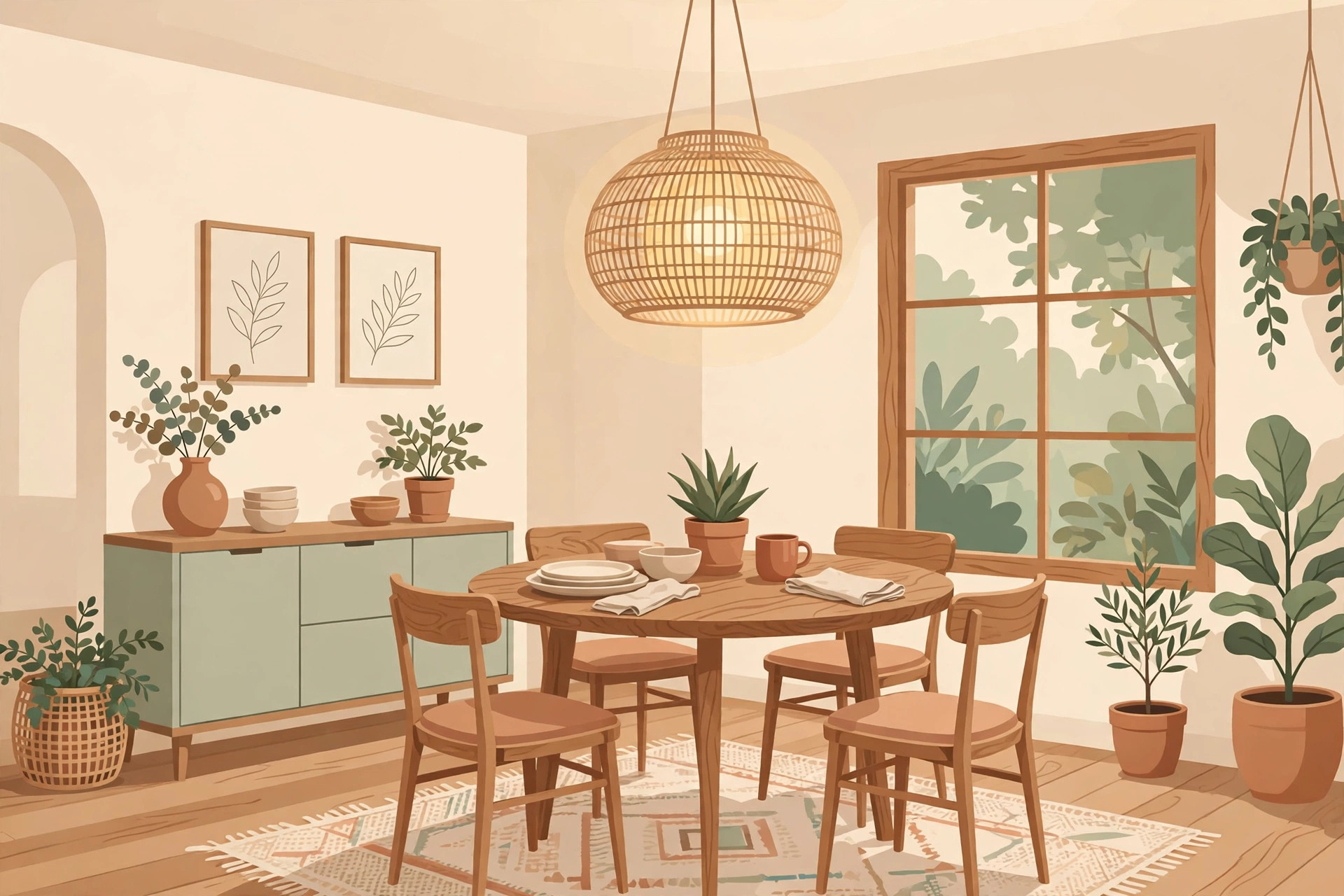
Dining room lighting goes wrong in two predictable ways: a chandelier so small it looks like jewelry on a warehouse wall, or one hung so low that guests duck when they reach for the salt. Both problems are measurement problems, and both are solved with a tape measure before anything is bought. This guide gives you the sizing rule, the hang-height rule, the brightness math, and a layering plan that works for weeknight dinners and holiday tables alike.
| Table size | Chandelier diameter | Hang height above tabletop | Total light target |
|---|---|---|---|
| 36–42 inch round | 18–21 inches | 30–36 inches | 1,500–2,000 lumens |
| 48 inch round | 24–30 inches | 30–36 inches | 2,000–3,000 lumens |
| 60 inch rectangular | 30–36 inches | 30–36 inches | 3,000–4,000 lumens |
| 72 inch rectangular | 36–42 inches, or two 20–24 inch pendants | 30–36 inches | 4,000–5,000 lumens |
| 96 inch rectangular | Two 24–28 inch pendants, spaced 30 inches apart | 30–36 inches | 5,000–6,000 lumens |
The Chandelier Size Rule: Half to Two-Thirds of the Table
Size the fixture to the table, not to the room. The working rule used by lighting designers is simple: the chandelier’s diameter should be one-half to two-thirds of the table’s width. For a 48-inch round table, that means a fixture 24 to 32 inches across; for a 60-inch rectangular table, 30 to 40 inches. Under one-half, the fixture looks lost; over two-thirds, it crowds the table and blocks sightlines across it.
For long rectangular tables, one fixture rarely covers the whole length well. A 72-inch table lit by a single central chandelier leaves both ends dim, which is why two pendants spaced about 30 inches apart center-to-center usually look and work better. Measure the table first, then shop: most product listings give the fixture diameter, so the rule can be checked in seconds before ordering. When the dining area opens into the living room, the same measurement-first approach pays off underfoot too — our living room rug size guide sizes rugs by furniture footprint in exactly this way.
How High Should a Chandelier Hang?
Hang the bottom of the fixture 30 to 36 inches above the tabletop. That height puts the light where food and faces are, while keeping the fixture out of everyone’s eye line when seated. At 30 inches, the glow feels intimate and warm; at 36 inches, the room feels more open and the fixture reads as part of the architecture. Both ends of the range work — the mistake is outside it. Below 30 inches, diners stare into bulbs; above 40 inches, the light floats uselessly near the ceiling and the table goes dim.
Ceiling height changes the math only at the extremes. With standard 8-foot ceilings, the 30-to-36-inch rule is the whole story. With 9- or 10-foot ceilings, add roughly 3 inches of hang height per extra foot of ceiling — so a 10-foot ceiling lands around 36 to 42 inches above the table. Never hang a chandelier by its chain length out of the box; measure from the tabletop up, mark the spot with painter’s tape on the wall, and sit down at the table to check the sightline before the electrician or the ladder comes out.
How Bright Should a Dining Room Be?
Dining rooms need less raw brightness than kitchens and more control than living rooms. Aim for 30 to 40 lumens per square foot of dining area for the main fixture, then add layers (below) for the rest. A 120-square-foot dining room therefore wants roughly 3,600 to 4,800 lumens in total, not from one bulb but from the whole layered scheme. A single 60-watt-equivalent LED bulb produces about 800 lumens, so a five-bulb chandelier delivers around 4,000 lumens on its own — right in range for a medium room.
Color temperature matters as much as brightness. Choose 2700K warm white for dining rooms: it flatters food and skin tones, while 4000K-plus daylight bulbs make a dining room feel like a cafeteria. And put the main fixture on a dimmer — it is the single highest-value upgrade in this guide, typically $25 to $30 for the switch, and it turns one fixture into both a bright family-dinner light and a low holiday-glow light. Never buy non-dimmable bulbs for a dimmed circuit; they flicker and buzz.
Layering: The Three Lights Every Dining Room Needs
One overhead fixture alone makes a flat, shadowy room. The layered scheme that designers actually specify has three parts. First, the overhead fixture — the chandelier or pendants — which does the main work over the table. Second, ambient fill: a pair of wall sconces, a buffet lamp on a sideboard, or a floor lamp in a corner, which lifts the edges of the room so the table does not sit in a spotlight. Third, accent light: a small picture light over art, or a candle-style glow on the sideboard, which gives the room depth after dark.
The budget-friendly version of layering skips hardwiring entirely. Plug-in wall sconces ($40 to $50 each) mount with two screws and a cord cover, and a buffet lamp is simply a lamp on furniture you already own. If you do only one layer beyond the chandelier, make it the sideboard lamp: it throws warm light upward, fills the darkest corner of most dining rooms, and costs less than the dimmer switch.
Pendants or One Chandelier? A Decision Guide
This is the choice that stalls most dining room projects, so decide it with the table shape, not with taste alone. Choose one chandelier when the table is round or square (up to about 60 inches), when the ceiling is standard height, and when you want one visual anchor in the room. Choose two or three pendants when the table is rectangular and longer than 72 inches, when the room is open-plan and needs the light spread along the table, or when the ceiling is high enough that a row of pendants can define the dining zone without a wall.
The hybrid that works in awkward rooms: one chandelier over the table plus a single pendant over a sideboard or bar cart, on the same dimmer circuit if possible. It costs one extra fixture and gives the room a second focal point. Whatever you choose, match the metal finishes across fixtures — mixed brass and matte black reads as accidental, while one repeated finish reads as intentional, even on a budget.
A Worked Lighting Plan for $340
Here is what a complete dining room lighting scheme actually costs, using widely available pieces:
– Chandelier, 28-inch drum style with five E12 sockets: $189.00
– Dimmer switch, single-pole LED-compatible: $28.00
– Two plug-in wall sconces with cord covers: $96.00
– Six dimmable 2700K LED bulbs (one spare): $27.00
Total: $340.00. The chandelier is the one place not to go cheapest — thin metal shades and cloudy glass are visible every single night. The sconces and the dimmer are where the budget can flex: skip one sconce and the plan drops to $292, or add a buffet lamp later from the same $340 envelope by choosing a $140 chandelier instead.
Quick Questions, Answered
Can a chandelier be too big for a dining room?
Yes, when its diameter exceeds two-thirds of the table width or when it hangs below 30 inches above the tabletop. Oversized fixtures block conversation across the table and dominate small rooms. If the fixture you love is too big for the table, it belongs in an entryway, not over dinner.
Do I need an electrician to install a chandelier?
For a straight swap on an existing ceiling box, a confident DIYer can do it with the breaker off, a voltage tester, and 30 minutes. For a new fixture location, a moved junction box, or any wiring beyond a like-for-like swap, hire a licensed electrician — typically $150 to $300 for the job, and worth it for safety.
What if there is no ceiling fixture in my dining room?
Renters and older homes often have none. The best no-wiring options are a plug-in pendant swagged from a ceiling hook ($60 to $120 all-in) or a tall arc floor lamp positioned over the table end. Both give overhead light without touching the wiring, and both move with you. Dining walls deserve the same attention as the table — our gallery wall layout guide covers spacing and height rules for the art above the sideboard.
The Bottom Line
Dining room lighting is three measurements: a fixture one-half to two-thirds of the table’s width, hung 30 to 36 inches above the tabletop, on a dimmer with warm 2700K bulbs. Add one layer of fill light, and a $340 plan covers the whole scheme. Measure the table, check the sightline from a seated position, and buy once.

2 Comments