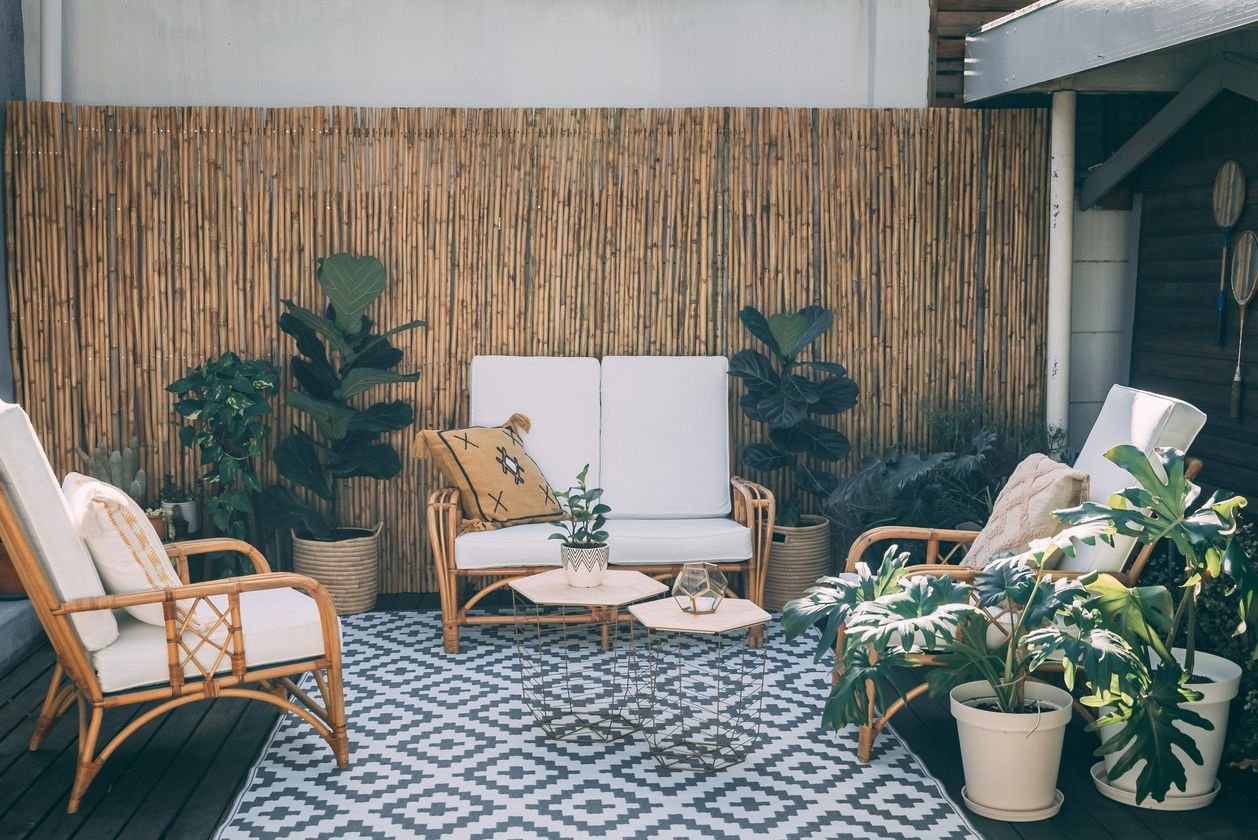
An outdoor rug size guide is the fastest way to stop guessing at the store, because the wrong size is the most common outdoor decorating mistake and the hardest one to live with. A rug that is two feet too short leaves chair legs hanging off the edge every time someone sits down, while a rug that is two feet too big swallows the deck and traps rainwater against the boards. The fix is simple: size the rug to the furniture zone, not to the patio. Measure the seating or dining group, add the clearance each use needs, leave a visible border of deck or paving, and then buy the nearest standard size. This guide covers the two rules behind every size, a size chart for patios, decks and balconies, the dining-table maths, real prices by size, and a tape-out test that costs about five dollars.
Quick answer: For most patios, a two-seat lounge set needs a 5×8 rug, a loveseat with two chairs needs a 6×9 or 8×10, a dining table for six needs an 8×10 or 9×12, and a large sectional needs a 9×12. Dining rugs should extend at least 24 inches past the table on every side, and every outdoor rug should leave 12 to 18 inches of bare floor visible around its edges.
The Two Rules Behind Every Outdoor Rug Size
Every outdoor rug decision comes down to two rules, and they pull in opposite directions. The first rule is that the rug must hold the furniture. For a seating area, at least the front legs of every sofa and chair should sit on the rug, and for a dining area, all four legs of every chair must stay on the rug even when the chair is pulled out. The second rule is that the rug must not fill the space: leave 12 to 18 inches of bare deck, paving or patio visible around the rug so the area still reads as an outdoor room with a rug in it, rather than a carpeted floor.
Outdoor rugs read smaller than indoor rugs of the same size. There are no walls to frame them, the furniture is bulkier, and strong daylight flattens the pattern, so a 5×8 that would anchor a small living room can look lost under a patio set. When the tape measure puts you between two standard sizes, size up, unless the larger rug would block a door swing, a step or the grill. An undersized rug is the mistake people notice every day; a slightly generous one is the mistake nobody notices.
Outdoor Rug Size Chart: Patio, Deck and Balcony
Most outdoor spaces fall into a handful of recognisable layouts, and the rug sizes follow those layouts closely. Use this chart as the starting point, then check it against your own furniture measurements, because a deep sectional and a slim bistro set can share the same patio and need very different rugs.
| Outdoor space or layout | Rug size | Best for |
|---|---|---|
| Narrow balcony, two chairs | 3×5 | Bistro set, two chairs, morning coffee spot |
| Small balcony or porch seating | 4×6 or 5×8 | Two chairs and a side table |
| Compact patio seating | 5×8 or 6×9 | Loveseat, two chairs, coffee table |
| Standard conversation set | 8×10 or 9×12 | Sofa, two chairs, coffee table |
| Outdoor sectional | 9×12 or 10×14 | Sectional with chaise or ottoman |
| Dining table for four | 8×8 or 8×10 | Square or small rectangular table |
| Dining table for six | 8×10 or 9×12 | Standard rectangular patio table |
| Dining table for eight or more | 9×12, 10×14 or 12×15 | Long table with pulled-out chairs |
| Pergola or covered patio | 8×8, 10×10 or 12×12 | Square layouts under a roof |
| Large patio or deck, two zones | Two rugs, 8×10 and 5×8 | Separate dining and seating areas |
The chart works because it is built on furniture footprints rather than patio dimensions. A 12×14 patio with a loveseat and two chairs takes a 6×9 or 8×10 rug, while the same patio with a dining table for six takes an 8×10 or 9×12. Start with what sits on the rug and let the patio size set the upper limit, not the target.
How Much Rug Does a Dining Table Need?
Dining areas need the most clearance of any outdoor layout, because chairs move. A chair that is fully on the rug when pushed in can end up half off it when someone pulls it out to sit down, and a chair leg catching the rug edge is how rugs get dragged out of place and how people trip. The rule is that the rug should extend at least 24 inches past the table on every side, and 30 to 36 inches is more comfortable for everyday use and for entertaining.
The maths is simple: add 48 inches to both the length and the width of the table, then round up to the nearest standard size. A table 3 feet wide and 6 feet long needs a rug at least 7 feet wide and 10 feet long, so an 8×10 is the size to buy. A table 42 inches wide and 7 feet long needs a rug at least 90 inches by 132 inches, which pushes you to a 9×12. For a round table, measure the diameter, add 48 inches, and choose a rug at least that long in both directions: a 48-inch round table needs a rug at least 8 feet across, so an 8×10 works, and a 60-inch round table needs a 9×12.
Two details matter as much as the size. First, choose a low, flat pile for dining areas, because chair legs slide more easily across it and food and drink wipe off faster. Second, check the rug’s thickness against the chair legs: a rug thicker than about half an inch can make lightweight chairs wobble on uneven pavers.
A Real Example: Two Rugs for a 12×16 Deck
A 12-by-16-foot deck is one of the most common sizes in the US, and it is exactly the size where one big rug fails and two smaller rugs work. The deck in this example holds a dining table for six on one end and a loveseat with two chairs on the other, with a three-foot walkway between the zones and the grill.
The dining zone measures 8 feet by 11 feet once the table and pulled-out chairs are counted, so the rug there is a 9×12, which leaves about 18 inches of bare decking on the long side and keeps every chair leg on the rug. The seating zone measures 7 feet by 9 feet, so the rug there is a 6×9, which catches the front legs of the loveseat and both chairs. Buying two rugs in the same colour family, or the same pattern in two sizes, ties the zones together without forcing one shape over both. The budget for this layout, at typical US online prices, is about 120 to 220 dollars for the 9×12 polypropylene rug, 60 to 140 dollars for the 6×9, and 25 to 45 dollars for a rug pad cut to fit the larger rug, which comes to roughly 205 to 405 dollars before tax. One 12×15 rug covering the same deck would cost 180 to 450 dollars on its own, trap water under the middle, and still leave the chairs half off at the edges.
What Outdoor Rugs Cost by Size
Neither of the big rug guides publishes prices, yet price is what decides most purchases. Outdoor rugs are usually polypropylene, which handles rain and sun, or polyester, which feels softer but fades faster in full sun. The table below shows typical US online prices for a flatweave polypropylene rug in a plain or simple geometric pattern; patterned, hand-hooked or designer styles cost roughly double.
| Rug size | Typical price | Best use |
|---|---|---|
| 3×5 | 25 to 60 dollars | Balcony, doorway, bistro set |
| 5×8 | 40 to 90 dollars | Two-seat lounge set |
| 6×9 | 60 to 140 dollars | Loveseat and two chairs |
| 8×10 | 80 to 200 dollars | Conversation set, dining for six |
| 9×12 | 120 to 300 dollars | Sectional, dining for eight |
| 10×14 | 180 to 450 dollars | Large deck or patio |
Budget for the extras too. A rug pad costs 20 to 60 dollars depending on size and stops the rug sliding on smooth deck boards, and it also lifts the rug slightly so water drains instead of pooling underneath. Outdoor rug tape costs 10 to 15 dollars a roll and holds the corners down in wind. A 5×8 rug in a covered spot can last five years or more, while the same rug in full sun and rain usually lasts three to five years before the colours fade and the backing stiffens.
The Tape-Out Test: Try the Size Before You Buy
The tape test is the step people skip and regret, and it costs about five dollars. Buy a roll of painter’s tape, or use old newspapers weighed down with plant pots, and mark the exact rug size on the deck or patio. Then put the furniture back in place, pull the dining chairs out as if someone is about to sit, and walk the route you use every day, from the door to the grill and back.
Check four things. First, do all four chair legs stay on the tape when the chair is pulled out? Second, is there 12 to 18 inches of bare floor between the tape and the deck edge, the railing or the wall? Third, does the tape cross a door swing, a step or a walkway where someone could trip on the rug edge? Fourth, does the size still look right from inside the house, through the patio door, where you will see it most? Leave the tape down overnight if you can. A size that looks right at noon can feel too big at dusk, when the light is lower and the rug reads darker. If the tape fails any of the four checks, move to the next size up or down before ordering, because returning a 9×12 rug can cost 30 to 60 dollars in return shipping.
Wind, Rain and Cleaning: Keeping the Rug Put
An outdoor rug lives a harder life than an indoor one, and sizing decisions change how it survives. On a windy balcony or an upper-floor deck, a light rug can lift at the corners, so anchor it with furniture on the corners, outdoor rug tape, or planters, and avoid sizes that overhang the deck edge where wind can catch them. On a deck, leave the rug slightly smaller than the zone so air can move under the edges; a rug that sits flat against the boards for months traps moisture, and trapped moisture is what stains decking and grows mildew under the rug.
Cleaning is part of the sizing choice too. A rug you can lift and shake out is easier to keep than one that needs two people to move, which is another reason two smaller rugs often beat one large one. Sweep it weekly, hose it down monthly, and let it dry fully in the sun before putting furniture back on it. Polypropylene rugs can be hosed and scrubbed with mild soap; avoid pressure washers, which fray the weave. If the rug sits in a spot that puddles after rain, size down and move it towards the centre of the deck so water runs off the edges instead of sitting underneath.
Outdoor Rug Size FAQs
What size outdoor rug do I need for a patio?
It depends on the furniture, not the patio. A two-seat lounge set suits a 5×8, a loveseat with two chairs suits a 6×9 or 8×10, and a dining table for six suits an 8×10 or 9×12. Measure the furniture zone, add the clearance, and round up to the nearest standard size.
Should an outdoor rug cover the whole patio?
Not usually. Outdoor rugs work best when they define a seating or dining zone rather than covering the entire surface. Leaving 12 to 18 inches of visible floor around the rug keeps the space feeling open and lets rainwater drain off the deck.
How far should a rug extend past a dining table?
At least 24 inches on every side, so all four chair legs stay on the rug when chairs are pulled out. Adding 48 inches to the table’s length and width gives the minimum rug size; 30 to 36 inches of overhang is more comfortable for everyday use.
What size rug goes under a sectional?
A large sectional usually needs a 9×12, and an oversized or U-shaped sectional needs a 10×14 or 12×15. The rug should be at least as wide as the sectional and catch at least the front legs of every seat.
Can I use two rugs on one patio?
Yes, and on a large patio or deck it usually looks better than one oversized rug. Size each zone on its own, one rug under the dining set and one under the seating, and choose two rugs in the same colour family or the same pattern in two sizes.
Measure the Furniture Zone First
The right outdoor rug size is decided by the furniture, checked against the deck, and confirmed with tape before money changes hands. Measure the seating or dining group with the chairs pulled out, add 24 inches of overhang for dining or a front-legs fit for seating, leave 12 to 18 inches of bare floor around the edges, and round up to the nearest standard size. Do that, and the rug will anchor the patio instead of fighting it. For the room the rug sits outside, see our living room rug size guide, and for the rest of the patio, see outdoor patio decor on a budget.