
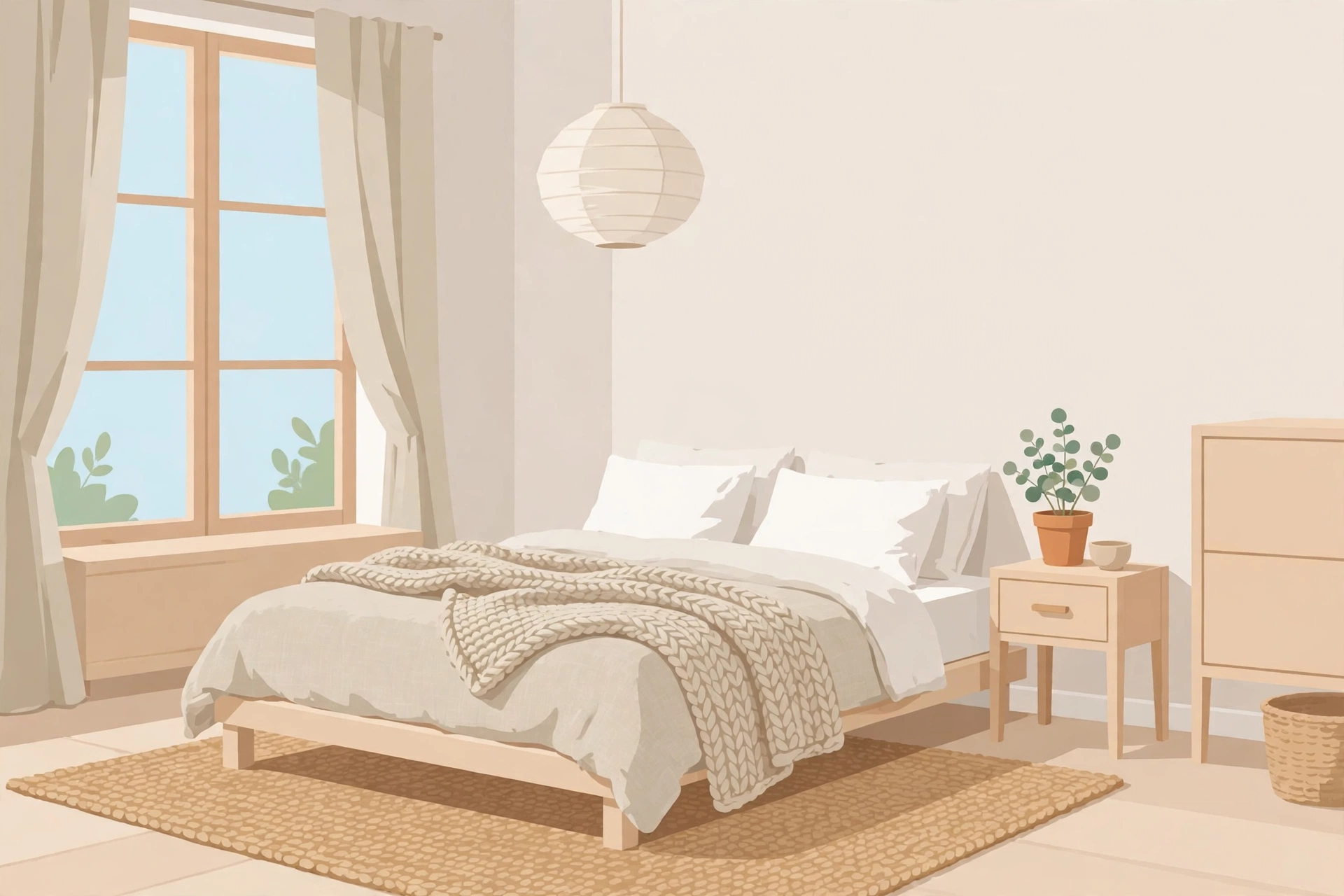
Scandinavian bedrooms look expensive because they look calm, and calm reads as expensive. The truth is kinder than the photos suggest: the look is a palette and a set of habits, not a price tag. Pale walls, pale wood, layered textiles, and low warm light do almost all of the work, and none of those four things requires designer furniture. A room built from one gallon of warm white paint, linen-look bedding, a thrifted wooden nightstand, and a decent rug can feel as restful as the magazine version — for about the cost of a single designer throw pillow.
The plan below totals under $250, and it is built for a real bedroom, not a showroom. It assumes you already own a bed, a mattress, and a dresser, and it spends money only where the eye actually lands: the walls, the bed, the floor, and the light.
The $250 Scandinavian Bedroom: The Shopping List
Here is the whole plan in one table, using typical US discount and big-box prices. The total lands at $235 to $250, and the order matters — buy in the order listed, because each layer builds on the one before it.
| Item | What to buy | Typical cost |
|---|---|---|
| Warm white paint | 1 gallon, warm white (e.g. White Dove or Alabaster) | $45–$60 |
| Linen-look bedding | Washed cotton or linen-blend duvet set, queen | $55–$70 |
| Throw + pillow covers | 1 chunky knit or waffle throw, 2 linen pillow covers | $30–$40 |
| Rug | 5×7 ft jute or low-pile wool rug, or a sheepskin | $45–$60 |
| Lighting | 1 paper or linen pendant + 2700K bulbs | $25–$35 |
| Greenery | 1 real plant in a terracotta or ceramic pot | $12–$18 |
| Secondhand wood | 1 thrifted wooden tray, stool, or small bench | $8–$15 |
| Total | $220–$298 |
That total needs one honest correction: at the top of the ranges it creeps past $250. Stay at the low end — a $45 gallon of paint, a $55 duvet set, a $45 rug — and the plan lands at $220. The discipline is in choosing the cheaper option at each line, not in cutting a layer. Every layer on the list earns its place, and cutting one usually costs more in lost calm than it saves in dollars.
Start With the Walls: Warm White, Not Stark White
The single most common mistake in a budget Scandinavian bedroom is painting the walls stark white. On a paint chip it looks clean; on four walls under a cool ceiling bulb it looks like a clinic. Real Nordic interiors use warm whites — Benjamin Moore White Dove runs about $75 a gallon at full price and closer to $55 on sale, and Sherwin-Williams Alabaster is similar — because warm undertones stop the room from going cold the moment the sun moves off the wall. A warm greige or a very pale sage on one accent wall works the same way, but keep it to one wall: the style is mostly one color, with texture doing the talking.
One gallon covers 350 to 400 square feet, which is enough for two coats in a standard 10×12 bedroom with one accent wall. Paint the ceiling a flat bright white, not the wall color, so the room keeps its height. And use a low-VOC paint — a bedroom is where you breathe for eight hours a night, so fumes are not a detail to skip. Our low-VOC paint guide explains the real numbers and the tinting trap to watch for when you buy.
What Does a Scandinavian Bed Actually Need?
The bed is the anchor of the room, and Scandinavian style asks it to be low, pale, and uncluttered. A low platform frame in pale wood — birch, ash, or light pine — is the classic, and the budget version is often already in the house: an existing wooden frame sanded lightly and finished with a clear matte coat looks closer to the real thing than a new flat-pack frame in the wrong wood tone. If you are buying, a simple pine platform frame starts around $150 to $200, which is why this plan does not include a new frame — paint and bedding transform the bed you have for a quarter of the price.
Bedding is where the cozy actually happens, and it is about weight and texture, not thread count. The formula is three layers: a washed cotton or linen-blend duvet in white, oatmeal, or pale grey; a folded throw across the foot of the bed in a chunky knit or waffle weave; and two pillow covers in linen or linen-look cotton. Real linen wrinkles, and in this style the wrinkles are an asset, not a flaw — they are what make the bed look slept-in and soft instead of starched. Skip busy patterns entirely. One solid color, layered in two or three textures, is the whole trick. For more on arranging the room around the bed, our small bedroom layout ideas guide covers six floor plans with exact measurements.
How Do You Layer Textiles Without Clutter?
Layering is the difference between a Scandinavian bedroom and an empty white room, and the difference between layering and clutter is that every layer has a job. The rug is the biggest textile decision in the room. A 5×7-foot jute rug under the foot of the bed, or an 8×10 wool rug if the budget stretches, warms the floor and softens the sound of the room. A genuine sheepskin draped over the foot of the bed or beside it costs around $39 and does the same work in a smaller footprint. Avoid flat-weave cotton rugs: they look right in photos and feel like cardboard underfoot, and they slide around without a pad.
Curtains should be sheer linen or linen-look cotton, hung high and wide so they frame the window rather than covering it. The point is to filter light, not block it — Scandinavian design grew out of long dark winters, so natural light is treated as a resource, not a problem. One pair of panels per window is enough, and they should reach the floor. If privacy is a concern, add a simple white roller shade behind the sheers rather than swapping to heavy drapes, which would break the lightness of the room.
Where Does the Light Come From?
Skip the single overhead light. Scandinavian bedrooms use three small sources instead: one ambient, one task, one accent. A paper or linen pendant over the center of the room at about $25 to $35 gives soft, diffused ambient light. A small lamp on each nightstand — or one, if the room is small — gives task light for reading. A candle, a salt lamp, or a low-wattage floor lamp in the corner gives the warm glow that makes the room feel restful after dark.
All three should run on warm bulbs, 2700K to 3000K, and none should be brighter than it needs to be. A 40-watt-equivalent bulb in the bedside lamp is plenty. The overhead fixture, if it stays, should be on a dimmer or fitted with the lowest-wattage warm bulb you can find — a single 800-lumen ceiling light is roughly ten times brighter than a bedside lamp, and brightness is the enemy of the calm this style is selling. Our lumens-per-room guide gives the exact numbers for every room in the house.
A 10×12 Layout That Works
Put the bed on the longest wall, with the headboard against a solid wall and clear space on at least one side. Leave 24 to 30 inches of walkway on the side you get in from, and 36 inches at the foot of the bed if the room allows it. Nightstands should be smaller than you think you need — 18 to 20 inches wide and about the same height as the mattress top, which is usually 24 to 26 inches. A nightstand taller than the mattress looks like a tower; one much shorter looks lost.
Storage goes into the wardrobe and the walls, which keeps surfaces empty — and empty surfaces are the whole point of the style. One piece of art, or a small cluster of two, above the bed or on the longest empty wall, is enough. A wooden tray on the dresser, a stool at the foot of the bed, or a small bench does the job of the second or third decorative object, and it is useful as well as pretty. The rule that keeps the room honest is lagom, the Swedish idea of enough: a bed, two nightstands, a rug, one or two pieces of art, one plant. Nothing without a job, and nothing doubled for decoration alone. For a fuller take on editing a room down to what it needs, our minimalist living room guide uses the same principle room by room.
5 Budget Traps That Ruin the Look
The same five mistakes show up in budget Scandinavian bedrooms again and again, and each one costs money to fix after the fact. First, the cool grey palette. A room painted in cool grey with grey bedding and grey furniture does not look Scandinavian — it looks like a waiting room. Warm whites, warm wood, and one muted accent color are what keep the room from going cold.
Second, the flat-weave rug. It photographs well, feels terrible underfoot, and slides across hard floors. Spend the rug money on jute, wool, or a sheepskin instead. Third, polyester sheers. Real linen or linen-look cotton filters light softly; polyester sheers shine under lamps and look plasticky up close. Fourth, too much decor. A Scandinavian bedroom with twelve small objects on the dresser is a cluttered bedroom with pale walls — the style is the editing, not the color. And fifth, buying the expensive bed first. A $400 frame in a room with bare walls and thin bedding still looks unfinished, while a $60 gallon of paint and a $55 duvet set in a room with an old frame looks like a renovation. Spend on the layers people touch and see first.
Buy in This Order: The 4-Week Plan
If $250 at once is too much, spread the plan over four weeks and the room still comes together in the right order. Week one: paint and bulbs, about $60 — the walls change everything else. Week two: bedding and the throw, about $70 — the bed is the largest surface in the room. Week three: the rug, about $50 — the floor is the next largest surface. Week four: the pendant, the plant, and the thrifted wood piece, about $55 — the finishing layer. Each week the room looks noticeably better than the week before, which is the point of a plan: progress you can see, in an order that never wastes a dollar.
Scandinavian calm is not a purchase. It is a short list of decisions — warm white, pale wood, three textile layers, low warm light, and nothing extra — made in the right order and kept honest by a budget. Follow the plan, skip the traps, and the room will feel like the photos. The only difference is that yours cost $250, and you will know exactly where every dollar went.


One Comment