Pattern mixing is the decorating skill that separates rooms that look collected from rooms that look chaotic — and it is also the one most people avoid. The fear is understandable: one wrong cushion and a calm living room can suddenly feel like a fabric shop exploded. But designers are not guessing. They follow a small set of rules about scale, colour, and balance, and once those rules are clear, mixing stripes with florals or geometrics with checks becomes a repeatable skill rather than a gamble.
Quick answer: Mix patterns like a designer by choosing three patterns at three different scales — one large, one medium, one small — in one shared colour, with one solid colour to rest the eye. Keep the largest pattern on the biggest surface, such as a rug or curtains, and use the smallest pattern sparingly, on a cushion or a throw.
The Scale Rule: Large, Medium, Small
Scale is the single most important rule in pattern mixing, and it is the one beginners most often break. The mistake is choosing three patterns of similar size — three medium-scale prints, for example — which compete with each other and make the eye jump around the room without landing anywhere. When the scales are clearly different, each pattern gets its own job.
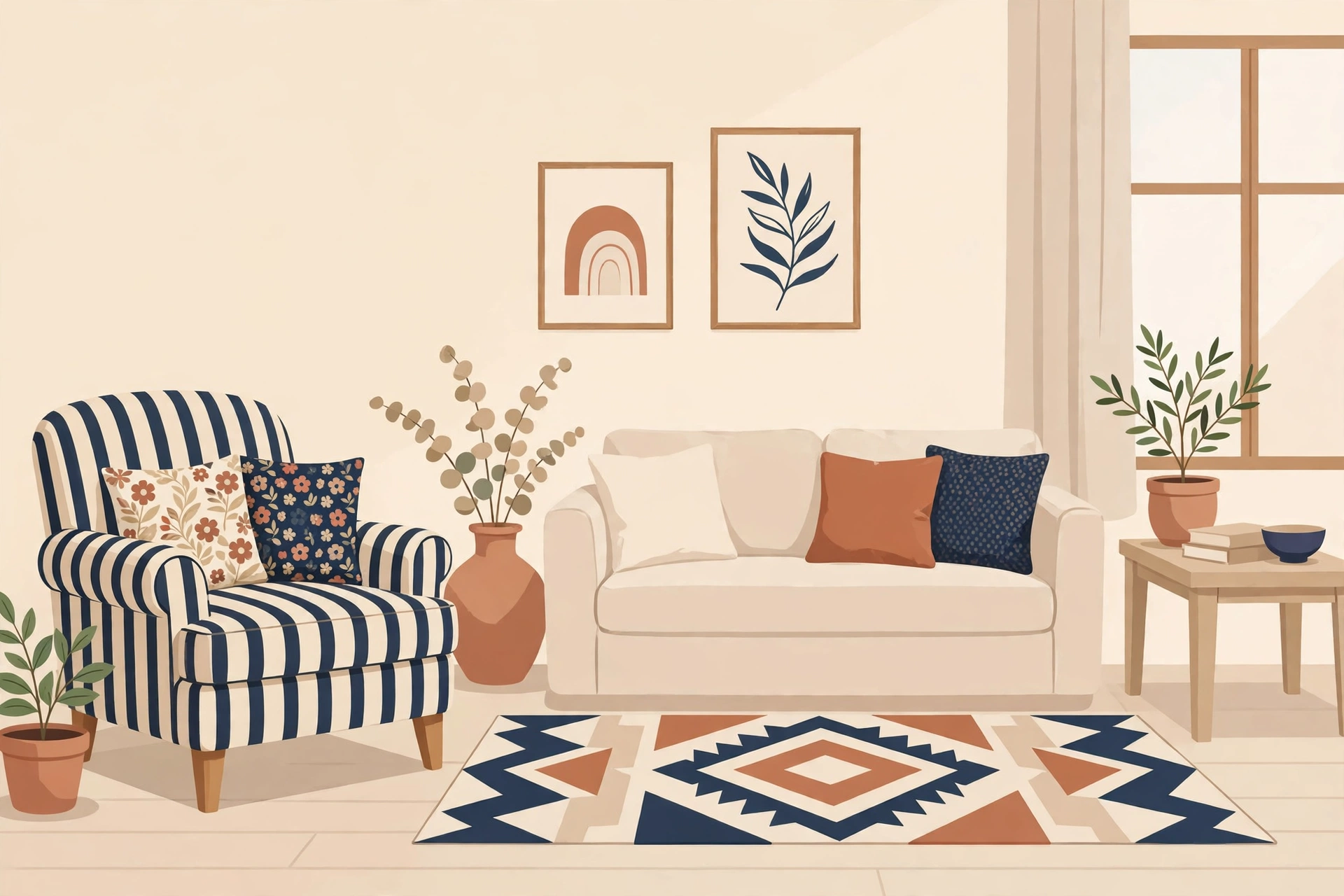
Think of it as a ladder. The large pattern, with motifs roughly 6 to 12 inches across, belongs on the biggest surface: a rug, curtains, or an accent chair. The medium pattern, with motifs of 2 to 5 inches, works on sofa cushions or a throw. The small pattern, with motifs under 2 inches — a tiny check, a fine stripe, a small dot — is the accent, best on a single cushion or a lampshade. A room needs all three rungs for the mix to feel intentional, but it rarely needs more than one pattern per rung in a single seating area.
What Colour Ties Patterns Together?
The second rule is simpler than it sounds: every pattern in the mix must share at least one colour. It does not need to be the dominant colour of each pattern — a shared accent is enough. A navy stripe, a floral with navy leaves, and a geometric with a navy outline all belong together because navy repeats, even if the floral is mostly cream and the geometric is mostly beige.
Start from a solid you already own. If the sofa is beige, build the mix around beige plus one accent colour, such as navy or terracotta. If the rug is the starting point, pull two colours from it and repeat them in the cushions. The shared colour is what stops the mix from looking random: the eye registers the repetition and reads the different patterns as a set. Limit the palette to three colours in total — one neutral base, one main accent, and one supporting colour — and the patterns will stay calm even when their shapes are bold.
A $180 Pattern Starter Plan
Here is a realistic starter plan for a living room with a plain sofa, showing how the scale rule works with real prices. The plan assumes the rug and curtains are already plain, so the patterns arrive through cushions and one throw — the cheapest surfaces to change.
| Piece | Pattern and scale | Typical cost |
|---|---|---|
| Two large cushions | Medium floral or botanical, motifs 3–5 inches | $30–$45 |
| Two small cushions | Small geometric or check, motifs under 2 inches | $25–$40 |
| One throw | Bold stripe, stripes 2–3 inches wide, sharing the accent colour | $30–$45 |
| One plain cushion | Solid colour matching the shared accent, for resting the eye | $15–$25 |
| Table runner or placemat set (optional) | Small-scale pattern echoing one cushion | $20–$30 |
| Total | $120–$185 |
Arrangement matters as much as selection. Place the two medium-pattern cushions at the outer ends of the sofa, the small-pattern cushions just inside them, and the solid cushion in the centre or on an armchair. Drape the striped throw over one arm, not across the whole sofa, so the stripe reads as an accent rather than a competing large pattern. If the room already has a patterned rug, count it as the large pattern and skip the striped throw — the rug is already doing that job. For help choosing a rug that will anchor the mix, our living room rug size guide covers measurements for every common layout.
Pattern Pairings That Clash
Some combinations fight no matter how careful the colour palette is. Two large, busy patterns in one seating area — a big floral sofa plus a big geometric rug, for example — will almost always clash, because both demand attention at the same scale. Two patterns with the same motif family but different styles, such as a traditional floral and a tropical floral, also tend to argue rather than harmonise. And animal print counts as a bold pattern: pair it with a quiet stripe or a solid, never with another bold print.
Safe pairings, by contrast, are almost boring in their reliability: stripes with florals, geometrics with solids, checks with botanicals, and any pattern with a plain texture such as linen or velvet. If a pairing feels uncertain, test it before buying a full set: place one cushion of each pattern side by side, step back six feet, and check whether the eye settles or keeps jumping. That six-foot test catches most mistakes before they cost money. Choosing wall colours that let patterns breathe also helps — our paint colours guide explains which shades keep a patterned room feeling calm rather than crowded.
Frequently Asked Questions
How many patterns can one room handle?
Three patterns per seating area is the safe maximum, plus solids. A larger open-plan room can carry a second group of three in a different zone, such as the dining area, as long as the two groups share at least one colour so the zones still relate.
Can I mix patterns in a small living room?
Yes, but keep the scales smaller and the palette tighter. Use a small and a medium pattern only, skip the large pattern, and let one shared colour — plus plenty of solid fabric — do the calming work. Small rooms punish pattern overload faster than large ones.
Do patterns have to match the wall colour?
They do not need to match exactly, but they should not fight it. A warm beige wall suits warm-toned patterns; a cool grey wall suits cool-toned ones. If the wall colour and the patterns come from opposite temperature families, the room will feel unsettled even when the patterns match each other.
What is the easiest first pattern mix for a beginner?
Start with stripes plus one floral, tied by one shared colour, with a solid cushion between them. It is the most forgiving combination in decorating, it works with almost any sofa colour, and it teaches the scale rule without risking a clash.
Should curtains match the cushions?
They should coordinate, not match. Curtains in a solid colour pulled from the cushion palette, or in a very small-scale version of one pattern, look designed. Curtains in the exact same print as the cushions usually look like a set bought together rather than a room put together.
Pattern mixing rewards restraint more than courage. One large, one medium, one small; one shared colour; one solid to rest the eye — and a six-foot test before committing. Follow those rules and the room will look collected and confident, whether the patterns cost $120 or far more.