
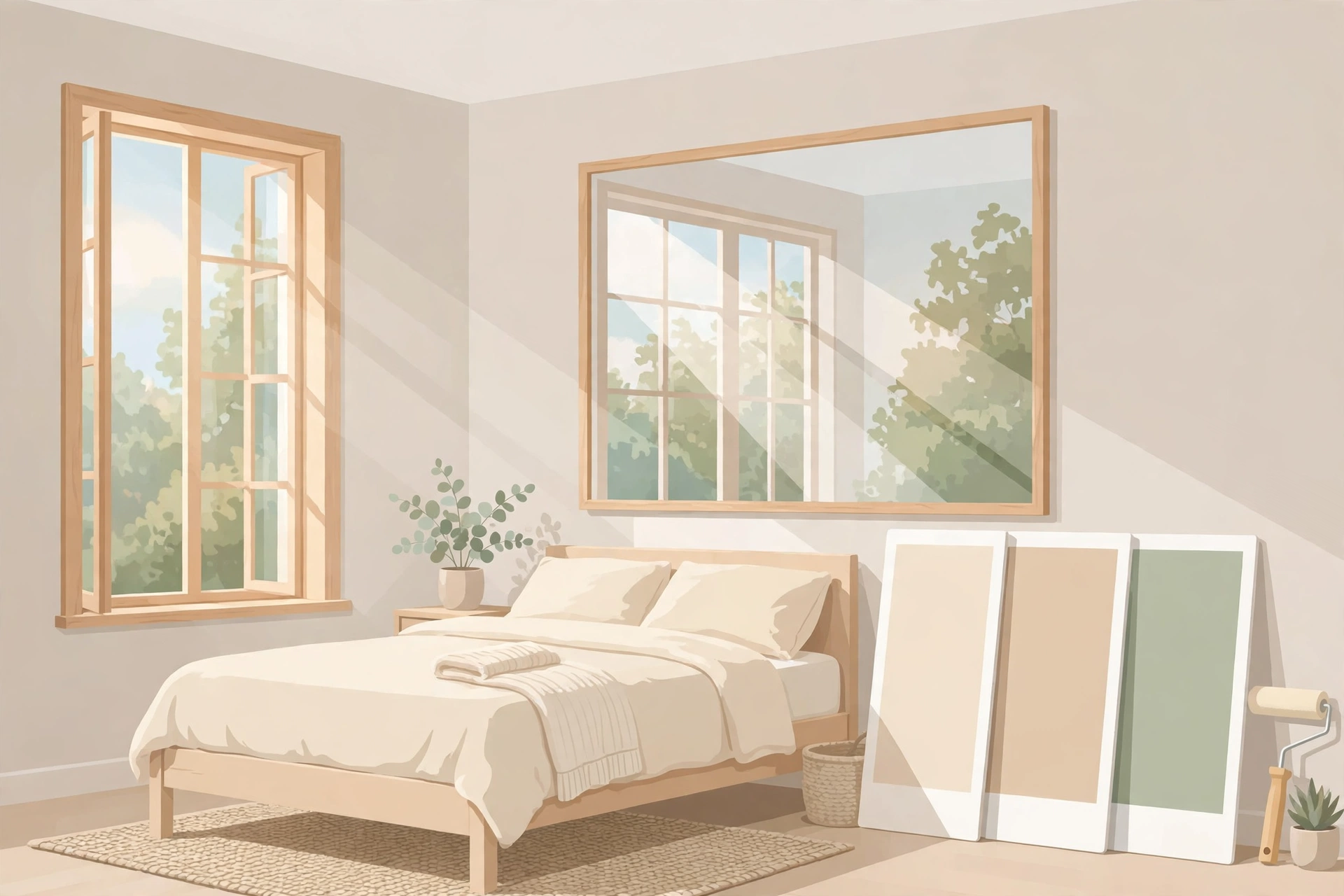
Paint is the cheapest square footage you can buy. One gallon costs less than dinner out, yet it changes how every wall, corner, and ceiling in a small room behaves — mostly by changing how light moves around. The mistake most people make is choosing from the swatch alone: a colour that looks airy on a two-inch card can turn flat or dingy across 300 square feet of wall. This guide skips the guesswork with twelve colours chosen by a number most paint cans quietly print — light reflectance value — plus the finish rules, the ceiling trick, and a complete $124 budget for repainting a 10×12 bedroom.
The 12 Picks at a Glance
Every colour below is a real, widely available shade with a high light reflectance value (LRV) — the 0–100 scale that measures how much light a colour bounces back. For small rooms, aim for 60 and above; the higher the number, the more light the wall returns to the room.
| Paint colour | Brand | Approx. LRV | Where it works hardest |
|---|---|---|---|
| Chantilly Lace (OC-65) | Benjamin Moore | 92 | Windowless rooms, bathrooms |
| Simply White (OC-117) | Benjamin Moore | 92 | Kitchens, trim, ceilings |
| White Dove (OC-17) | Benjamin Moore | 85 | Bedrooms, living rooms |
| Alabaster (SW 7008) | Sherwin-Williams | 82 | Warm-toned living rooms |
| Classic Gray (OC-23) | Benjamin Moore | 75 | North-facing rooms |
| Pale Oak (OC-20) | Benjamin Moore | 70 | Bedrooms, nurseries |
| Edgecomb Gray (HC-173) | Benjamin Moore | 63 | Hallways, open-plan spaces |
| Sea Salt (SW 6204) | Sherwin-Williams | 62 | Bathrooms, calm bedrooms |
| Agreeable Gray (SW 7029) | Sherwin-Williams | 60 | Whole-home colour flow |
| Repose Gray (SW 7015) | Sherwin-Williams | 58 | Living rooms, home offices |
| Boothbay Gray (HC-165) | Benjamin Moore | 45 | One accent wall, dens |
| Evergreen Fog (SW 9130) | Sherwin-Williams | 30 | Moody accent wall only |
Notice the last two sit below the 60 threshold. They are here honestly: dark colours do not make rooms look bigger, but used on a single accent wall in a tiny powder room or den they create a deliberate, jewel-box mood. If the goal is strictly “look bigger,” stay in the top ten.
Why LRV Matters More Than the Colour Name
Two “whites” can sit ten LRV points apart — the difference between a room that glows at 4pm and one that looks grey by 3pm. LRV is printed on most paint chips and brand websites; it is simply the percentage of light the colour reflects. A colour at LRV 85 returns 85% of the light that hits it, which is why White Dove reads luminous in a dim bedroom while a beige at LRV 45 reads heavy on the same wall.
Use LRV as your first filter, then choose undertone. North-facing rooms get cool, bluish daylight, so they suit warm-leaning colours like Alabaster or Pale Oak; south-facing rooms get warm light and handle cooler shades like Sea Salt or Classic Gray. And never judge from the card: paint a 2×2-foot swatch on foam board, move it around the room, and live with it for 48 hours before committing.
Which Paint Finish Reflects the Most Light?
Finish is the second half of the light equation. Flat and matte finishes absorb light, which hides wall flaws but dulls a small room. Eggshell has a soft sheen that bounces a little light back while still forgiving imperfect drywall — it is the best default for small-room walls. Step up to satin in kitchens and bathrooms, where moisture demands wipeability, and keep trim in semi-gloss so it catches light and outlines the room crisply.
One exception: ceilings. A flat white ceiling (try Simply White or Chantilly Lace in flat) scatters light evenly downward with no glare, which reads as height. A shiny ceiling does the opposite — it mirrors every flaw and draws the eye up to the imperfections.
A 10×12 Bedroom, Repainted for $124: A Worked Budget
Here is the honest maths for a standard 10×12 bedroom with 8-foot ceilings. Wall area: two 10-foot walls (160 sq ft) plus two 12-foot walls (192 sq ft) = 352 sq ft, minus roughly 40 sq ft for the door and window = about 312 sq ft. Two coats means covering ~624 sq ft; at ~350 sq ft per gallon, you need 1.8 gallons — so buy two.
- 2 gallons mid-tier interior paint (e.g. Behr Premium Plus, ~$39/gal): $78
- 9-inch roller frame + 2-pack of 3/8-inch covers: $16
- 2.5-inch angled sash brush for cutting in: $11
- Painter’s tape, 1.5-inch × 60 yards: $9
- Paint tray + 9×12 plastic drop cloth: $10
- Total: $124
Two ways to cut it: buy during Memorial Day or Labor Day sales, when major brands run 30–40% off, and the paint line drops to about $50 (total ~$95). Or skip the tape and cut in freehand with the angled brush — it takes a steadier hand but saves $9 and an hour of taping. Only add primer if you are covering a dark colour: one gallon of primer adds about $25 and a morning of work.
Should All Four Walls Be the Same Colour?
In the smallest rooms, yes. One continuous colour erases the visual stops where walls meet, so the eye travels further and the room reads larger. The popular accent-wall instinct usually backfires in tight spaces: a single dark wall advances toward you visually, which is the opposite of what a 10×10 bedroom needs. If you crave contrast, put it in the textiles and art — a rust throw or walnut frame gives you the depth without shrinking the walls. Pair the new colour with a layout that fits the room; see this small bedroom layout guide for floor plans that work with light walls.
Quick Questions, Answered
Will painting the ceiling white make the room feel taller?
Marginally, yes — a flat white ceiling reflects light downward and reads as open sky, which most people perceive as an extra couple of inches of height. Painting the ceiling the same light colour as the walls works too: it erases the line where wall meets ceiling, so the boundary disappears entirely.
Do dark colours ever work in small rooms?
They do not make rooms look bigger — nothing dark does — but they can make small rooms feel intentional. A deep green powder room or a navy reading nook reads as a deliberate jewel box rather than a cramped box. Use dark colours for mood, light colours for spaciousness, and do not expect one to do the other’s job.
How many paint samples should I buy?
Two or three at most. More than that and decision fatigue sets in. Paint each candidate in a 2×2-foot square on foam board (not directly on the wall), prop the boards around the room, and check them in morning, afternoon, and lamplight before choosing. And finish the look with the right curtain hanging rules — curtains hung high and wide multiply whatever spaciousness the paint creates.
The Bottom Line
Making a small room look bigger with paint comes down to three decisions: pick a colour with an LRV of 60 or higher, put it in eggshell on the walls with flat white above, and run it across all four walls so the corners disappear. Do that for about $124 and a weekend, and the room will feel — and photograph — noticeably larger.

8 Comments