Walk into any furniture store and the labels start flying: Scandinavian, Japandi, farmhouse, boho, mid-century, industrial, transitional. They sound like separate worlds, but most of them are just different answers to the same three questions: how much color, how much stuff, and how much wood and metal versus soft fabric. Once you can answer those three for your own home, the labels stop being intimidating and start being useful shorthand for shopping, because you can filter out whole aisles in seconds.
This guide compares seven popular styles side by side, with the palettes, signature pieces and realistic starter budgets for each. It does not ask you to redecorate a whole house. The goal is smaller: pick one direction for one room, test it with a few low-cost swaps, and only then spend more.
Find Your Style in Three Questions
Before reading the table below, answer these honestly. They predict your style better than any quiz that asks about your dream vacation.
1. Do you relax more in a calm, empty room or a full, layered one? If empty calms you, lean Scandinavian, Japandi or minimalist. If a room feels cold until it has throws, plants and objects on every surface, lean boho, farmhouse or eclectic traditional.
2. Do you prefer warm wood and earth tones, or cool, crisp contrast? Warm wood, cream and sage point to farmhouse, Japandi and boho. Black, white and chrome with one bold accent point to modern, mid-century and industrial.
3. What does your current furniture already look like? The cheapest style is usually the one closest to what you own. A light-wood sofa and plain linen cushions are one step from Scandinavian; a dark leather sofa and exposed brick are already halfway to industrial. Fighting your biggest pieces is the fastest way to blow a budget.
The 7 Styles at a Glance
| Style | Palette | Signature pieces | Starter budget |
|---|---|---|---|
| Scandinavian | White, pale grey, light wood | Light-wood legs, linen, sheepskin-style throws | $150–$300 |
| Japandi | Warm white, beige, light wood, sage | Low sofa, jute rug, one sculptural plant | $200–$300 |
| Farmhouse | Cream, sage, weathered wood, black accents | Slipcovered sofa, wooden beams look, galvanized metal | $150–$350 |
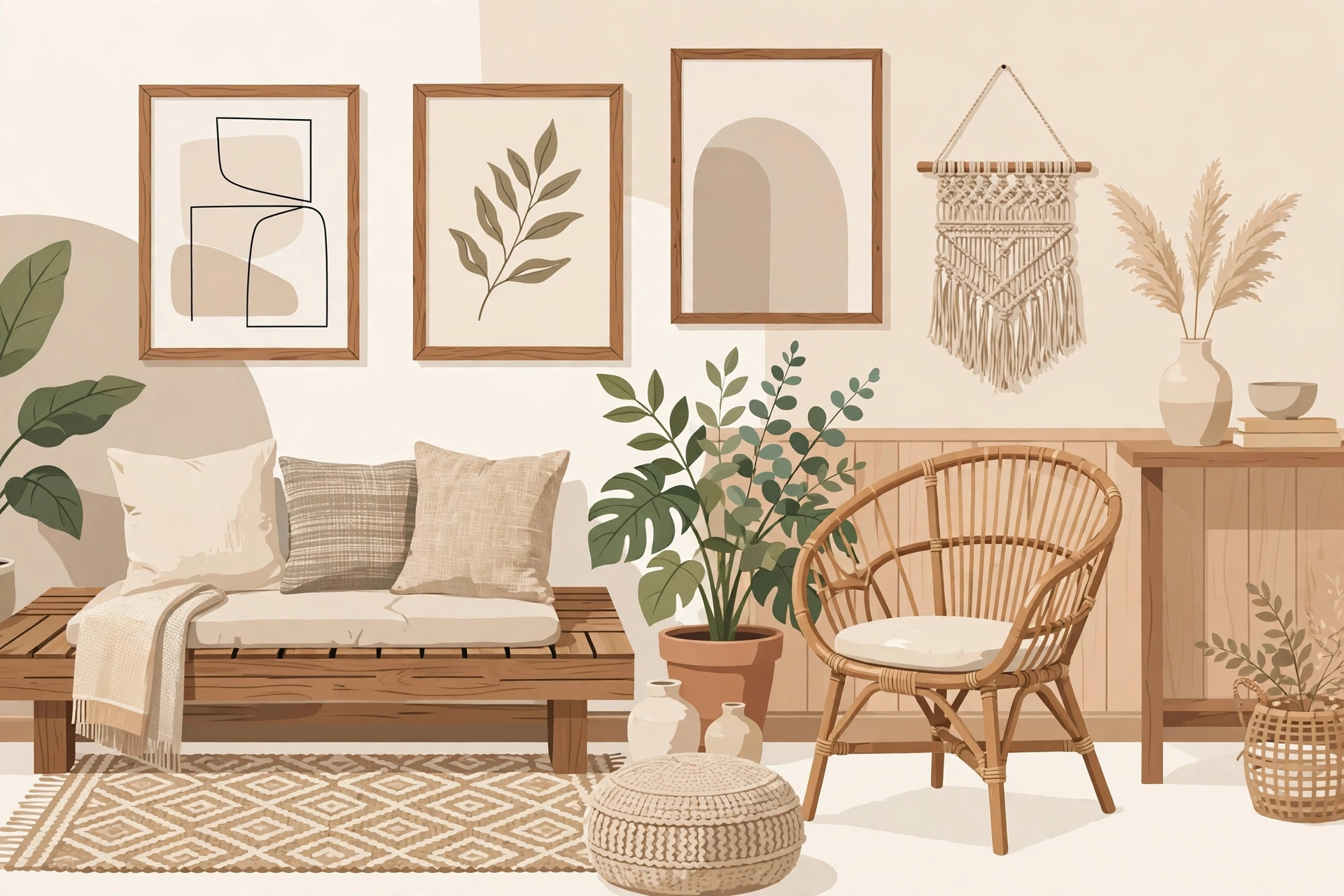
| Boho | Terracotta, mustard, deep green, rattan | Rattan chair, layered rugs, macrame, plants | $120–$280 |
| Mid-century modern | Walnut, orange, olive, cream | Tapered legs, walnut sideboard, sunburst or arc lamp | $200–$450 |
| Industrial | Charcoal, brick, black metal, leather | Metal shelving, Edison bulbs, leather sofa | $150–$400 |
| Traditional / transitional | Navy, cream, brass, rich wood | Upholstered armchair, brass lamp, framed art | $200–$450 |
Starter budget means steering one living room with textiles, paint, lighting and thrifted accents — not a new sofa. Our Japandi living room on a budget guide shows the same palette-first approach in detail.
Which Style Fits a Small Room?
Small rooms punish clutter and dark, heavy furniture, so the calm styles have a natural advantage. Scandinavian and Japandi work well because pale walls, low furniture and one rug that reaches under the sofa’s front legs make the floor read as larger. Our paint colors for small rooms guide lists warm whites that keep that effect without turning clinical, and our living room rug size guide covers the exact rug dimensions for common layouts.
That does not rule out the warmer styles. Boho and farmhouse can work in a small room if you keep one rule: one statement texture per surface. A rattan chair plus a woven rug plus a macrame hanging is plenty; add a patterned throw, a patterned cushion and a patterned curtain and the room tips from collected into crowded. In a room under 120 square feet, pick two of the three — rug, wall hanging, cushions — and keep the third plain.
Industrial and traditional are the hardest in small rooms, because both rely on visual weight: dark metal, heavy leather, large framed art. If you love them, use them as an accent style instead — black metal shelf brackets, a brass lamp, one leather chair — rather than the whole room.
How to Mix Two Styles Without a Mess
Mixing is where most beginners go wrong, and the fix is a simple ratio: 70 percent dominant style, 30 percent supporting style. A Japandi room with a boho rattan chair still reads as Japandi, because the palette, the low furniture and the empty surfaces stay Japandi. A room that is half Japandi and half farmhouse, with equal amounts of both, reads as undecided.
Keep the palette shared. Two styles mix cleanly when they agree on at least two colors — for example, cream and light wood work for Scandinavian, Japandi, farmhouse and boho alike, so pieces can cross over without clashing. What breaks a mix is usually not the furniture shape but a color that belongs to only one style, like a bright farmhouse red in a muted Japandi room.
Repeat the supporting style at least twice. One lone boho basket in a minimalist room looks like a mistake; the same basket plus a woven throw looks intentional. Our minimalist living room guide and our boho bedroom ideas show both ends of that spectrum, and the same repetition rule works in either direction.
Start With $150: A Style Starter Kit
Instead of shopping by style name, shop by layer. These five purchases, at typical US thrift, discount and big-box prices, move almost any living room visibly toward a chosen style for about $150 total:
| Layer | Typical cost | What to choose for your style |
|---|---|---|
| Cushion covers (set of 4) | $24–$36 | Linen in your palette; patterned only for boho or farmhouse |
| Throw blanket | $18–$28 | Chunky knit for Scandinavian; waffle cotton for Japandi; plaid for farmhouse |
| One large plant or tall faux stem | $20–$35 | Olive or eucalyptus for Japandi; trailing pothos for boho; fiddle-leaf style for modern |
| Warm bulbs (2700K, pack) | $10–$15 | Warm light suits every style here except crisp modern, which tolerates 3000K |
| One thrifted accent: vase, tray or basket | $12–$25 | Light wood for Japandi; ceramic for traditional; metal for industrial |
| Total | $84–$139 | Leave the remaining $10–$65 for a second plant or a framed print |
Live with that kit for two weeks before buying furniture. If the room still feels wrong, the problem is usually the palette — the wall color or the rug — not a missing chair. Our farmhouse decor on a budget guide uses the same layer-first order.
Common Mistakes Beginners Make
Buying a matching set. A sofa, loveseat and chair in the same fabric, plus a matching coffee table set, reads like a showroom floor. Mixed pieces in a shared palette look collected and cost less, because thrifted and sale pieces can join gradually.
Copying a photo instead of a palette. Inspiration photos use specific light, room sizes and camera angles. Copy the palette and the proportions — rug size, art height, furniture scale — and let your own room supply the rest. A style that needs a 10-foot ceiling will not fit a 8-foot one, no matter how exact the shopping list.
Changing everything at once. A room changed in one weekend usually has three competing ideas in it, because there was no time to see what worked. Change the textiles first, live with them, then change lighting, then art. Slow decorating is not indecision; it is how a room ends up coherent.
Ignoring the floor. The rug and the flooring set the room’s color temperature more than any cushion. A cool grey rug under warm farmhouse furniture will fight the whole room. If you can only change one large surface, change the rug, not the sofa.
Key takeaways: Pick your style by answering the three questions — calm or layered, warm or cool, and what you already own — then test it with a $150 textile-and-lighting kit before buying furniture. Keep one dominant style at about 70 percent, share at least two palette colors with any supporting style, and repeat that supporting style twice so it looks deliberate. Small rooms favor the calm styles, but any style works as an accent if its colors agree with the room.