A living room focal point is the one feature your eye lands on first when you walk into the room, and the feature the seating is arranged to face. When a room has one, everything else falls into place: the sofa has a direction, the rug has a centre, and the art has a home. When a room has none, furniture drifts to the walls and the space feels restless. When a room has three competing focal points, it feels noisy. This guide shows how to find the focal point your room already has, size it correctly with real measurements, settle the fireplace-versus-TV argument, and style it for under $150.
What Is a Living Room Focal Point?
A focal point is not the biggest object in the room or the most expensive one. It is the feature that organises the layout. Designers describe it as visual hierarchy: the eye goes to the focal point first, then to the supporting pieces around it, then to the background. The usual candidates are a fireplace, a large window or view, a television wall, a statement piece of art, built-in shelving, or a striking piece of furniture such as a bold sofa.
The focal point matters because it answers the only layout question that counts: which way does the seating face? A sofa facing a fireplace creates a conversation room. A sofa facing a television creates a viewing room. A sofa facing a window creates a room for light and looking out. Each is valid, but a room can only do one of them well at a time. Picking the focal point is therefore picking what the room is for, and every later decision, from rug size to lamp placement, follows from that choice.
Find the Focal Point Your Room Already Has
Before buying or building anything, run the doorway test. Stand in the main entrance and notice what your eye goes to first without trying. Then sit in the seat you use most and notice the same thing. If both answers agree, the room already has a focal point, and the job is to strengthen it rather than invent one. Fireplaces, large windows and chimney breasts usually win this test, because size, light and position all pull the eye toward them.
If the two answers disagree, or if nothing stands out, check the room’s fixed facts before choosing. Measure the length and width, mark the doors and their swing, the windows, and the walkways between them. A main walkway needs 30 to 36 inches of clear width, and the focal wall should not sit across a walkway, or people will cross in front of the seating all evening. The focal point should be visible from the doorway and from the main seat at the same time. If it is visible from only one of those places, the room will feel as if it has its back to whoever walks in.
Daily use decides between equal candidates. A household that watches television most evenings should treat the TV wall as the focal point, even if the fireplace is prettier. A household that entertains should favour the fireplace or the window. Honesty here saves money: styling a fireplace the household never sits near is decoration for a room nobody uses.
Focal-Point Size Maths: Art, TV and Fireplace Rules
Most focal points fail on size, not taste. Art that is too small over a sofa, a television hung too high, and a mantel crowded with small objects all make the focal point feel weak, and the fix is measurement rather than more spending. The table below covers the three most common focal types.
| Focal point | Size rule | Height rule |
|---|---|---|
| Artwork above a sofa | Two-thirds of the sofa width (an 84-inch sofa takes 56 inches of art) | Centre 57 to 60 inches from the floor; 6 to 8 inches above the sofa back |
| Television | Viewing distance 1.5 to 2.5 times the screen diagonal (a 55-inch TV suits 7 to 11 feet) | Centre of the screen at seated eye level, about 42 inches from the floor |
| Mantel styling | One anchor piece two-thirds of the mantel width; two smaller objects flanking it | Anchor art 4 to 6 inches above the mantel; nothing taller than one-third of the wall above it |
| Gallery wall as focal point | Span two-thirds of the furniture below it | Centre of the whole group 57 to 60 inches from the floor |
| Window or view | Curtains hung 4 to 6 inches above the frame and 3 to 6 inches wider each side | Curtain rod 4 to 6 inches above the window frame |
The television rule deserves a closer look, because it is the most commonly broken. A 55-inch screen measured diagonally suits a sofa 7 to 11 feet away; closer than 7 feet and the screen dominates the room, further than 11 feet and the picture feels small. The centre of the screen should sit at about 42 inches from the floor, which is seated eye level for most adults. Mounting a television above a fireplace usually puts its centre at 60 inches or higher, which is why that arrangement so often feels uncomfortable to watch, however tidy it looks.
Fireplace vs TV: When Two Focal Points Compete
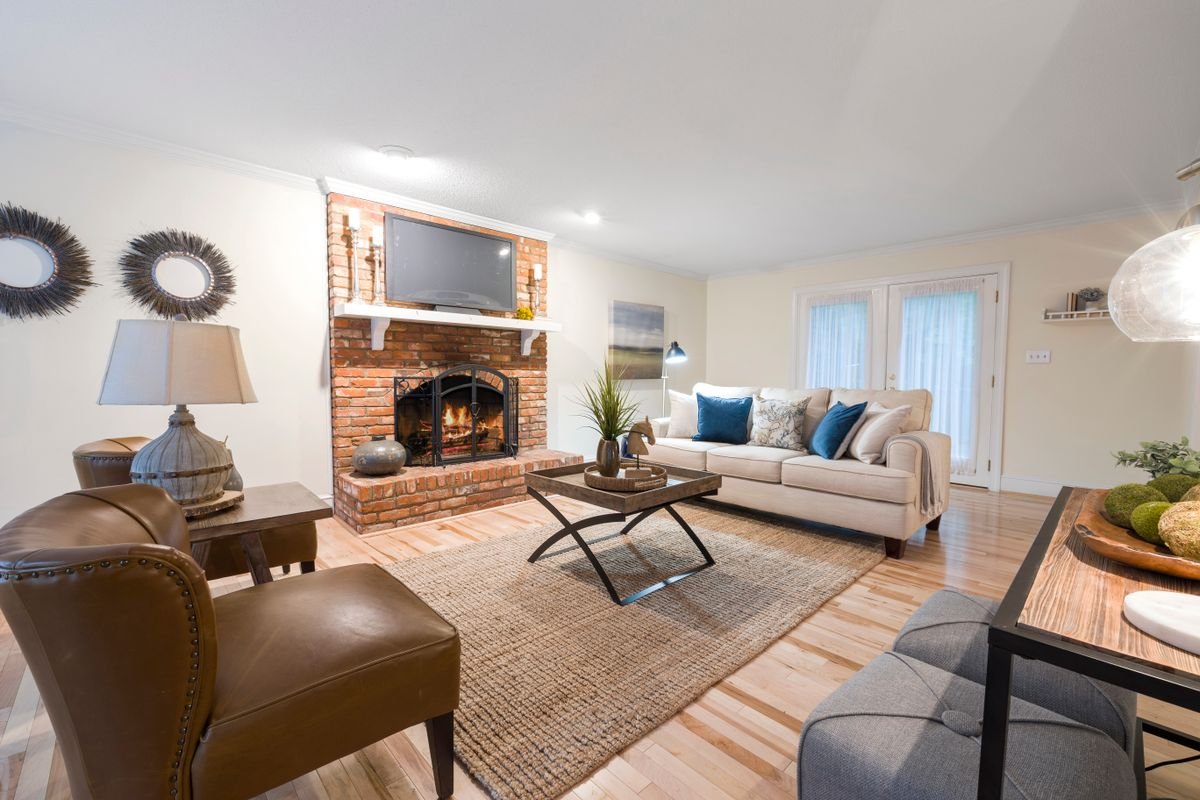
The most common focal-point problem in American living rooms is a fireplace on one wall and a television on another, pulling the seating in two directions. The solution is a decision, not a compromise, because a sofa cannot face two walls at once.
Choose the fireplace as the primary focal point when the room is used mainly for conversation, reading or entertaining, and when the fireplace sits on the wall opposite the main entrance, where it is visible on arrival. Arrange the sofa to face it, place the television on a side wall at a 45-degree angle if it must stay in the room, and keep the screen small enough not to compete: under 50 inches in a room under 200 square feet. For mantel styling that supports rather than crowds the fireplace, see Fireplace Mantel Decor.
Choose the television as the primary focal point when the room is used mainly for viewing, and when the fireplace is small, decorative or rarely lit. In that case, treat the fireplace as a secondary feature: style its mantel quietly, keep the seating angled 10 to 20 degrees toward the screen rather than squared to the fireplace, and let the television wall carry the room’s strongest colour or texture. A room that tries to give both features equal weight ends up with seating angled at nothing, which is the layout that feels wrong even when every individual piece is attractive.
Rooms with no architectural feature at all need a created focal point, and the cheapest is a single oversized piece of art or a mirror over the sofa, sized by the two-thirds rule above. A 48-by-36-inch canvas over an 84-inch sofa costs $60 to $120 from a discount retailer and does the same organising work as a fireplace. For the seating distances that make a focal-point layout comfortable, see Living Room Conversation Area Layout.
How Much Does Each Focal Point Cost to Style?
Styling a focal point is mostly editing, not shopping, and the budgets below assume the main feature already exists. The most expensive item in every case is the anchor piece, and it is the only item worth spending real money on.
| Focal point type | What to buy | Budget |
|---|---|---|
| Fireplace | One anchor art piece or mirror, two vases, a pair of sconces or candles | $90 to $150 |
| Artwork wall | One oversized canvas or framed print, two picture lights or a floor lamp | $80 to $140 |
| Television wall | Low media console, cable management, two small plants, bias lighting strip | $70 to $130 |
| Window or view | Curtain rod, full-length curtains, one low plant | $60 to $110 |
| Built-in shelving | Bookends, three storage baskets, editing (removing half the objects) | $40 to $80 |
Lighting is the cheapest way to strengthen a focal point. A $15 picture light over art, a $20 LED strip behind a television, or a pair of $25 sconces flanking a fireplace each make the focal point brighter than its surroundings, which is exactly what the eye follows. Spend on light before spending on objects.
Common Mistakes That Kill a Focal Point
The first mistake is having two focal points of equal strength, usually a fireplace and a television on opposite walls. The seating cannot face both, so it faces neither properly. Pick one primary feature and quiet the other.
The second mistake is art that is too small. A 24-inch print over an 84-inch sofa looks lost, and adding more small frames around it rarely fixes the problem. One piece at two-thirds of the sofa width beats five small ones every time.
The third mistake is hanging art too high. The centre of a focal-point artwork should sit at 57 to 60 inches from the floor. Art hung at 70 inches or higher floats above the furniture and disconnects from the seating it is meant to anchor.
The fourth mistake is crowding the mantel. More than five objects on a mantel, or objects of similar height in a straight line, flatten the focal point into a shelf. One tall anchor, two shorter flanking pieces and empty space between them is the arrangement that works.
The fifth mistake is ignoring the walkway. A focal-point layout that puts the coffee table or an accent chair across the main route through the room will be rearranged within a week, usually badly. Keep 30 to 36 inches clear on the main path, even if that means the seating sits slightly off-centre from the focal wall.
Key takeaways: Pick one focal point that matches how the room is actually used, and let the seating face it. Size it by the numbers: art at two-thirds of the sofa width with its centre 57 to 60 inches high, a TV 1.5 to 2.5 times its diagonal away from the sofa, and a mantel with one anchor plus two flanking pieces. When a fireplace and a television compete, choose one and quiet the other. Lighting does more than objects, and a focal point can be styled well for $60 to $150.
A living room focal point is a decision more than a purchase. Find the feature the room already offers, check it against the doorway test and the walkway measurements, size it by the table above, and remove whatever competes with it. Rooms that follow that order feel settled the first evening, and they stay settled, because nothing in them is fighting for attention.