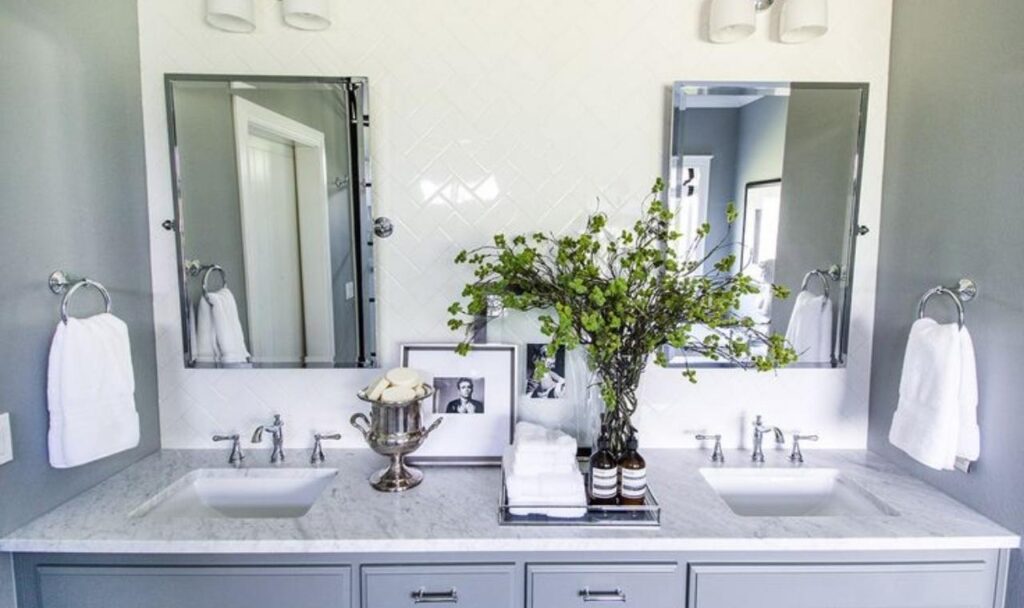
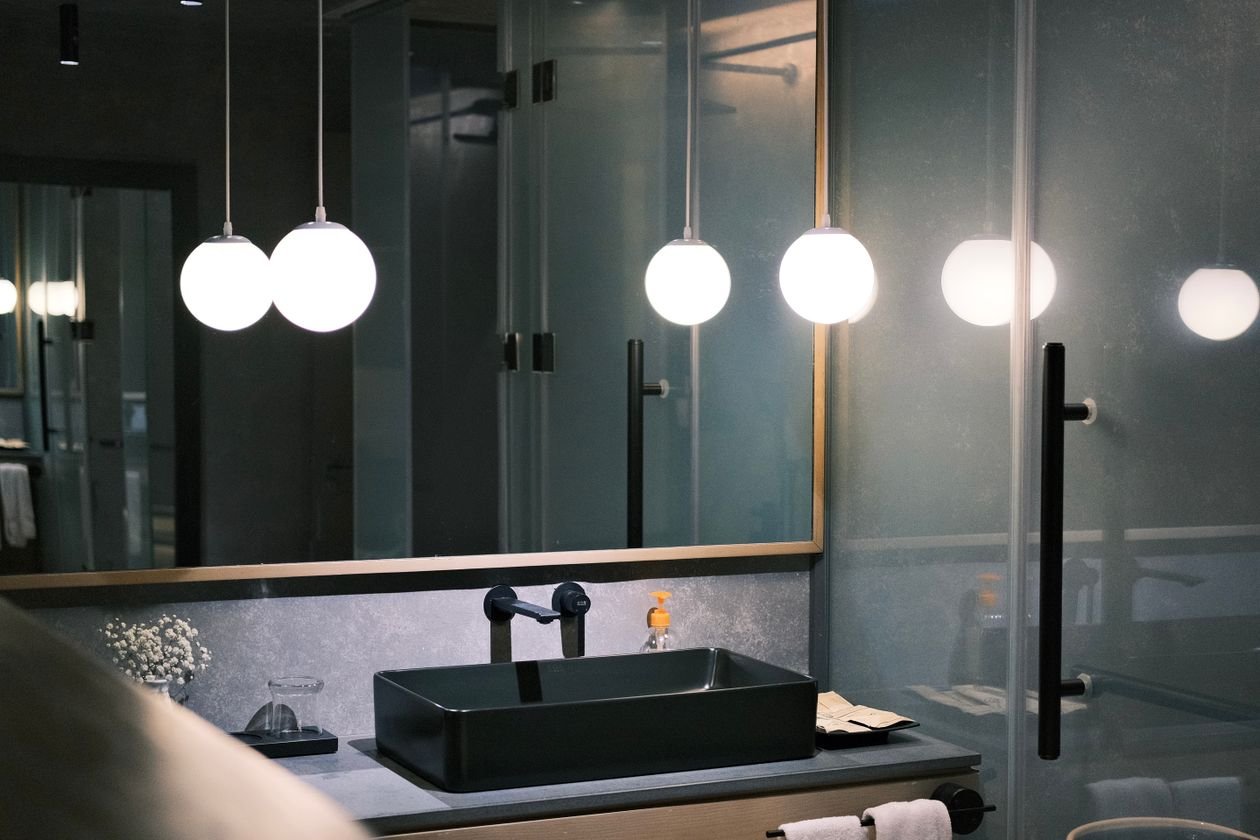
A bathroom pendant can be the best light in the house or the most annoying one, and the difference is usually two inches. Hang it too low and the shade crowds the mirror, throws shadows across your face and blocks the view across the room. Hang it too high and it lights the ceiling while your face stays in shadow, which defeats the whole point of a vanity light. The right height is not a guess, and it is not one number either. It shifts with the ceiling height, the vanity width and the size of the shade, and this guide works through all three in order, with the measurements and the budget to match.
| What you are paying for | Typical cost | Notes |
|---|---|---|
| Single pendant fixture | $40 to $180 | Glass or open-frame shades sit at the low end; brass and artisan shades run higher |
| Pair of pendants | $80 to $360 | Buy a matched pair — mixing shades is the fastest way to make a vanity look lopsided |
| Simple fixture swap (existing wiring) | $100 to $250 | Electrician labour only, same junction box |
| New wiring, one pendant | $300 to $450 | New junction box and cable run |
| New wiring, a pair | $400 to $600 | Two junction boxes, one switch |
| Dimmer switch | $25 to $60 | Worth it in every bathroom — see the brightness section below |
Read the table as a total, not a menu. A pair of mid-range pendants over a double vanity, replacing an existing bath bar, usually lands between $250 and $600 all in. The same pair in a bathroom with no existing vanity wiring runs $500 to $950 once the electrician has opened the wall. Knowing which side of that line your bathroom sits on is the first decision, and it is made before buying a single fixture.
The Short Answer: 30 to 36 Inches Above the Counter
Hang the bottom of the pendant shade 30 to 36 inches above the vanity countertop. That is the rule almost every lighting guide agrees on, and it is the number to start from. On a standard 32-to-36-inch-high vanity, that puts the bottom of the shade roughly 62 to 72 inches from the floor, which is at or just above eye level for most adults. The light lands on the face instead of the forehead, the shade stays out of the sightline across the room, and the mirror stays fully usable.
Measure from the countertop, not from the ceiling. Ceiling height varies, counter height barely does, so the counter is the stable reference point. Hold the tape at the counter surface, mark 30 inches and 36 inches on the wall or mirror with painter’s tape, and stand at the vanity. If the lower mark feels like the shade would block your view of the mirror, move toward the upper end of the range. If the upper mark makes the pendant feel like it is floating disconnected from the vanity, drop toward the lower end. The right spot inside the range is the one where you can see your whole face in the mirror without the shade entering the frame.
How High Should Bathroom Pendant Lights Hang?
The 30-to-36-inch rule assumes an 8-foot ceiling, which is what most bathrooms have. Higher ceilings stretch the drop, and the adjustment is simple: add 3 inches of drop for every extra foot of ceiling height beyond 8 feet. A 9-foot ceiling takes the bottom of the shade to 33 to 39 inches above the counter; a 10-foot ceiling takes it to 36 to 42 inches. The pendant should look like it belongs to the room, not like it is dangling from a distant ceiling or hovering just above the taps.
| Ceiling height | Bottom of shade above counter | Bottom of shade above floor (36-inch vanity) | Cord or rod drop from ceiling |
|---|---|---|---|
| 8 feet | 30 to 36 inches | 66 to 72 inches | 24 to 30 inches |
| 9 feet | 33 to 39 inches | 69 to 75 inches | 33 to 39 inches |
| 10 feet | 36 to 42 inches | 72 to 78 inches | 42 to 48 inches |
Two warnings sit inside that table. First, if the ceiling is under 8 feet, pendants are usually the wrong choice. The drop leaves the shade at forehead height, and there is no comfortable position that both lights the face and clears the head. In a low-ceiling bathroom, wall sconces or a lighted mirror do the same job better — for the sconce heights that work, see Bathroom Vanity Styling: Small Touches, Big Difference. Second, the centre of the shade is a different number from the bottom of the shade, and some guides quote one while others quote the other. If a guide says the centre of the shade should sit 60 to 66 inches from the floor, that is the same position as a bottom edge at roughly 66 to 72 inches for a typical 10-to-12-inch-tall shade. Compare like with like before concluding two guides disagree.
How Many Pendants Does Your Vanity Need?
One pendant suits a single-sink vanity up to about 36 inches wide. Two pendants suit a double vanity, or a single vanity wider than 42 inches. Three pendants almost never suit a bathroom vanity — the spacing gets so tight that the shades read as clutter, and the light overlaps instead of spreading. When in doubt, go with fewer, larger shades rather than more, smaller ones.
Spacing is measured centre to centre. For a pair, keep the centres 28 to 30 inches apart, and centre the pair on the vanity, not on the mirror. On a double vanity, centre each pendant over its own sink basin, which usually lands the pair 28 to 30 inches apart anyway. The outer edge of each shade should stop at least 4 inches short of the edge of the mirror, so the shade never overlaps the glass and never throws a hard line of shadow across it.
| Vanity width | Pendants | Shade diameter each | Centre-to-centre spacing |
|---|---|---|---|
| 24 inches (single) | 1 | 6 to 8 inches | Centred over the sink |
| 30 inches (single) | 1 | 8 to 10 inches | Centred over the sink |
| 36 inches (single) | 1 | 10 to 12 inches | Centred over the sink |
| 48 inches (double) | 2 | 8 to 10 inches | 28 inches |
| 60 inches (double) | 2 | 10 to 12 inches | 30 inches |
| 72 inches (double) | 2 | 10 to 12 inches | 30 inches |
Worked example: a 60-inch double vanity with a 48-inch mirror. Two 10-inch shades, centres 30 inches apart, puts the centre of each shade 15 inches either side of the vanity centreline, which lands each one directly over a basin. The outer edges of the shades sit 20 inches from the vanity centreline, well inside the 24-inch half-width of the mirror. Nothing overlaps, nothing crowds, and each person gets their own light.
Sizing the Shade: Diameter and Drop
Shade diameter follows the mirror, not the room. A good rule is that the shade should be about one-third the width of the mirror, and never wider than half of it. A 36-inch mirror takes a 10-to-12-inch shade; a 48-inch mirror takes a pair of 10-inch shades; a 24-inch mirror takes a single 8-inch shade. Go bigger and the pendant dominates the mirror. Go smaller and it reads as a detail that was added by accident.
Shade shape matters as much as size. Glass, open-frame and drum shades with a diffused or open bottom throw light sideways and down, which is what a face needs. Solid metal shades throw light straight down only, which lights the counter and leaves the face in shadow — the exact problem a vanity light is supposed to solve. If the shade you love is solid metal, pair it with a second light source, such as sconces or a lighted mirror, rather than relying on the pendant alone. And keep the shade depth in mind: a pendant that sticks out more than 6 inches from the wall can bump a forehead when someone leans toward the mirror.
How Bright Should a Bathroom Pendant Be?
Plan for 400 to 800 lumens per pendant, which is roughly the output of a 40-to-60-watt equivalent LED bulb. A single pendant over a small vanity wants the upper end of that range; a pair over a double vanity can sit at the lower end each, because the two sources add up. Choose a colour temperature of 2700K to 3000K — warm white that flatters skin without turning it yellow. Anything above 4000K looks clinical and makes every blemish sharper than it is.
Put the pendants on a dimmer. Morning grooming wants full brightness; a late-night bathroom visit wants a quarter of it. A dimmer costs $25 to $60 and is the single best upgrade in this whole project, because it turns one fixed light into a light that fits the time of day. Check that the bulbs are dimmable before buying — non-dimmable LEDs on a dimmer flicker, buzz or simply refuse to dim. For the general brightness numbers behind these figures, see How Many Lumens Per Room? A Practical Lighting Guide.
Damp Ratings and the Water Zones
Bathrooms are wet rooms, and the rating on the fixture is not decoration. A fixture in the general vanity area, away from direct water, needs a damp-location rating. A fixture inside the shower enclosure, directly above a bathtub, or within 3 feet horizontally and 8 feet vertically of a tub or shower needs a wet-location rating. Most decorative pendants are damp-rated at best, which is fine over a vanity and not fine over a tub.
Check the rating on the box or the listing before buying, not after installing. A pendant hung over a freestanding tub needs at least 8 feet of clearance between the bottom of the fixture and the top of the tub, and in practice that rules out pendants over most tubs in standard-height bathrooms. If the pendant will sit anywhere near steam — a small bathroom with a weak extractor fan, for example — choose a damp-rated fixture even if the position technically only requires a dry rating. Moisture finds the gap between the rule and the room.
Should You DIY or Hire an Electrician?
Swapping an existing pendant or bath bar for a new pendant, using the same junction box, is a straightforward DIY job for anyone comfortable turning off a breaker and matching three wires. Budget $100 to $250 if you hire it out, and an afternoon if you do it yourself. Running new wiring — a new junction box in the ceiling, a cable run through the wall, a second box for a pair — is electrician work in most jurisdictions, and the $300 to $600 in the table above is money well spent. Bathroom circuits also need GFCI protection, and if the circuit serving the vanity is not GFCI-protected, that is a job for a licensed electrician regardless of the fixture.
One planning tip saves real money: if a bathroom renovation is on the horizon, have the electrician rough in junction boxes for pendants during the renovation, even if the fixtures are not being installed yet. Adding a box during construction costs a fraction of retrofitting one through finished tile and drywall, and it keeps every option open.
Renter-Friendly Pendant Options
Renters can get the pendant look without touching the wiring. A plug-in pendant — sometimes sold as a swag light — hangs from a ceiling hook and plugs into a wall outlet, with the cord draped along the ceiling or hidden in a cord cover. A pair of plug-in pendants over a vanity, hung at the same 30-to-36-inch height and plugged into a switched outlet, gives the same light as a hardwired pair for $60 to $150 total, and it all comes down again on moving day.
Where even a ceiling hook is not allowed, two workarounds still help. Battery-powered puck lights with a warm 3000K bulb, stuck inside a decorative shade or under a shelf above the mirror, add fill light for $15 to $30. And a pair of plug-in wall sconces on either side of the mirror, at 60 to 66 inches from the floor, gives the flattering side light that a single overhead pendant cannot. Neither is a perfect substitute for a hardwired pendant, but both beat a bare overhead bulb, which is the light most rental bathrooms come with.
Bathroom Pendant Light Height FAQs
How high should a pendant light hang over a bathroom vanity?
Hang the bottom of the shade 30 to 36 inches above the vanity countertop. On a standard 32-to-36-inch vanity, that is roughly 62 to 72 inches from the floor. Add 3 inches of drop for every extra foot of ceiling height beyond 8 feet.
How far apart should two bathroom pendants be?
Space a pair 28 to 30 inches apart, measured centre to centre, and centre the pair on the vanity. On a double vanity, centre each pendant over its own sink basin. Keep the outer edge of each shade at least 4 inches inside the edge of the mirror.
Can pendant lights go in a bathroom with an 8-foot ceiling?
Yes, an 8-foot ceiling is the standard case for bathroom pendants — the 30-to-36-inch rule was written for it. Below 8 feet, pendants usually hang too low to clear the head comfortably, and sconces or a lighted mirror are the better choice.
Do bathroom pendants need to be damp-rated?
Fixtures in the general vanity area need a damp-location rating. Fixtures inside a shower, above a bathtub, or within 3 feet horizontally and 8 feet vertically of a tub or shower need a wet-location rating. Check the rating before buying, not after installing.
What size pendant works over a 36-inch vanity?
One pendant with a 10-to-12-inch shade, centred over the sink. The shade should be about one-third the width of the mirror. For a 36-inch mirror, that is a 12-inch shade at the largest, and a 10-inch shade is the safer, better-proportioned choice.
The number to remember is 30 to 36 inches above the counter, measured from the countertop, with 3 extra inches of drop for every foot of ceiling above 8 feet. Size the shade to one-third of the mirror, space a pair 28 to 30 inches apart, and put the whole thing on a dimmer. Get those four decisions right and the pendant stops being a decoration that happens to give off light and becomes the best light in the bathroom.