
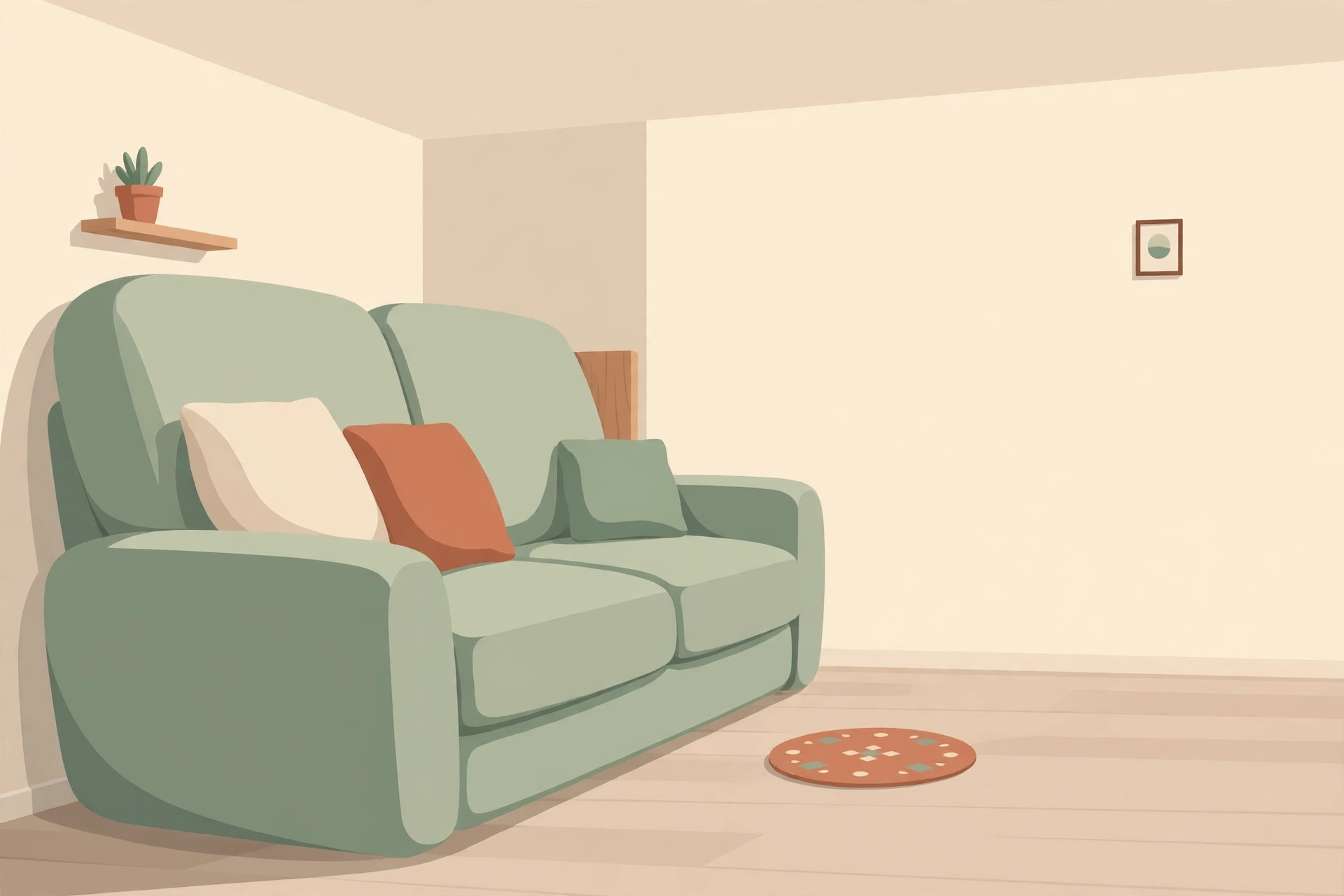
A room can have good furniture, good paint, and good light — and still feel wrong. Most of the time, the problem is scale: a piece that is too big for the room, too small for the wall, or out of proportion with the furniture next to it. Scale mistakes are expensive because you usually only notice them after delivery, and frustrating because the furniture itself is not the problem. The fit is.
The fix is almost always a tape measure, not a new credit card. Every mistake below has a right size attached to it, and most can be corrected by moving a piece, swapping one item, or choosing differently next time. Run the three-number check first, then match your room against the seven mistakes.
Quick answer: Most scale mistakes come down to three numbers: 30 to 36 inches for main walkways, a sofa no longer than two-thirds of its wall, and 14 to 18 inches between sofa and coffee table. A rug should reach under every seat’s front legs, and art should span 60 to 75 percent of the furniture below it.
How Do You Check Scale Before You Buy?
Three numbers decide whether a piece fits before it ever enters the house. First, the wall: a sofa should take up no more than about two-thirds of the wall behind it, so a 12-foot wall (144 inches) points to a sofa up to about 96 inches long. Second, the walkway: keep 30 to 36 inches clear for main paths through the room, and at least 24 inches for secondary paths. Third, the gap: leave 14 to 18 inches between the front of the sofa and the coffee table, close enough to reach a drink and far enough to stretch your legs.
Then tape it out. Mark the full footprint of the piece on the floor with painter’s tape — length and depth, including a chaise or corner — and live with the outline for a day. Walk around it, open the doors, pull out a chair. If the taped outline leaves narrow corridors or crowds the furniture that is already there, the piece is too large. If it looks lost in the space, it is too small. Finally, measure the delivery route: every door, hallway turn, and stair landing between the street and the room. A sofa that fits the room still has to fit through a 30-inch interior door, and the delivery path is the check most buyers skip.
7 Furniture Scale Mistakes (and the Right Size for Each)
1. Buying the biggest sectional that fits
Fitting is not the same as working. A 110-inch sectional can physically squeeze along one wall and still ruin the room: it blocks the natural path through the space, the chaise cuts across the walkway, and every other piece looks like an afterthought. The right size is the two-thirds rule — on a 12-foot wall, an 84- to 90-inch sofa plus an accent chair seats the same number of people and leaves 30 to 36 inches of walkway. If the oversized sectional is already yours, float it off the wall, remove a chaise section if it is modular, or sell it and downsize; a replacement three-seater in the $600 to $1,200 range usually costs less than the returns and repairs of living with the wrong one.
2. A rug that floats in the middle of the floor
A 5-by-7 rug under an 8-foot sofa reads like a postage stamp: it chops the seating group into disconnected islands and makes the whole room look smaller than it is. The right size is an 8-by-10 rug for a standard seating group, large enough that the front legs of every seat rest on it, with 8 to 18 inches of bare floor visible around the edges. In a small room, a 6-by-9 can work if it still reaches under the front legs. Our living room rug size guide has the exact rug dimensions for every common layout.
3. A coffee table that is too small — or too far away
A 30-inch coffee table beside an 84-inch sofa looks lost, and a table pushed 24 inches out is too far to use. The right size follows the same two-thirds rule: a coffee table should be roughly two-thirds the length of the sofa, so about 56 inches for an 84-inch sofa, with its height within 2 inches of the seat height — usually 16 to 18 inches. Keep the gap at 14 to 18 inches; closer than 14 and knees hit the table, farther than 18 and nobody reaches their drink. Our sofa to coffee table distance guide covers the spacing for sectionals and small rooms too.
4. Art that gets lost on the wall
A single small frame centered over a wide sofa looks like an afterthought, and it makes the sofa look bigger than it is by comparison. The right size is art that spans 60 to 75 percent of the width of the furniture below it — a 48- to 60-inch piece over an 84-inch sofa — hung with its center at 57 to 60 inches off the floor, which is average eye level. If the art you own is small, group three or four smaller frames into one larger shape with 2 to 3 inches between them; the group reads as one piece and costs nothing.
5. Everything pushed flat against the walls
Lining every sofa, cabinet, and chair up against the walls leaves a dead, empty center and makes the room feel like a waiting area. Pull the sofa 12 to 18 inches off the wall and float the seating inward, anchored by a rug, and the same furniture suddenly defines a room instead of edging it. In a room under 10 feet wide there may not be space to float the sofa — keep it on the wall and float the accent chairs instead, which gives the same effect without blocking the walkway.
6. A bed that eats the bedroom
A king bed is 76 inches wide, so in a 10-by-10 bedroom it leaves only 22 inches of walking space on each side — well short of the 30-inch comfortable minimum — and the room becomes a bed with walls. The right size keeps at least 30 inches clear on each side of the bed: a queen (60 inches wide) in a 10-by-12 room leaves exactly 30 inches per side, and a full (54 inches) is the honest choice for a 10-by-10. Measure the room before upgrading the mattress, because a bigger bed is the one purchase that cannot be fixed by rearranging.
7. Every piece the same height
When the sofa back, the console, the art, and the curtain rod all land at one level, the room reads as a flat band, however good the individual pieces are. Vary heights deliberately: aim for at least 6 to 12 inches of difference between neighboring pieces, and hang curtains 4 to 12 inches above the window frame so they draw the eye up. Ceiling height matters too — rooms with 8-foot ceilings need low-profile furniture (sofas under 36 inches tall), while rooms with 9- or 10-foot ceilings need taller pieces and larger art, or the furniture looks dwarfed from below.
Fix It or Replace It? A Quick Decision Guide
Not every scale mistake needs a new purchase. Use this guide to decide what a fix actually costs before you start shopping.
| Mistake | Cheapest fix | Typical cost | Replace instead when |
|---|---|---|---|
| Oversized sofa or sectional | Float it, remove a modular section | $0 | Walkways stay under 30 in — budget $600–$1,200 for a smaller sofa |
| Rug too small | Layer a larger rug underneath | $80–$150 | The rug is under 5×7 in a full seating group — a right-size rug runs $150–$300 |
| Wrong coffee table | Move it closer, 14–18 in from the sofa | $0 | It is under half the sofa’s length — a right-size table runs $80–$200 |
| Art too small | Group small frames into one shape | $0–$40 | Nothing on hand spans 60% of the furniture — a larger print runs $40–$100 |
| Bed too big | Remove one nightstand to buy clearance | $0 | Side clearance stays under 24 in — downsizing the bed runs $400–$900 |
Frequently Asked Questions
How do I know if my furniture is the wrong scale for my room?
Check the clearances first. Main walkways under 30 inches, less than 14 inches between sofa and coffee table, or a single piece taking up more than about a third of the room’s floor area all signal a scale problem. So does a piece that dominates one wall while the rest of the room sits empty, or a piece that looks lost in open space.
What is the two-thirds rule for furniture?
It is a proportion rule that shows up everywhere: a sofa should take up about two-thirds of the wall behind it, a coffee table about two-thirds of the sofa’s length, and art about 60 to 75 percent of the width of the furniture below it. It keeps pieces related to each other instead of competing.
How big should a rug be under a sofa?
For a standard three-seat sofa, an 8-by-10 rug is the usual right size, with the front legs of every seat resting on it and 8 to 18 inches of bare floor around the edges. A 5-by-7 rug is too small for a full seating group; it works under a loveseat or a pair of chairs, not under an 8-foot sofa.
Can furniture be too small for a room?
Yes. A small sofa in a large room looks lost and makes the room feel sparse and echoey, even when the room is technically furnished. Fix it by upsizing the anchor piece or by creating a second furniture grouping — a reading chair with a small table in an empty corner — instead of scattering more small pieces around.
Does ceiling height change what size furniture I need?
Yes. Low 8-foot ceilings call for low-profile furniture, with sofa backs under 36 inches, or the room feels oppressive. High 9- or 10-foot ceilings need taller pieces and larger art, or the furniture looks dwarfed. The same sofa can look oversized in one room and undersized in another for this reason alone.
Scale is the cheapest design skill there is: a tape measure, three numbers, and ten minutes before you buy. Get the sizes right and even inexpensive furniture reads as calm and intentional. Get them wrong and even beautiful pieces fight the room. Measure the wall, the walkway, and the gap — then let the numbers, not the showroom, choose the furniture.

One Comment