You cannot unsee a floor you hate. The orange-toned laminate, the pinkish bathroom tile, the stained rental carpet — it sits under everything you own and quietly argues with every decorating choice you make. Replacing it is the obvious answer, and also the expensive one: new flooring installed runs $6 to $12 per square foot in most US markets, which puts even a single 12 by 12 room at $900 to $1,700 before trim and underlayment. Most people do not need a new floor. They need a plan that makes the existing one stop running the room.
The good news is that floors are the easiest surface in a house to camouflage, because you control everything above them. Rugs, furniture, wall color, and lighting all compete for the eye, and a floor only wins that competition when nothing else is doing its job. The seven fixes below work for renters and owners alike, and none of them requires permission, a contractor, or a weekend of demolition.
Cover It or Work With It? The 30-Second Decision
Before buying anything, decide which of two strategies fits your floor, because they pull in opposite directions. Covering works best when the floor’s problem is pattern or damage — stained carpet, scratched laminate, a busy tile pattern that clashes with everything. Working with it works best when the problem is color: a floor in a shade you dislike but that is otherwise in good condition.
Here is the quick test. Stand at the doorway and look at the room for ten seconds. If your eye keeps landing on stains, scratches, or a pattern that fights the furniture, cover it. If your eye lands on a color that simply feels wrong — too orange, too pink, too yellow — work with it, because a floor you coordinate with stops looking like a mistake and starts looking like a choice. Many rooms need a little of both: a rug over the worst patch, and color coordination for the rest. Pick your main strategy first, and spend your budget there.
What Size Rug Actually Hides a Floor?
A rug that is too small is worse than no rug at all, because it frames the ugly floor around its edges like a picture mat. The rule is simple: the rug should be large enough that the front legs of every seat in the conversation area sit on it. For a standard sofa and two chairs, that usually means an 8 by 10 foot rug in a living room, or 9 by 12 if the room is larger than 14 feet wide. In a bedroom, the rug should extend at least 18 to 24 inches beyond each side of the bed, so your feet land on rug, not on the floor you dislike.
Measure before you shop, and tape the outline on the floor with painter’s tape first. A taped rectangle costs nothing and prevents the most common rug mistake in decorating: buying a 5 by 7 rug for a room that needs an 8 by 10. For covering carpet you dislike, choose a low-pile rug with a non-slip pad underneath; a thick pad stops the top rug from creeping and adds the cushioning the old carpet used to provide. A good 8 by 10 rug costs $120 to $250 at discount retailers, and a quality rug pad adds $30 to $50. For guidance on choosing the right size for your specific layout, see our living room rug size guide.
How to Use Color to Make a Floor Disappear
When the floor’s color is the problem, the fix is not to fight it but to repeat it. A color that appears only once in a room reads as an accident. The same color appearing three times reads as a deliberate palette. This is the oldest trick in decorating, and it works on floors because the floor is the largest color block in the room.
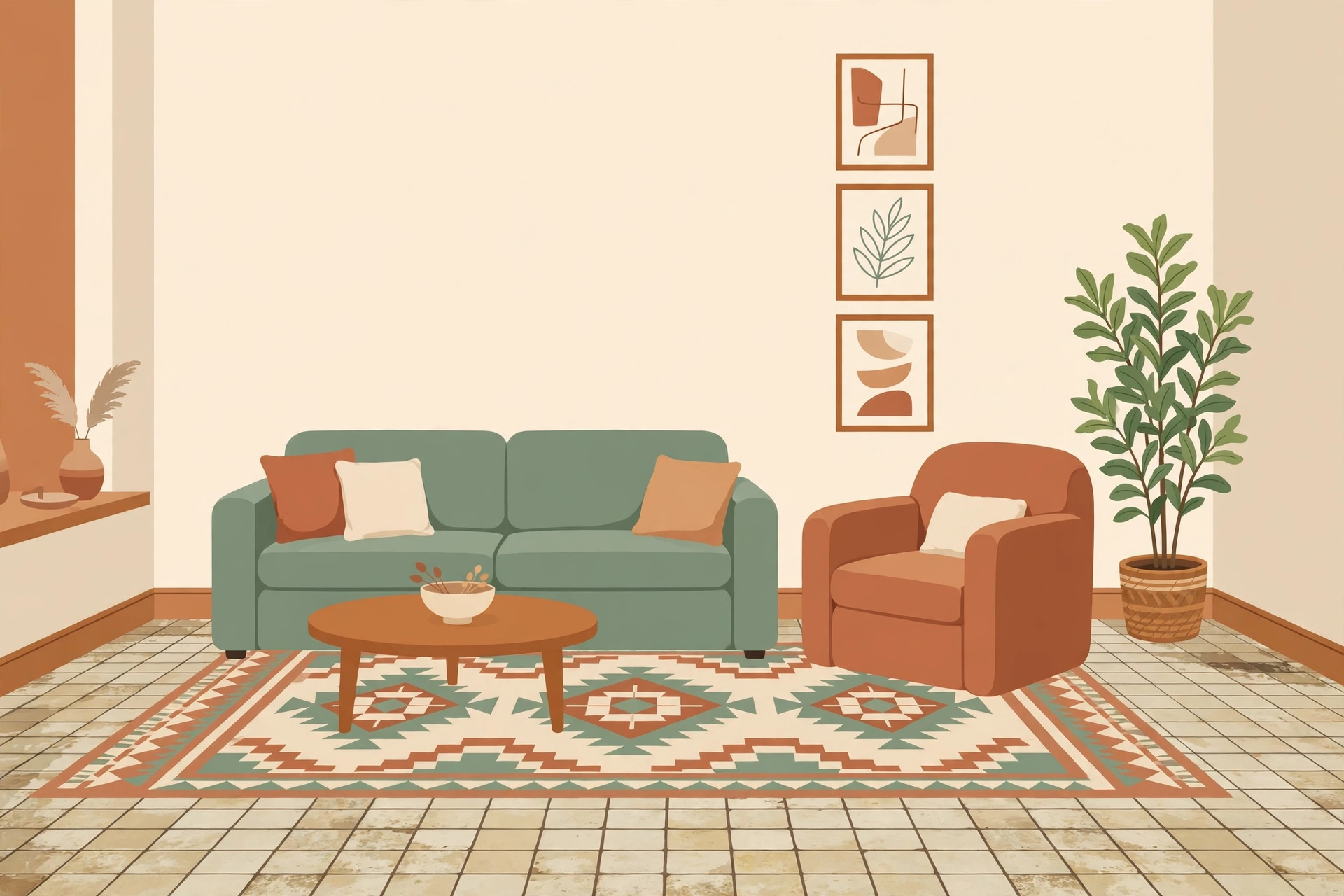
Start by identifying the floor’s undertone, not its surface color. Orange-toned wood has a warm undertone, so pull warm tones into the room: terracotta cushions, a cream-and-rust throw, warm brass picture frames. Pinkish tile has a cool undertone, so pair it with soft blues, sage green, and brushed nickel. Grey laminate goes with almost anything, but it turns cold and industrial unless you warm it with wood tones and cream textiles. The goal is not to match the floor exactly — it is to make its color echo somewhere at eye level, so the eye stops treating it as an intruder.
Wall paint is the other half of this trick. A wall color that clashes with the floor makes the floor louder; a wall color that sits quietly beside it makes the floor fade. As a rule, if the floor is warm, paint the walls warm-neutral — soft white with a warm undertone, greige, or pale taupe. If the floor is cool-toned tile or grey laminate, a cool white or pale grey-blue keeps the peace. Our paint colors for small rooms guide explains how undertones work and which shades open up tight spaces.
Peel-and-Stick Flooring: The Renter-Safe Cover-Up
Peel-and-stick vinyl tiles and planks are the closest thing to a new floor without the cost or the commitment, and they are the one fix that works on hard floors rather than over them. A box of peel-and-stick planks covers about 15 to 20 square feet and costs $25 to $40, which works out to roughly $1.50 to $2.50 per square foot. For a 12 by 12 room, that is 144 square feet, or about $220 to $360 in materials — still far below a real refloor, and the tiles lift off with a heat gun or a hair dryer when you move out.
The honest limits matter. Peel-and-stick tiles stick best to smooth, clean hard surfaces such as vinyl, tile, and sealed laminate, and they do not belong over carpet or heavily textured floors. Clean the floor thoroughly, let it dry completely, and lay the tiles from the centre of the room outward so the cut pieces land at the edges where furniture hides them. In a bathroom or kitchen, choose tiles rated for wet areas and seal the seams with a thin bead of clear silicone. Expect three to five years of good wear in a low-traffic room and two to three in a busy hallway — this is a disguise, not a lifetime floor.
Draw the Eye Up: Furniture and Wall Tricks
Every decorating choice that pulls attention upward makes the floor matter less. Tall bookshelves, floor-to-ceiling curtains, and large wall art all move the eye’s resting point from ankle height to eye level. A gallery wall over the sofa, a tall mirror leaning against the wall, or a statement light fixture can each do more for a hated floor than a second rug, because they change what the room is about.
Furniture placement does the same job at floor level. Arrange the sofa, coffee table, and chairs so the largest unbroken stretch of exposed floor is broken up, and place the biggest furniture pieces over the worst patches — a stain under the sofa is a stain nobody sees. Low, wide furniture such as a media console or a storage bench covers more floor per dollar than any single accessory. Plants help too: a tall fiddle-leaf fig or snake plant in a large pot covers a corner of bad flooring and adds height at the same time, and a cluster of three plants at different heights works better than one plant alone.
A Worked Budget: Fixing a 12×12 Room for $210
Here is a realistic plan for a 12 by 12 living room with carpet you dislike, using the cover-and-coordinate strategy together. The numbers are typical US discount-retailer prices, not sale prices.
| Item | What to buy | Typical cost |
|---|---|---|
| Area rug | 8×10 ft low-pile rug, neutral pattern | $120–$180 |
| Rug pad | 8×10 ft non-slip felt pad | $30–$45 |
| Throw pillows | 2 covers in a color pulled from the floor | $20–$30 |
| Wall art | One large framed print, hung at eye level | $25–$40 |
| Plant | One tall plant in a floor pot | $20–$35 |
| Total | $215–$330 |
The rug and pad are two-thirds of the budget, which is correct: coverage is the job, and everything else is coordination. If the room is a bedroom rather than a living room, swap the wall art for a bedspread in a tone that echoes the floor, and the total stays in the same range. Either way, the whole fix costs less than a quarter of the cheapest professional refloor, and it can be done in a single afternoon.
Can you put a rug over carpet?
Yes, and it is one of the best fixes for ugly rental carpet. Use a low-pile rug so it sits flat, and always use a non-slip rug pad made for carpet-on-carpet use. Without a pad, the top rug will bunch and creep within days. Choose a rug at least 8 by 10 feet for a living room so it reads as a deliberate layer rather than a patch.
Will peel-and-stick tiles damage the floor underneath?
On smooth hard floors, no, if the surface is clean before application and the tiles are removed with gentle heat. They can pull up the finish on old, unsealed wood, so test one tile in a hidden corner first. Never use them over carpet or on floors with loose tiles underneath.
What color rug hides a stained floor best?
A medium-tone patterned rug hides stains better than any solid color. Small busy patterns in mid-tones — a vintage-style print, a geometric in muted colors — break up the eye and mask both the stain below and future wear. Very light rugs show every mark, and very dark rugs show every speck of dust.
Can I paint a floor I hate?
Yes, on wood and concrete, with the right product. Use a floor-specific paint or porch-and-floor enamel, sand and prime first, and expect to recoat every two to three years in high-traffic areas. Do not paint rental floors without written landlord permission, and never paint tile in a shower or other constantly wet area.
How do I decorate around orange wood floors?
Repeat the warmth instead of fighting it. Add terracotta, rust, cream, and warm wood tones in textiles and accessories, paint walls a warm white or greige, and avoid cool grey furniture, which makes orange floors look louder. Once the orange appears in three places, it reads as a warm palette choice.
Key takeaways
Decide first whether to cover your floor or work with it: cover damage and busy patterns, coordinate with a color you simply dislike. Size the rug to the furniture, not the room — 8 by 10 feet for most living rooms — and repeat the floor’s color at least three times at eye level so it reads as a choice. Peel-and-stick tiles cover a 12 by 12 hard floor for about $220 to $360 and come off when you move. The whole room can be transformed in one afternoon for roughly $215 to $330, which is a fraction of any real refloor.