
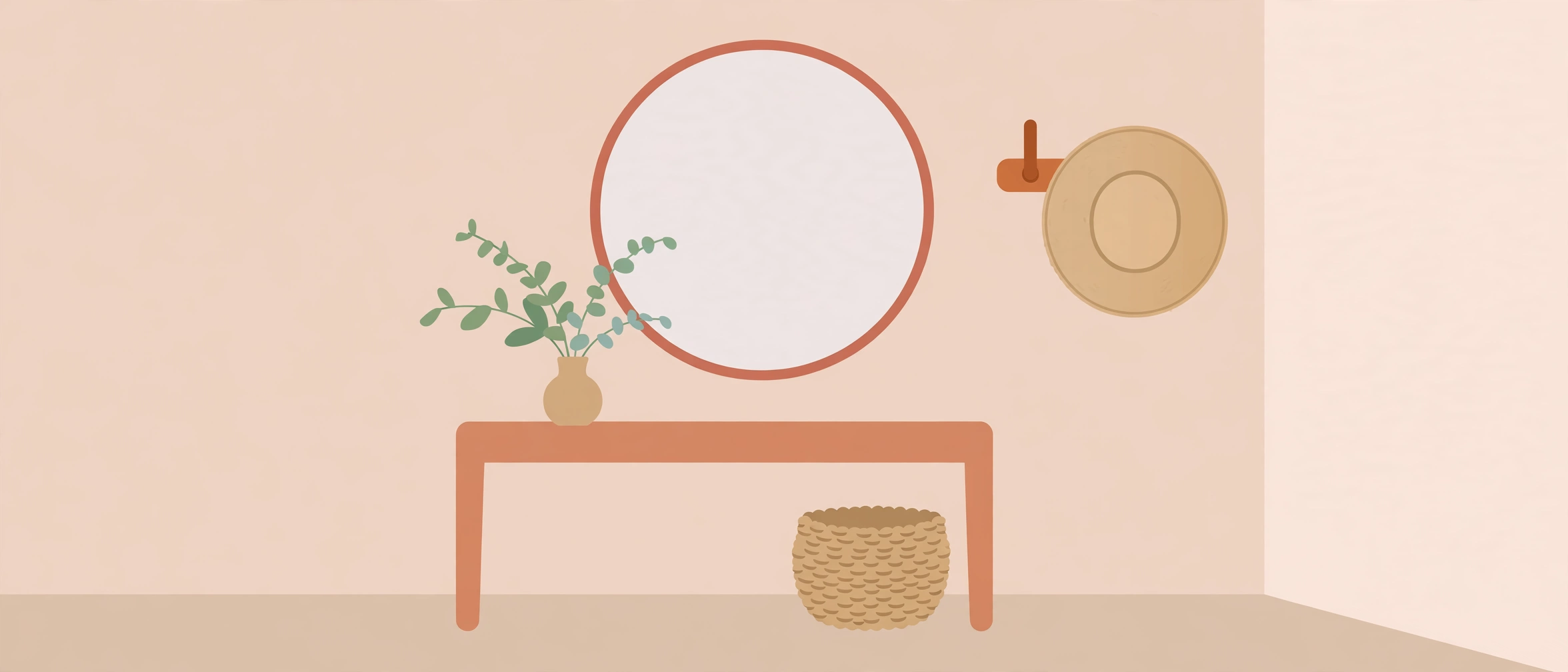
The entryway mirror is the first thing guests see and the last thing you check before leaving the house. It bounces light into a dim hall, makes a narrow space feel wider, and gives keys, bags and coats a place to land underneath it. Yet most entryway mirrors are hung too high, sized too small, or crowded by everything piled on the console below them.
Getting a mirror right comes down to three measurable decisions: how wide it should be, how high it should hang, and what shape suits the wall. This guide covers all three, with a sizing table you can use in the shop, five layouts for different entryways, and the styling rules that keep the whole arrangement calm rather than cluttered.
Quick answer: Pick a mirror about two-thirds the width of your console table, hang it so its centre sits 57 to 60 inches from the floor, and leave 4 to 6 inches between its bottom edge and the tallest item below it. A round mirror softens a narrow hall; a rectangular mirror suits a wide console. Keep the table low and simple.
What Size Mirror Fits Your Console Table?
Use the two-thirds rule: the mirror should span roughly two-thirds of the width of the console table beneath it. A mirror much smaller looks lost on the wall, while one as wide as the table leaves no breathing room at the edges and makes the whole arrangement feel cramped. Measure the console first, then shop to the number, not to a photograph.
| Console table width | Ideal mirror width | Shape that works best |
|---|---|---|
| 30 inches | 20 to 22 inches | Round |
| 36 inches | 24 to 26 inches | Round or arch |
| 42 inches | 28 to 30 inches | Arch or rectangular |
| 48 inches | 32 to 34 inches | Rectangular |
| 60 inches | 40 to 42 inches | Rectangular or wide arch |
If there is no console table, size the mirror to the wall instead: it should fill about two-thirds of the available wall width, with at least 6 inches of clear wall on each side. In a very narrow hall, a tall, narrow mirror of 16 to 20 inches wide works better than a small round one, because it draws the eye upward and gives a full-length reflection without eating wall space.
How High Should You Hang an Entryway Mirror?
Hang the mirror so its centre sits 57 to 60 inches from the floor — roughly eye level for most adults. This is the same height galleries use, and it works in an entryway for the same reason: you see yourself properly without crouching or stepping back. For a mirror above a console table, check the gap as well: leave 4 to 6 inches between the mirror’s bottom edge and the tallest object on the table, so the arrangement reads as one group rather than two separate pieces.
In a home with very tall or very short residents, adjust by a couple of inches, but keep the centre within 55 to 62 inches. A mirror hung above 65 inches at its centre reflects the ceiling more than the person standing in front of it, which defeats the purpose. If the mirror leans against the wall instead of hanging, its centre will naturally sit lower — that is fine for a full-length leaner, but wall-hung mirrors should follow the eye-level rule.
Fixings matter as much as height. A mirror heavier than about 15 pounds should hang on a wall stud or on anchors rated for its weight — check the rating on the packet, not the size of the screw. For spacing and hanging hardware, the gallery wall layout guide covers the same principles in more detail.
Choosing a Shape That Fits the Space
Shape changes how a mirror feels in a room, even at the same size. Round mirrors soften hard lines and suit narrow halls, small entryways and spaces with a lot of straight furniture. Arched mirrors add height without width, which makes them a good choice under low ceilings or above slim consoles. Rectangular mirrors look calmer and more formal, and they suit wide consoles and long foyer walls.
- Round: best for narrow halls, small entryways and round console tables.
- Arch: best for adding height, softening boxy furniture and slim consoles.
- Rectangular: best for wide consoles, formal foyers and long walls.
- Sunburst or decorative: best as a statement piece on an otherwise empty wall — keep everything else minimal.
- Full-length leaner: best for wide, empty walls and renters, since it needs no fixings at all.
Frame choice follows the same logic as shape: a thin black or brass frame disappears and lets the reflection do the work, while a thick wooden frame becomes part of the decor. In a small entryway, a frameless or thin-framed mirror keeps the space feeling open; a heavy frame can make a narrow hall feel narrower.
Five Layouts for Different Entryways
Not every entryway has a console table and a blank wall. Use the layout that matches the space you actually have, rather than forcing a photograph’s arrangement into a different room.
- The classic console: mirror centred over a console table, with a small tray for keys on one side and a vase on the other. Works in most entryways.
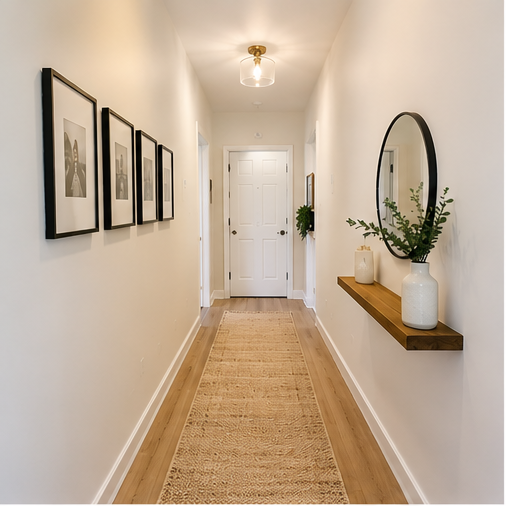
- The narrow hall: a tall, narrow mirror hung alone, with wall hooks below it instead of a table. Keeps the walkway clear.
- The wide foyer: a rectangular mirror over a long bench or credenza, flanked by a pair of sconces or matching lamps.
- The renter’s leaner: a full-length mirror leaned against the wall beside a small stool or basket. No holes, no fixings, fully reversible.
- The dark entry: a mirror placed on the wall opposite a window or glass door, so it reflects daylight into the space. Position matters more than size here.
Renters in particular benefit from the leaner and from adhesive hooks for lightweight mirrors under about 10 pounds, though hooks should never carry a heavy glass mirror. For more no-drill ideas, see the rental-friendly decor guide.
Styling Around the Mirror Without Clutter
An entryway mirror works hardest when the surface below it stays calm. Limit the console to three groups: something useful (a tray or bowl for keys), something living (a small plant or vase of stems), and something personal (a framed photograph or a candle). Three groups read as styled; six or seven read as storage.
Keep heights staggered: the tallest item beside the mirror should sit at least 4 inches below the mirror’s bottom edge, and nothing on the table should block the reflection. Baskets underneath the console handle the overflow — shoes, dog leads, reusable bags — so the tabletop itself can stay clear. If the console has no lower shelf, one slim basket beside it does the same job without blocking the walkway.
Entryway Mirror FAQs
Can an entryway mirror be too big?
Yes. A mirror wider than its console table overwhelms the arrangement and leaves no visual rest at the edges. It can also reflect clutter from across the room. Stick to the two-thirds rule, and if the wall is large, choose a wider console rather than a wider mirror.
What is the best mirror for a small, dark entryway?
A large, thin-framed rectangular or round mirror placed opposite the nearest light source — a window, a glass door, or a hallway light. The bigger the reflective surface, the more light it returns, and a light-coloured frame keeps the wall from feeling heavy.
Should an entryway mirror face the front door?
It is better on a side wall than directly opposite the door, where it reflects people straight back at themselves as they enter and can bounce harsh light. A mirror on the wall beside the door, or opposite a window, brightens the space without that head-on effect.
How do I hang a heavy mirror on drywall safely?
Find a wall stud with a stud finder and drive the fixing into it, or use wall anchors rated above the mirror’s weight. For mirrors over 25 pounds, use two fixings spread across the hanging wire. Never rely on a single adhesive hook for heavy glass.
A Mirror That Earns Its Place
The right entryway mirror is not the biggest or the most decorative one — it is the one sized to its console, hung at eye level, and given a calm surface below it. Measure first, hang once, and keep the tabletop to three groups. Done that way, the mirror stops being decoration and starts doing real work: more light, more space, and a calmer first step into the house.

One Comment