Bathroom tile slip resistance is the number most people never check until the first wet morning, when a foot slides on a polished floor and the whole renovation suddenly feels like a mistake. The good news is that the US tile industry has one clear number to shop by, and it is printed on most manufacturers’ technical sheets. The bad news is that the number only covers part of the bathroom. This guide explains what the DCOF rating measures, the 0.42 threshold that matters, why shower floors have no single number at all, what slip-resistant tile costs per square foot, and a fifteen-dollar wet test that tells you more than any spec sheet.
What Is DCOF? The 0.42 Number Explained
DCOF stands for Dynamic Coefficient of Friction, and it measures how much grip a hard floor keeps while something is already moving across it. That word, dynamic, is the point: it tests traction in motion, which is what walking is, rather than the force needed to start sliding from a standstill. Testing follows ANSI A326.3, the North American standard from the Tile Council of North America. A technician draws a tribometer fitted with a standardised rubber slider across the tile while a wetting solution is applied to the surface, and the result is the tile’s wet DCOF value. A higher number means more grip under those laboratory conditions.
For level interior floors that are expected to be walked on when wet, bathrooms, kitchens and entries, the accepted threshold is a wet DCOF of 0.42 or higher. That is the Interior Wet baseline, and it has been the industry’s long-cited minimum. Treat 0.42 as the floor, not the goal. A tile at 0.42 passes the test; a tile at 0.50 or 0.55 gives more headroom when kids, older family members or frequent wet traffic are part of the plan. And no number makes a floor slip-proof: soap film, slope, footwear and cleaning all matter alongside the rating, and the standard itself makes no claim that a DCOF value predicts how a real person walks in real shoes.
Which Rating Does Each Bathroom Zone Need?
ANSI A326.3 sorts floors into five product-use categories, and manufacturers declare which categories each product suits. That declaration matters more than the raw decimal, because it is the manufacturer committing the tile to a use. The table below shows the generally accepted minimums for each category.
| Category | Minimum wet DCOF | Where it applies |
|---|---|---|
| Interior Dry (ID) | 0.42 or higher, tested dry | Level interior floors kept dry, such as bedrooms |
| Interior Wet (IW) | 0.42 or higher, wet | Home bathrooms and kitchens, entry foyers |
| Interior Wet Plus (IW+) | Manufacturer-declared, generally 0.50 or higher, wet | Frequent standing water and barefoot areas, such as showers and locker rooms |
| Exterior Wet (EW) | 0.55 or higher, wet | Clean, maintained exterior areas, pool decks |
| Oils and Greases (O/G) | 0.55 or higher, wet | Kitchens and any space where grease is present |
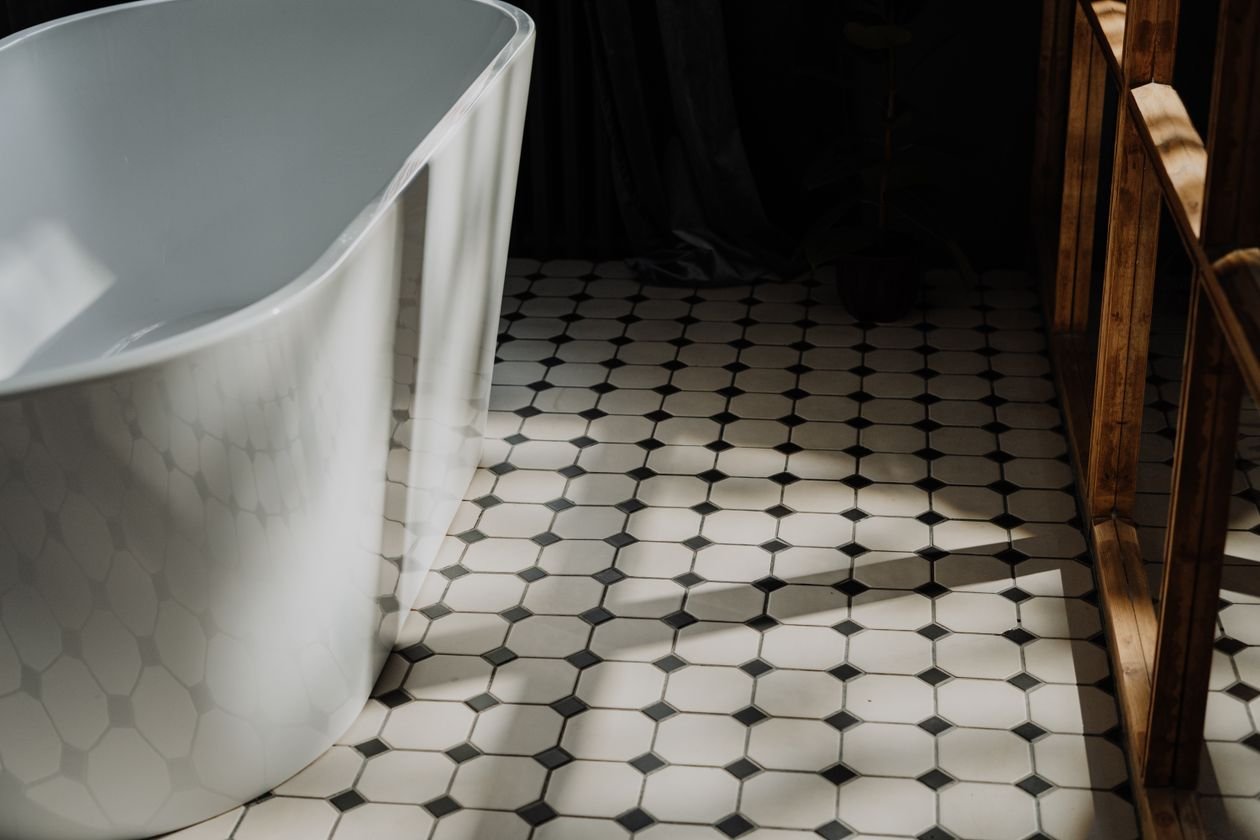
For a bathroom floor outside the shower, look for Interior Wet with a wet DCOF of 0.42 or higher, and favour matte or textured porcelain over polished tile underfoot, even when the polished version is the same print. For the shower floor, start at 0.42 and then look for the manufacturer’s Interior Wet Plus classification or published guidance, which commonly cites 0.60 or higher as a practical target. A polished marble-look tile can be perfectly safe as a wall tile and dangerously slick as a floor tile, so always check the rating for the exact finish you are buying, not for the collection as a whole.
Why Shower Floors Break the Rule
Here is the part the spec sheet will not tell you plainly: ANSI A326.3 deliberately sets no DCOF value for shower floors. A shower pan slopes to a drain, you are barefoot on it, and soap is on it, and those are three conditions the level-floor test does not reproduce. So for the wettest square metres in the house, the number stops helping and physical design takes over.
Two physical factors do most of the work in a shower. The first is tile size. Small-format tile and mosaic add grout joints, and every grout joint is an edge underfoot. A 2-inch mosaic puts roughly six times as many grout joints underfoot as a 12-inch tile, which is why most shower floors use 2×2 mosaic or penny rounds. The second is texture: a matte or structured face grips where a polished face slides, and the small sheets also follow the slope to the drain instead of fighting it. A curbless shower pushes the wet zone into the room, so the transition tile outside the shower deserves the same attention as the pan itself. If the person using the shower has limited mobility, work the slope and the tile choice through with the installer rather than deciding from a spec sheet alone.
What Slip-Resistant Tile Costs
Neither of the big tile guides puts real prices next to the ratings, yet price decides most bathroom projects. The table below shows typical US prices for tile only, before setting materials and labour. Matte and textured finishes usually cost the same as polished versions of the same tile, so choosing a safer finish rarely costs extra.
| Tile type | Typical price | Slip notes |
|---|---|---|
| Matte porcelain, 12×24 | 2 to 8 dollars per sq ft | Most common bathroom floor choice; check the DCOF on the sheet |
| Textured or structured porcelain | 3 to 10 dollars per sq ft | Best grip in large formats; harder to mop |
| Mosaic sheets, 2×2 or penny round | 7 to 15 dollars per sheet | Shower floors; grout joints add grip |
| Natural stone, honed finish | 5 to 15 dollars per sq ft | Needs sealing; grip varies by stone |
| Textured ceramic wall tile | 1 to 5 dollars per sq ft | Walls only; wall tile is not DCOF rated |
Worked example: a 5-by-8-foot bathroom has 40 square feet of floor. Allow 10 percent for cuts and waste, so buy about 44 square feet. In matte porcelain at 4 dollars per square foot, the tile costs about 176 dollars. Mosaic for a 3-by-5-foot shower pan adds roughly 60 to 120 dollars. Thinset, grout and sealer add about 60 to 100 dollars, and professional labour often runs 300 to 800 dollars for a floor this size. The full floor therefore lands around 600 to 1,300 dollars, and choosing a tile with a published wet DCOF above 0.42 costs nothing extra over a polished tile at the same price point. The expensive mistake is the other way round: re-tiling a slippery floor costs the whole project again.
The DIY Wet Test: Check Grip Before You Buy
A spec sheet is a laboratory result, and your bathroom is not a laboratory. Before ordering a full box, order samples. Most US tile retailers sell single-piece samples for 5 to 15 dollars each, and many showrooms give them free. Order one sample of each finalist, and test them the same way.
First, lay the sample on a flat surface and press your bare foot onto it while it is dry, then wet it with a little water and a drop of liquid soap, which is closer to real shower conditions than plain water. Drag your foot slowly across it and notice how much resistance you feel. Then stand on the wet sample in socks and shift your weight; a tile that feels secure barefoot can feel very different in socks. Compare the samples side by side rather than judging one alone, and keep the polished finalist in the test even if you have already decided against it, because the contrast teaches your feet what the numbers mean. A sample that feels slick when wet is telling you the truth, whatever its spec sheet says. Fifteen dollars of samples can save a thousand-dollar re-tile.
Already Own Slippery Tile? Four Retrofit Fixes
Re-tiling is not the only answer when the floor you already have is too slick. Four retrofit options exist, and each has honest limits. An anti-slip treatment kit, typically 30 to 80 dollars, etches microscopic texture into glazed tile and ceramic; it improves wet grip noticeably, lasts one to three years depending on traffic, and will not help polished natural stone. A clear anti-slip coating, about 40 to 90 dollars per bottle, paints on like a sealer and adds grip, but it can dull the tile’s shine and needs reapplying every year or two in a shower.
Stick-on treads and strips cost 15 to 30 dollars for a pack and work well in a tub or at the shower entry, though they peel in standing water and need replacing every few months. A good bath mat, 20 to 50 dollars, is the cheapest honest fix for the step-out zone beside the tub, where most bathroom slips happen. None of these fixes turns a polished floor into a rated one, and none replaces a mat or a grab bar for someone with limited mobility. But for a rental, or for a floor that is only slightly too slick, they buy safety for the price of a takeaway.
Common Mistakes That Make Bathroom Tile Slippery
Most slippery bathroom floors were not bought slippery; they were made slippery. The first mistake is choosing polished tile for the floor because it matches the wall tile, when the same print exists in a matte finish. The second is trusting an old COF number: the static COF test under the withdrawn ASTM C1028 standard measured dry, standing friction, and a tile marketed as COF 0.60 dry can still be slick when wet. The third is sealing the floor with a film-forming sealer or cleaning it with a waxy, shine-restoring cleaner, which coats the texture that provides the grip. The fourth is confusing PEI with slip resistance: a PEI rating measures how hard the glaze is to scratch, not how much grip it has, and a tile can have a very high PEI rating and a very low DCOF. The fifth is skipping samples and ordering forty square feet of a tile nobody has stood on wet.
Bathroom Tile Slip Resistance FAQs
What DCOF rating do I need for a bathroom floor?
For a level bathroom floor expected to get wet, choose tile with a wet DCOF of 0.42 or higher under ANSI A326.3. Treat 0.42 as the minimum rather than the target, and favour matte or textured finishes over polished tile underfoot.
What DCOF rating do I need for a shower floor?
There is no single standard number for showers, because ANSI A326.3 sets no value for sloped shower pans. Start at 0.42, then prioritise matte or textured porcelain in a small mosaic format and follow the manufacturer’s Interior Wet Plus guidance, which commonly cites 0.60 or higher.
Do European R-ratings translate to DCOF?
No. R-values from R9 to R13 come from a German ramp test on an incline with oiled footwear, while DCOF measures dynamic traction on a level, wetted surface. There is no conversion between the two scales, so if a spec sheet only lists an R-rating, ask for the US DCOF data.
Can tile lose its slip resistance over time?
Yes. Traction degrades as dirt, soap scum, grease, wax and film-forming cleaners build up on the surface, and heavy traffic can gradually smooth a tile’s texture over many years. Clean with a neutral, non-film-forming tile cleaner to preserve the floor’s original grip.
Key Takeaways
Bathroom tile slip resistance comes down to four checks. Buy a wet DCOF of 0.42 or higher for the bathroom floor, and treat 0.42 as the minimum, not the goal. For the shower, forget chasing a single number and choose small-format matte mosaic with plenty of grout joints instead. Test samples wet, with soap, before ordering a full box. And keep the grip you bought by cleaning with neutral, non-film-forming products, because wax and soap scum undo the rating.
Buy the Rating, Then Feel the Tile
The rating gets you to a shortlist and the sample gets you to a decision. Check the manufacturer’s technical sheet for a published wet DCOF and an Interior Wet or Interior Wet Plus declaration, then order the samples, wet them, and stand on them. A floor that passes both tests is a floor you can step onto half asleep, with wet feet, without thinking about it, which is exactly what a bathroom floor should be. For the rest of the room, see our bathroom vanity styling guide and our bathroom pendant light height guide.