
A bathroom vanity is a small surface with a big job. It holds everything used twice a day — soap, toothbrushes, skincare, towels — in a room where moisture, splashes and limited counter space work against tidiness. Most vanities fail not because they lack storage, but because everything lives on top of them, where it collects water marks, dust and visual noise.
Styling a vanity is therefore less about decoration and more about editing: deciding what earns counter space, what moves into a drawer, and how the few remaining pieces are grouped so the surface looks intentional. This guide sets out a simple tray system, a realistic $95 styling budget, and the rules for single, double and pedestal vanities.
The Tray System: One Boundary That Changes Everything
A tray is the single most useful styling tool for a vanity, because it creates a boundary. Everything inside the tray belongs on display; everything outside it needs a home elsewhere. Without that boundary, bottles migrate across the counter one by one until the whole surface is covered. With it, the eye reads one tidy group instead of ten separate objects.
Choose a tray that fits the space with room to spare: about 12 to 16 inches long for a standard single vanity, and no wider than half the counter depth, so there is still clear space beside the sink for washing hands. Wood, stone or ceramic trays all work; avoid fabric or untreated rattan, which absorb moisture and develop marks in a bathroom. Wipe the tray down weekly — it collects soap residue faster than the rest of the counter.
Start With What You Use Every Day
Before buying anything decorative, empty the vanity completely and sort every item into three groups: used daily, used weekly, and rarely used. Daily items — hand soap, toothbrushes, one or two skincare products — earn counter space, ideally inside the tray. Weekly items go in a drawer or cabinet. Rarely used items leave the bathroom entirely, to a linen closet or bedroom storage.
What if the vanity has almost no counter space? Use the wall and the inside of cabinet doors: a small wall-mounted soap dispenser, a magnetic strip inside a medicine cabinet for bobby pins, and a hook on the door for a hand towel free up more room than any organizer. A pedestal sink with no counter at all needs a different answer — see the pedestal section below.
This edit is worth doing honestly, because styling cannot fix overcrowding. A tray holding twelve bottles looks no better than twelve bottles without a tray. Most bathrooms can cut counter items by half in ten minutes, and the result feels calmer immediately, before a single decorative piece is added.
How to Style a Small Vanity Without Clutter
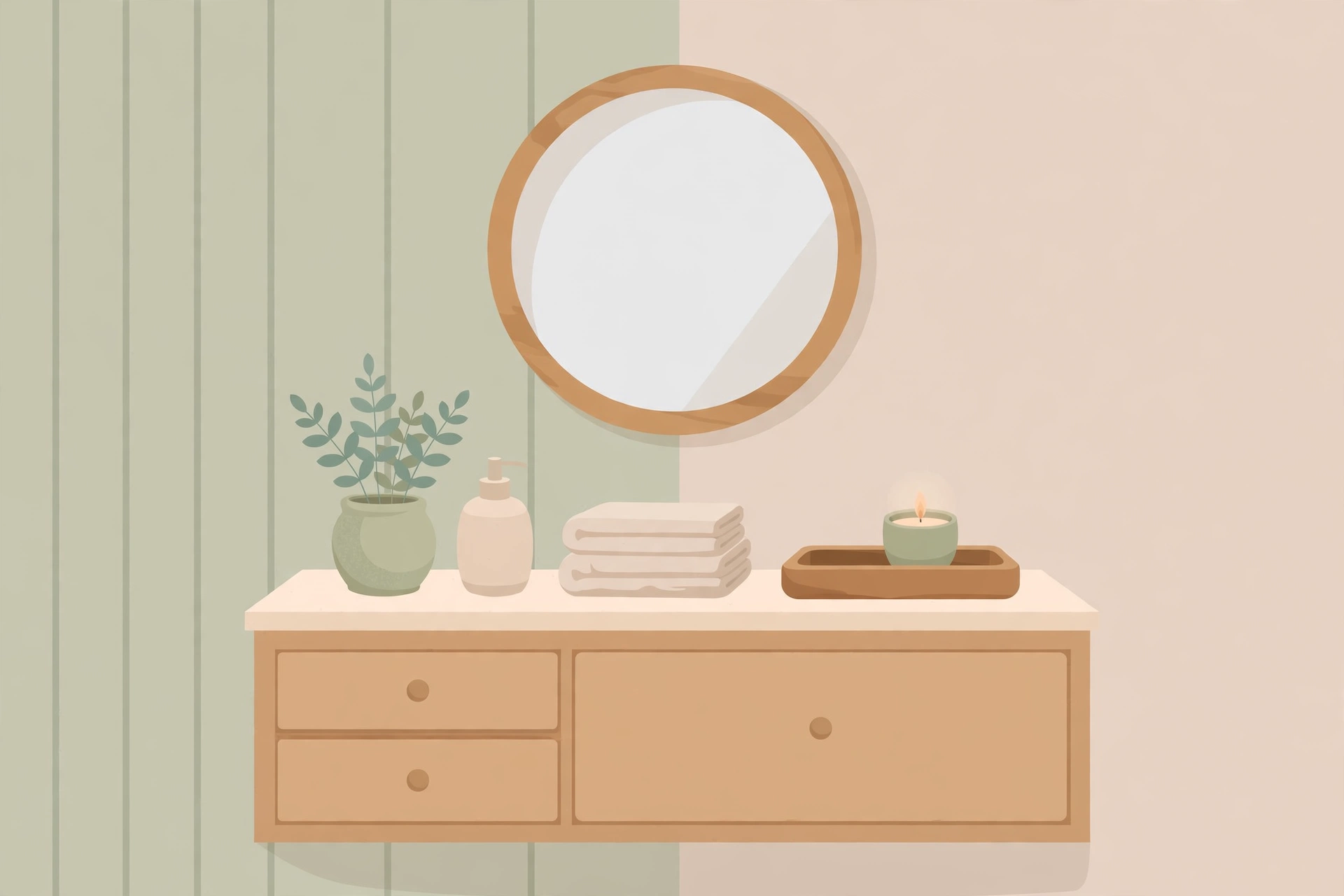
Once only daily items remain, group them by height: tallest at the back of the tray, shortest at the front. A soap dispenser and a small plant at the back, a candle or lidded jar in the middle, and a folded hand towel or a small dish at the front gives a gentle slope the eye can follow, rather than a flat row of same-height bottles. Keep the total to five or six objects in the tray, including the soap.
Colour discipline matters on a small surface. Pick one accent colour — sage green, warm terracotta, soft navy — and let towels, the tray and one small accessory carry it, while everything else stays white, wood or clear glass. A vanity with five colours looks busy; the same vanity in two colours looks designed. For choosing colours that open up a small room, see the paint colours for small rooms guide.
Do matching soap dispensers really make a difference? Yes, disproportionately. Mismatched product bottles with bright labels are the single biggest source of visual noise in a bathroom. Decanting soap and lotion into two matching dispensers costs little and instantly makes the vanity look considered, even before anything else changes.
A Worked Budget: A Styled Vanity for $95
Here is a complete vanity styling kit, priced honestly. The tray and dispensers are the biggest spends because they do the structural work; everything else is finishing detail.
| Piece | Cost |
|---|---|
| Wooden tray | $22 |
| Matching soap and lotion dispensers | $18 |
| Pair of hand towels | $16 |
| Small faux eucalyptus plant | $12 |
| Scented candle | $10 |
| Lidded jar for cotton pads | $9 |
| Small framed print | $8 |
| Total | $95 |
Where to save: towels and candles are cheapest in multi-packs, and a plain wooden tray can be found for less than a stone one. Where not to save: dispensers with pumps that clog or leak, which cost more in spilled product than the saving. Keep the receipt for the tray — if it warps in bathroom humidity, swap it for a ceramic one.
How often should vanity styling be refreshed? The structure — tray, dispensers, towels — can stay for years. Refresh only the small details: a new candle scent, a different plant, a seasonal hand towel. A full restyle every few months usually means the original edit was never done, and the counter has quietly refilled.
Styling for Different Vanity Types
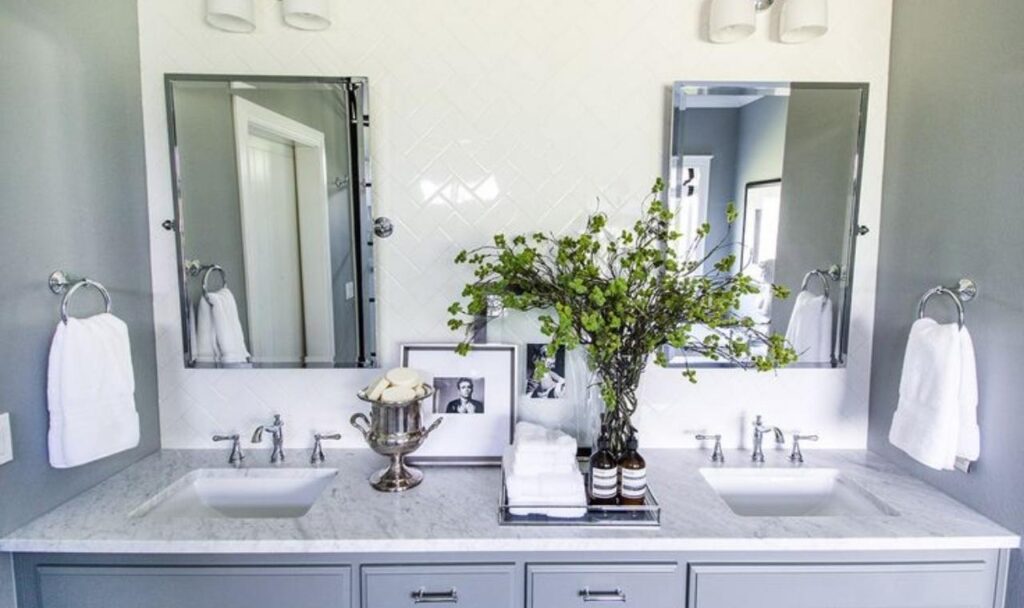
A single vanity, typically 24 to 36 inches wide, gets one tray placed to one side of the sink, leaving the other side clear for daily use. A double vanity, 48 to 72 inches wide, works best with a small tray at each sink and a shared centrepiece — a plant or a candle — in the middle, rather than one long arrangement that neither person owns.
A pedestal sink has no counter at all, so the styling moves to the wall: a small floating shelf above or beside the sink for the soap and one plant, a towel ring instead of a folded towel, and a basket on the floor for spare rolls. Wall-mounted storage is the theme here, and the hallway decor guide uses the same slim-profile thinking for narrow spaces.
What to Keep Off the Counter
Some things never earn counter space, however pretty their packaging. Medicines belong in a closed cabinet, out of humidity and reach. Cleaning products belong under the sink or in a utility closet. Hair tools belong in a drawer or a heat-resistant holder inside a cabinet, not balanced on the counter edge. And anything used less than once a week — a face mask, a specialty treatment — belongs in a drawer, brought out when needed and put away after.
The test is simple: if an item has sat untouched for two weeks, it does not live on the counter. Move it, and the vanity will stay styled with almost no effort, because the surface only holds what the household actually reaches for.
Key Takeaways
- Use one tray as the boundary for everything on display — if it does not fit in the tray, it lives elsewhere.
- Keep only daily-use items on the counter; weekly items go in a drawer, rare items leave the bathroom.
- Group by height, tallest at the back, and stick to one accent colour plus neutrals.
- A full styling kit costs about $95, with the tray and matching dispensers doing most of the work.
- Pedestal sinks need wall storage, not counter styling — a shelf, a towel ring and a floor basket.
Small Touches, Calmer Mornings
A styled vanity is not a showroom — it is a working surface with a boundary, a few matching pieces, and nothing it does not need. Edit first, add a tray, keep the colours calm, and the smallest room in the house becomes one of the easiest to keep looking good.


2 Comments