Seasonal decorating on a budget fails most often for one reason: every season is treated as a fresh shopping trip. A cart full of fall pumpkins in October, a different cart of red and gold in December, pastel everything in March, and by June the closet holds four sets of decor that match nothing else in the house. The cheaper system works the other way around. Buy one set of neutral anchors once, keep them out all year, and change only a small kit of accents when the season turns. The room still changes. The spending does not.
Quick answer: Seasonal decorating on a budget works best as a swap system, not a shopping spree. Buy one reusable base of neutral anchors once — garland, wreath, pillow inserts, bins — then change only a kit of accents each season. Each kit costs $40 to $55, the first year runs about $271, and the same base serves all four seasons.
The Swap System: One Base, Four Small Kits
The system has two parts. The base is a small set of neutral pieces that never come down: a plain green garland, a plain faux wreath, two pillow inserts with neutral covers, a soft throw, and the storage bins everything lives in. The kits are the seasonal part: a shoebox-sized set of small accents — pumpkins in fall, white candles in winter, eucalyptus in spring, a woven tray in summer — that swaps in and out in about 30 minutes. Nothing in the base carries a season’s colors, so nothing in the base ever looks wrong.
The rule that makes it work is the palette. Pick three colors and never leave them: one light neutral, one deep color, and one warm metal. Cream, deep forest green, and brass is a combination that reads as fall in October, as winter in December, and as fresh in April, because the deep green changes meaning with the accents around it while the neutral and the metal stay constant. Write the three colors on a card and keep it in a wallet. Every seasonal piece has to match at least two of the three, or it does not come home. A second rule keeps the storage honest: one clear bin per season, labeled on two sides, and nothing buys its way in unless it fits in the bin.
What Does Each Season Actually Cost?
Here is the whole year priced out, line by line, for a typical living room. The base is bought once. Each kit stays under $100 — in fact, none of them passes $55 — and the kits are the only spending that repeats.
| Part | What it is | Cost |
|---|---|---|
| Base (buy once) | 9 ft plain pre-lit garland $20, plain faux wreath $15, two pillow inserts $16, two 66 qt clear latch bins $18, adhesive hooks $8 | $77 |
| Spring kit | Two pillow covers $18, faux eucalyptus stems $12, light throw $15, ceramic vase $10 | $55 |
| Summer kit | Woven tray $12, shell and coral accents $8, linen table runner $14, citronella candle $6 | $40 |
| Fall kit | Ceramic pumpkin set $16, dried leaf bundle $6, rust throw $15, brass candle holders $12 | $49 |
| Winter kit | Pine cones and white candles $10, 20 ft string lights $10, faux greenery sprigs $12, plaid throw $18 | $50 |
| Year one total | Base $77 + four kits $194 | $271 |
Two details keep these numbers honest. First, pillow covers — not new pillows — are the whole trick for textiles: one set of inserts wears four different covers, at a fraction of the cost and a fraction of the storage. Second, the kits are deliberately small. Eight to ten pieces per season is plenty, because each piece sits on an anchor that is already doing the heavy visual work. A room with a garland, a wreath, two dressed cushions and a throw needs only a handful of accents to read as a new season.
Where Do the Swaps Go? A Room-by-Room Plan
Not every room deserves seasonal attention. Spreading a thin layer of decor across the whole house looks half-hearted and costs more than concentrating on the three places people actually see: the living room, the entryway, and the dining table. The bedroom gets one swap — the throw and the pillow covers — and the rest of the house sits the season out.
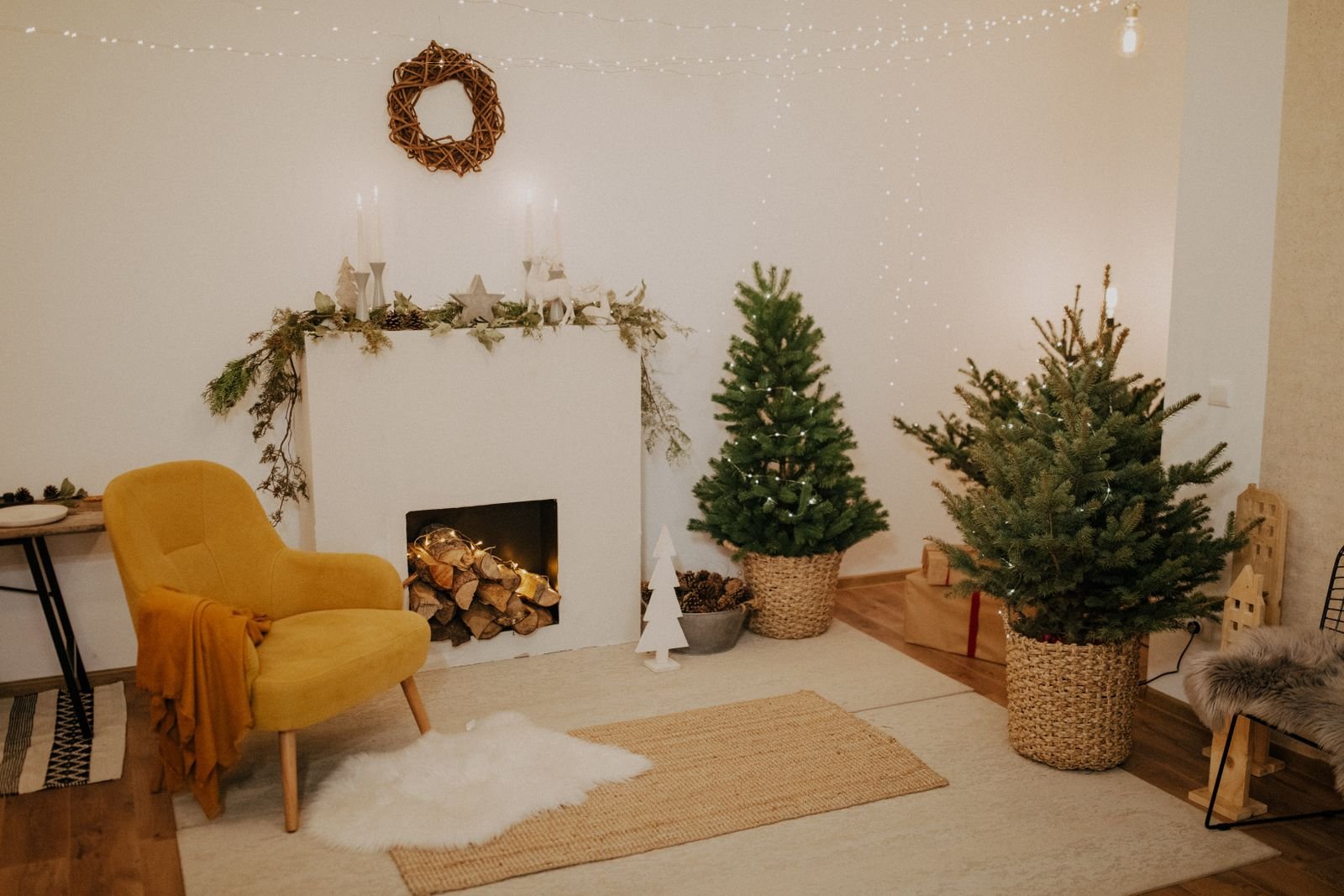
In the living room, the mantel carries the season. The garland stays up all year; only what is tucked into it changes — small pumpkins in fall, pine cones in winter, eucalyptus in spring, nothing at all in summer, when plain green is the look. The wreath on the wall above it gets the same treatment, dressed four ways from one plain base. For the full mantel rules, see Fireplace Mantel Decor. The sofa takes the textile swap: covers, throw, and one cushion in the season’s accent color. The coffee table gets a single centerpiece — a tray with the season’s kit pieces grouped on it — because one grouped display reads as intentional where five scattered objects read as clutter.
The entryway needs only two moves: the wreath on the door, swapped with the season, and a small bowl or tray on the console holding the season’s smallest accents. The dining table takes the runner and the centerpiece, and nothing else. A table runner in the season’s color plus the kit’s candle holders is a complete dining swap, and it packs flat into the bin when the season ends. One more swap costs nothing at all: rotate the art. Swapping two framed prints between rooms, or changing the mat color in a frame that already hangs, makes a wall feel new for the price of ten minutes. For spacing and templates, see Gallery Wall Layout Guide.
The 5-Year Math: Reusable System vs Buying New
The first year is the expensive one, because it includes the base. After that, the system gets cheap fast: most kit pieces last for years, and the only repeat spending is replacing the few things that wear out — a faded cover, a broken candle holder, a dried-out stem — at about $20 a season. Buying a fresh set every season, at a modest $50 a season, never gets cheaper.
| Approach | Year 1 | Years 2–5 | 5-year total |
|---|---|---|---|
| Swap system (base + kits) | $271 | $80 a year | $591 |
| Buying a fresh set each season | $200 | $200 a year | $1,000 |
| Difference | — | — | About $409 saved |
The saving is about $409 over five years, and it grows if the fresh-set habit runs higher than $50 a season — which it usually does, since a single store visit in December easily passes $60 before the garland is even in the cart. The other saving is time: a 30-minute swap against a full shopping trip four times a year, and no January clean-out of decor that matched nothing.
When Should You Buy Each Season’s Pieces?
The cheapest seasonal decor is last season’s decor, bought the week after the holiday ends, when stores clear the shelves and the plain pieces are the ones left on the rack. End-of-season clearance typically runs 50 to 70 percent off, which is where the base pieces and the next year’s kits should come from. The calendar below is the whole buying plan — one short trip per season, never a full-price impulse buy.
| Buy in | What to buy | Why then |
|---|---|---|
| January | Winter clearance: plain garland, wreath, string lights, white candles | Post-holiday clearance, 50–70% off |
| March | Spring kit: eucalyptus stems, light throw, ceramic vase | Spring lines arrive; last year’s spring stock clears |
| June | Summer kit: woven tray, linen runner, citronella candle | Summer textiles go on sale before July 4 |
| September | Fall kit: ceramic pumpkins, rust throw, brass holders | Fall stock is fullest; buy before October demand |
| November | Next year’s fall pieces on clearance | Post-Halloween and pre-Thanksgiving markdowns |
One guardrail applies at every trip: buy only pieces that match the palette card, and only pieces that fit in the bin. A second garland in the same green is worth buying on clearance, because garlands wear out first. A third color of pumpkin is not, because it breaks the palette and needs a new bin.
Renter-Friendly Seasonal Swaps That Leave No Marks
Renters can run the whole system without a single hole in the wall. The garland and the wreath hang on adhesive hooks — one hook at each end and one in the middle, so the weight spreads and the middle does not sag by December. A large adhesive hook holds up to 5 pounds, which covers a garland, a wreath, and a light string with room to spare. Press each hook firmly for 30 seconds when sticking it, wait an hour before hanging anything heavy, and pull the strip straight down, slowly, when the season ends — a strip pulled sideways takes paint with it. The rest of the swap needs no fasteners at all: textiles, trays, candles, and a leaning mirror against the entryway wall borrow light without a single fixing. For the full no-drill playbook, see Rental-Friendly Decor Ideas.
Three DIY Projects That Replace Store-Bought Decor
A wreath made from affordable natural materials costs a fraction of the $60 pre-made version and takes about 40 minutes: a plain grapevine wreath form, a bundle of faux eucalyptus or dried stems, floral wire, and the season’s accent — small pumpkins clipped on in fall, pine cones in winter. The same form gets re-dressed four times a year, which is exactly how the base wreath earns its place. A centerpiece is even simpler: the season’s kit pieces grouped on a tray the home already owns, with one candle in the middle and the tallest piece at the back. And printable art — seasonal prints swapped into frames that already hang — costs almost nothing and looks intentional, because the frame is doing the work. For more secondhand and thrifted starting points, see Thrift Store Decor Flips.
What Not to Buy
The most expensive seasonal mistake is buying a full themed set in one color that matches nothing else in the house — orange for fall, red for winter, pastel pink for spring — because each season then needs a full new set. The second is buying decor with the holiday glued on: berries fixed to a garland, a snowman printed on a throw. Plain pieces re-dress; decorated pieces expire. The third is buying more than the bin holds. If a piece does not fit in the season’s labeled bin, it lives on a closet floor, gets damaged, and gets bought again next year. The fourth is decorating rooms nobody sees — the guest bedroom and the laundry room can sit the season out, and the money goes further in the living room. And the fifth is buying in-season at full price when the same piece will be 50 to 70 percent off the week after the holiday.
How much does seasonal decorating on a budget cost per season?
With a swap system, each season costs $40 to $55 for the small accent kit — spring $55, summer $40, fall $49, winter $50. The one-time base of garland, wreath, pillow inserts, bins and hooks costs $77, so the first year runs about $271 and later years about $80.
What is the cheapest way to decorate for each season?
Build one reusable base of neutral anchors, then change only a small kit of accents per season. Buy the base and next year’s kits on end-of-season clearance at 50 to 70 percent off, buy pillow covers instead of new pillows, and use free natural elements like pine cones, branches and dried leaves.
How do I store seasonal decor so it lasts?
One clear latching bin per season, labeled on two sides, on a shelf reachable without a ladder. Coil the garland loosely on the bottom, never folded tight, put the wreath on top in a large paper bag so the branches do not snag, and keep the swap kit in a bag on top with the label facing up.
Can renters decorate seasonally without damaging walls?
Yes. Hang the garland and wreath on adhesive hooks rated to 5 pounds, one at each end and one in the middle, and pull strips straight down at move-out. Everything else — textiles, trays, candles, a leaning mirror — needs no fasteners at all.
Seasonal decorating on a budget is a system, not a shopping habit: one base, one palette, one bin per season, and four small kits that cost less together than a single full-price December trip. Build the base once, buy the kits on clearance, and the room changes four times a year for about $80 a year after the first. Start with the palette card and the two bins — everything else follows from those two purchases.