A long hallway feels endless, and learning how to decorate a long hallway starts with understanding why: the eye travels its whole length in one go, with nothing to stop on and nothing to look forward to. The fix is not to fill the passage with furniture. It is to give the walk an order — a clear path, a steady rhythm, and one place at the far end worth arriving at — so the same distance reads as two or three short stretches instead of one tunnel. That is the whole method behind this guide: measure first, zone the length, light it evenly, and spend on the floor and the runner before the decorations.
Everything here is written for a US home, with measurements in feet and inches and prices in dollars. The budgets below are worked totals for a typical 20-foot hallway, and the runner and lighting tables are sized the same way, so the numbers can be checked with a tape measure before anything is ordered.
| Item | $150 refresh | $450 full makeover |
|---|---|---|
| Paint, 1–2 gallons | $42 (1 gallon) | $84 (2 gallons) |
| Runner rug | $58 (2 x 8 ft) | $95 (2 x 10 ft) |
| Frames + prints | $32 (set of 3) | $68 (set of 6) |
| Lighting | $18 (bulbs + dimmer) | $96 (3 flush-mount fixtures) |
| Console table | — | $72 |
| Mirror | — | $35 |
| Total | $150 | $450 |
Measure the Walk Before You Buy Anything
Start with a tape measure and a slow walk, not with a shopping list. Write down four numbers: the total length, the narrowest clear width, the ceiling height, and the distance from the first doorway to the last. Those four numbers decide the runner length, the furniture depth, the light spacing and the number of frames that will fit without crowding. Note every door swing, radiator and step, because a console that fits beautifully in the wide middle can block the pinch point by a doorway — and that is the point that gets cursed daily.
Light matters as much as width. Walk the hallway in the morning, at midday and in the evening, and note which stretches get daylight from a door or a fanlight and which rely entirely on ceiling lights. A color, a mirror and a print all behave differently in those two kinds of light, so choosing them from a single daytime visit is a reliable way to end up with a hallway that looks dull after dark. Keep at least 36 inches of clear walkway after furniture is in place — that is the width two people need to pass without turning sideways, and it is the number every later decision must respect.
How Do You Break a Long Hallway Into Zones?
A hallway feels long because the eye travels its whole length in one go. Breaking it into zones gives the eye a nearer stopping point, and a hallway of two or three short stretches feels shorter than the same hallway seen as one stretch, even though the distance is identical. Zones are not walls or screens. They are changes a walker can feel: a different light, a grouping of frames, a runner section, a change in wall treatment, or a piece of furniture that marks a threshold.
| Hallway length | Zones | Layout |
|---|---|---|
| Under 12 ft | 1–2 | Arrival stretch + one focal point at the far end |
| 12–20 ft | 2 | Arrival zone, then a gallery stretch to the end wall |
| 20–30 ft | 3 | Arrival, middle gallery, destination stretch at the far end |
| Over 30 ft | 3 | Same three zones, with a bench or bookcase marking the middle |
Keep the zones unequal when possible. A middle zone that is clearly the longest reads as the main stretch, while two short bookend zones frame it. Equal zones marked too sharply feel like a repeating pattern, and a repeating pattern is another way of emphasizing length. One steady wall color through all the zones helps too: the eye is not given a new color to notice every few steps, and the hallway calms down instead of counting itself out.
What Size Runner Fits a Long Hallway?
A runner is the single most effective hallway purchase: it softens sound, adds color, protects the center of the floor where traffic is heaviest, and draws the eye down the walk in the right direction. Size it from the measurements taken earlier. The runner should stop 4 to 6 inches short of the wall on each side so a border of hard floor shows, and it should end 12 inches short of each doorway so it never catches a door swing or a threshold. A low pile with a non-slip backing is the practical choice, because doors must clear it and a rucked runner is a trip hazard.
| Hallway length | Runner length | Runner width |
|---|---|---|
| 10–12 ft | 8 ft | 2 ft |
| 14–16 ft | 10–12 ft | 2–2.5 ft |
| 18–22 ft | 14–16 ft | 2–2.5 ft |
| 24–30 ft | 18–20 ft | 2.5–3 ft |
Two short runners can beat one long one in a hallway with a doorway in the middle: each section gets its own 12-inch clearance at the door, and the break itself becomes a zone marker. Whichever route is chosen, the runner should sit centered on the walkway with the same border on both sides — a runner pushed against one wall makes the whole hallway look lopsided from the far end.
How Far Apart Should Hallway Lights Be?
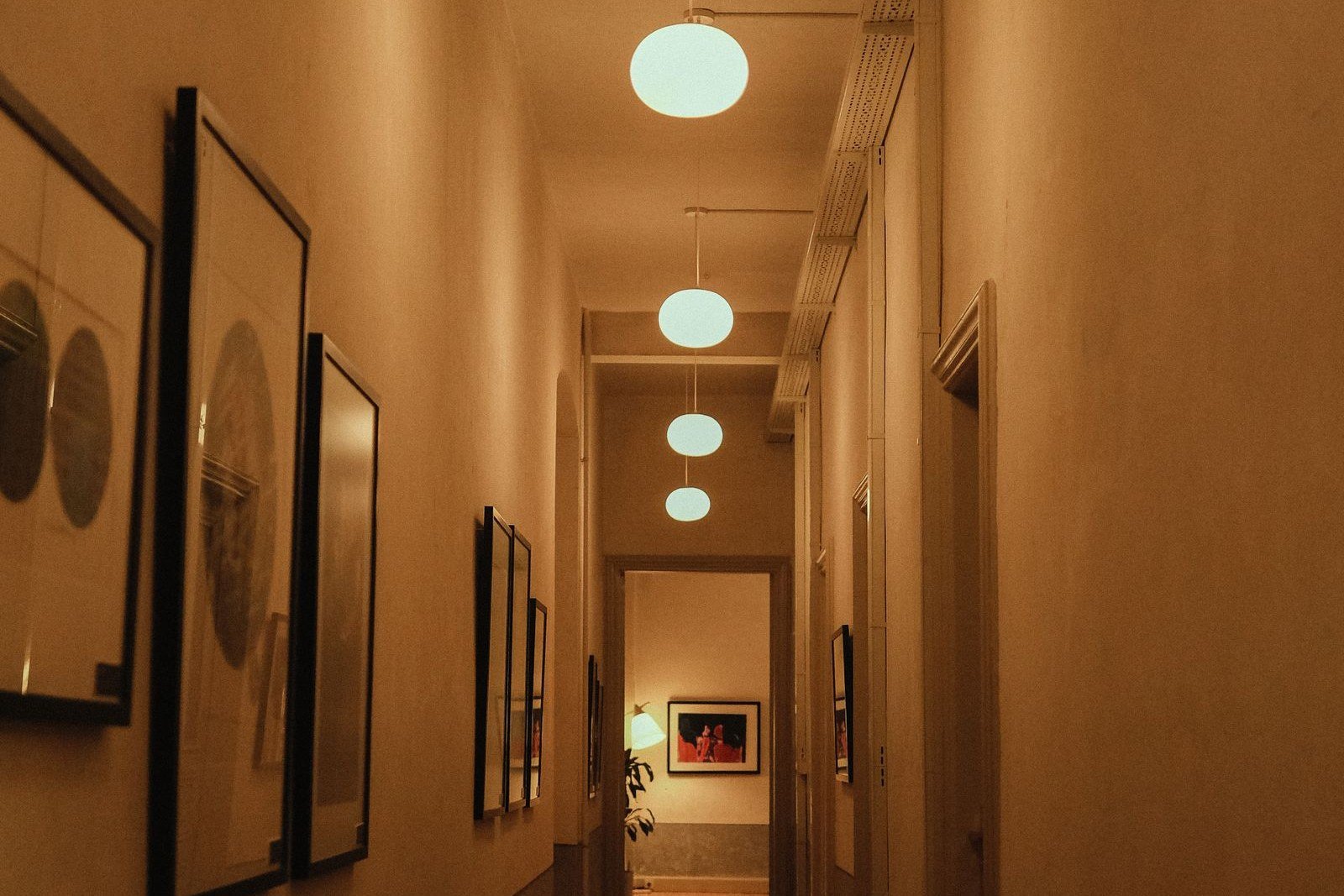
Even light is the single most effective shortener of a long hallway, and it is also the most commonly missed. A single fitting at one end leaves the middle dark and the far end glaring, which stretches the hallway in both directions. Evenly spaced ceiling lights at a steady interval remove the dark middle and give the walker a calm, unchanging brightness from door to door. As a planning rule, space flush-mount or recessed fixtures 5 to 6 feet apart along the run — a 20-foot hallway takes four fixtures, a 30-foot hallway takes five or six — and check the fitting’s own beam-spread guidance before committing, since ceiling height changes the result.
Once the ceiling layer is even, add one warm layer: a wall light or two, a picture light over the gallery, or a small lamp on a console, depending on what the hallway allows. This layer should be warmer in tone than the ceiling lights and sit at picture or console height, so the light falls where the eye actually looks. One warm layer is enough. Two competing warm layers plus the ceiling layer will make the hallway feel lit for display rather than for walking through. Put each layer on its own dimmer so the hall can shift from bright and practical for cleaning to soft and calm for guests arriving after dark.
The End Wall Deserves the Biggest Decision
Every long hallway has an end wall, and every walker looks at it, whether it is decorated or not. Leaving it blank hands the eye a dead end, which makes the whole length feel like a route to nowhere. Giving it a deliberate focal point — a large print, a shallow console with a vase, a painted panel, or a dressed doorway — turns the end into a destination, and a destination shortens the journey to it. Decide this wall before anything else, because the rest of the hallway is arranged around the destination, not the other way around.
Scale is the decision that matters. A small print on a large end wall looks lost and makes the wall feel larger, not smaller, because the eye measures the empty space around it. Aim for a piece or a tight grouping that covers roughly two-thirds of the wall’s width, measured before choosing, and keep the floor in front of it clear. If the end wall is a door, dress the door itself: paint it, add trim, or hang a wreath on it only if the door is rarely used. A focal point that has to be moved every time someone opens a door is not a focal point.
Gallery Walls That Read as One Line
A gallery is the classic long-hallway decoration, and it fails most often because it is hung as a random row: frames of different sizes at different heights with uneven gaps, so the eye stumbles from frame to frame instead of gliding along. Rhythm is the cure. Frames at one steady center height — about 57 to 60 inches from the floor, the middle of the grouping near eye level — with consistent gaps of 2 to 3 inches read as a single deliberate line, and a single line shortens a hallway far better than a scattered collection. For the full spacing and template rules, see Gallery Wall Layout Guide.
Choose one frame size for the main run, or two sizes used in a repeating pattern, and keep the content calm: landscapes, architecture, botanical studies or abstracts suit a hallway because they can be enjoyed in passing without demanding a long look. Hang the gallery on one side only. Art on both sides at once closes the hallway in and doubles the visual noise, while one quiet side leaves the walkway feeling open. A mirror hung at the same center height as the frames, placed where it reflects a window or a lit print, joins the rhythm and borrows light for free — but never aim a mirror straight down the length, or the reflection doubles the tunnel instead of opening it.
Slim Furniture That Earns Its Depth
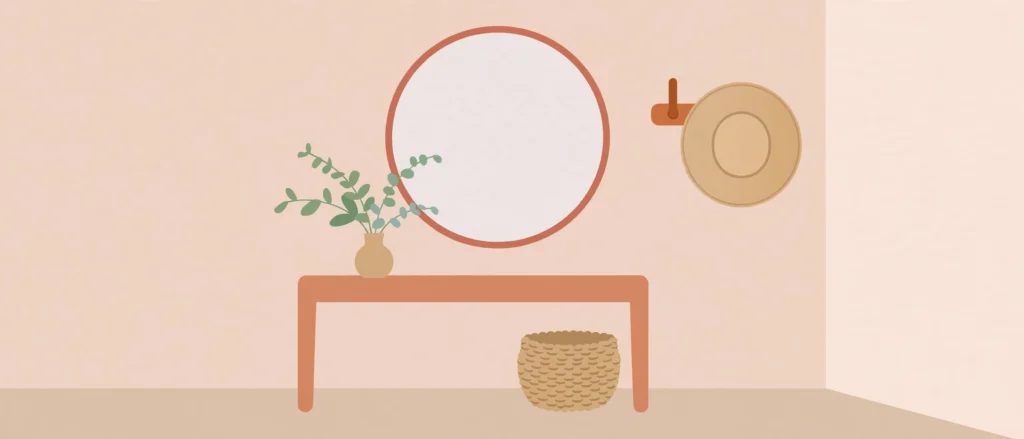
Hallway furniture earns its place by doing at least two jobs and by staying shallow. A console table with drawers holds keys and post while its top carries a lamp and a bowl for loose change. A bench gives people somewhere to sit while putting on shoes and can hide baskets of hats and gloves beneath it. The depth limit is strict: a console deeper than 12 inches will catch every passing shoulder and shopping bag in a 36- to 42-inch-wide hallway, so measure the narrowest point and subtract the 36-inch clear walkway before choosing. Wall-mounted pieces are the narrow hallway’s best friend — a floating shelf, a row of hooks or a shallow shoe cabinet keeps the floor clear and makes cleaning faster. For the storage math behind the entry, see Entryway Storage: How Much Space Do You Really Need?.
Keep one wall completely free if the hallway is narrow, and check that drawers and cupboard doors can open fully without blocking the walking route when someone is passing. Leave breathing room around the front door swing, and tape the furniture footprint on the floor with painter’s tape before ordering — then walk it at the busiest time of day with bags in hand. If the tape gets stepped on or sidestepped, the piece is too deep.
Renter-Friendly Swaps That Leave No Marks
Renters can fix a long hallway without a single hole in the wall. Peel-and-stick wallpaper on the end wall alone gives the destination the depth it needs and peels off cleanly at move-out. Command-strip picture ledges hold the gallery at one steady height with no nails, and a freestanding leaning mirror borrows light without a single fixing. A runner needs no fasteners at all — a non-slip rug pad underneath stops it creeping — and a plug-in wall light or a battery picture light adds the warm layer without an electrician. For the full no-drill playbook, see Rental-Friendly Decor Ideas.
Common Mistakes That Make a Hallway Feel Longer
The most common mistake is hanging art at different heights down the run, which turns a gallery into a stumble. The second is lighting only one end, leaving a dark middle that stretches the hallway in both directions. The third is a runner that runs wall to wall or under a door swing, so it rucks and trips. The fourth is furniture on both sides, which narrows the walkway below the 36-inch minimum and turns every crossing into a sidestep. And the fifth is leaving the end wall blank, which hands every walker a dead end and makes the whole length feel like a route to nowhere. Each of these is cheap to fix — rehang at one height, add one fixture in the middle, trim the runner 12 inches short of the door, move one piece to a single wall, and give the end wall one deliberate focal point — and together they are the difference between a tunnel and a gallery.
A long hallway becomes a room when the walk has an order: measure it, zone it, light it evenly, and give the far end something worth arriving at. The $150 refresh — paint, a runner, three frames and warmer bulbs — changes the feel of the walk in a single weekend, and the $450 version adds the lighting and the console that make it feel finished. Start with the tape measure, not the shopping list, and the longest space in the home becomes the one that quietly makes every other room easier to live in.