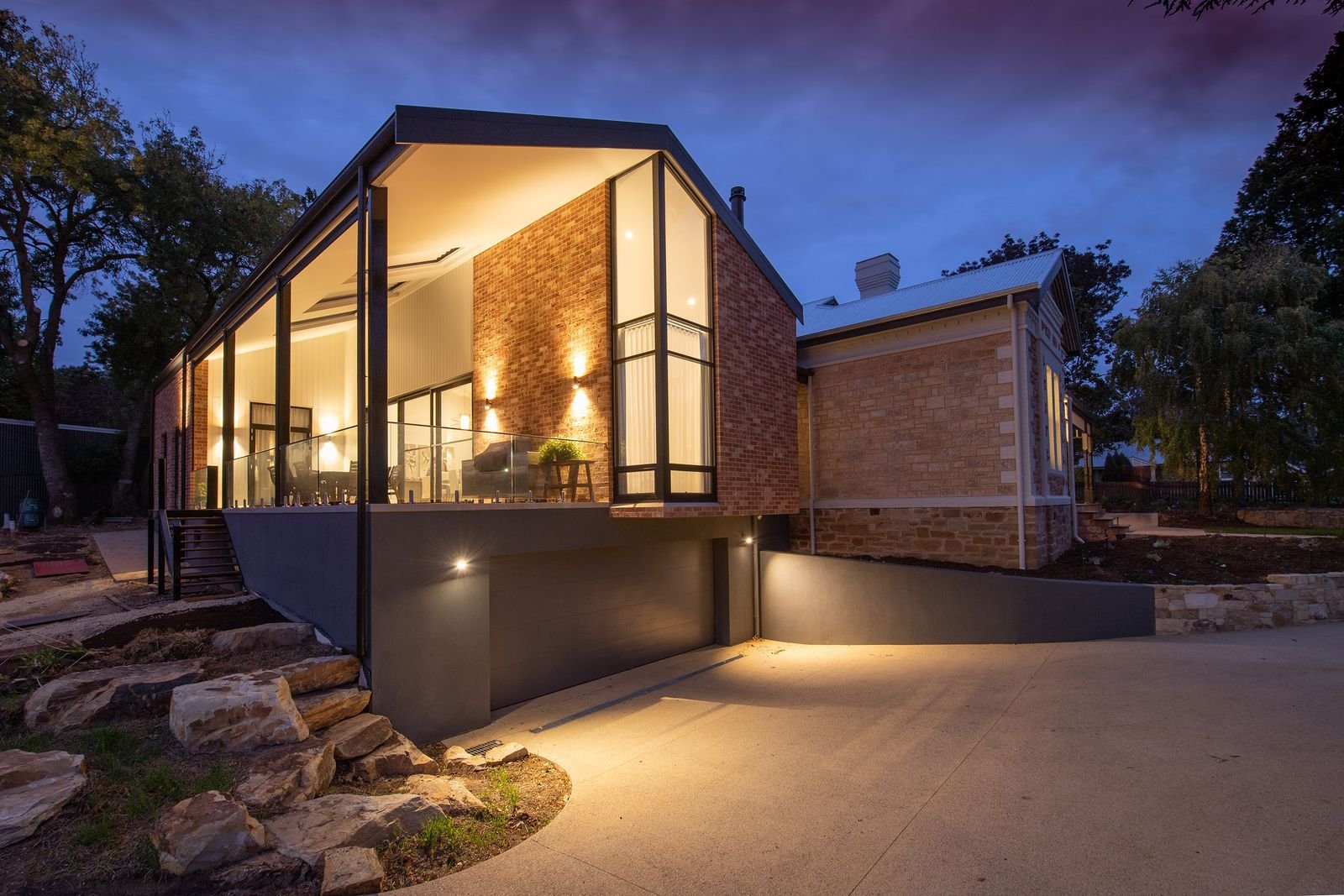
A house that looks welcoming by day can turn into a dark slab after sunset, and the fix is rarely more light. Outdoor facade lighting works when every fixture has a job: the front door reads clearly from the street, the path is safe to walk, and one architectural feature gets the spotlight while the rest of the facade stays quiet. Get that hierarchy right and a modest set of fixtures makes the whole house look finished; get it wrong and even expensive lights flatten the facade into a glare.
The numbers in this guide come from the same rules lighting designers use on residential projects: mounting heights near eye level, warm color temperature, and brightness matched to the size of the surface being lit. They work on a brick ranch, a two-story colonial and a modern stucco box alike, because the rules describe how eyes adapt at night, not how a particular style looks.
Quick answer: Mount wall lights 66 to 72 inches high at the front door, keep bulbs warm at 2700–3000K, and give the door 400–700 lumens while facade accents run 300–900 lumens. Space fixtures 8 to 9 feet apart, aim uplights at 30–45 degrees, and light one focal feature first — the rest of the facade should support it, not compete with it.
Start With One Focal Point, Not Five Fixtures
Walk to the curb at dusk and look at the house the way a visitor does. One thing should catch the eye first — usually the front door, sometimes a stone chimney, a gable, or a specimen tree. That feature gets the brightest, most deliberate light. Everything else — the path, the porch, the second-story wash — gets less, and in that order. When two or three features compete at equal brightness, the eye has nowhere to land and the facade reads as flat, no matter how much was spent on fixtures.
A practical way to test the hierarchy before buying anything is to stand at the curb with a phone flashlight after dark. Shine it on the front door, then on a column, then on the garage, and notice which single lit feature makes the house look most welcoming. That is the anchor. Plan the rest of the layout around it, and keep the total fixture count as low as the plan allows — most single-story facades need six to eight fixtures in total, not twelve.
How High Should Facade Lights Be Mounted?
Mounting height decides whether a fixture flatters faces or blinds them. The standard rule puts the center of a wall fixture close to eye level, roughly 66 to 72 inches from the ground at the front door, because light at that height falls on faces and the door itself instead of glaring into eyes or pooling on the ground. Garage doors take fixtures a little higher, 66 to 88 inches, because the surface is taller and the light has further to travel. Along a patio or a long facade run, hold one consistent height — 66 to 72 inches — so the row reads as even from the street.
| Placement | Mounting height | Notes |
|---|---|---|
| Front door sconces | 66–72 in | Center of fixture; flanking pair 6–12 in from the frame |
| Garage door sconces | 66–88 in | Higher for taller doors; one each side, 6–12 in from frame |
| Facade wall run | 66–72 in | Same height along the whole run for an even look |
| Path lights | 12–18 in | Low heads keep glare out of eyes |
| Step lights | 6–8 in | Recessed in risers or low on the wall beside steps |
| Uplights | Ground level | Set 12–18 in out from the wall for a clean wash |
How Bright Should Each Fixture Be?
Lumens are the honest measure of brightness, and facade lighting needs far fewer of them than most people buy. A front door is welcoming at 400 to 700 lumens per fixture; go much above that and faces wash out and the door hardware glares. A facade accent on brick or stone reads well at 300 to 900 lumens depending on the size of the surface, while path lights only need 100 to 200 lumens each — their job is to mark the edge of the walk, not to flood it. For the full room-by-room numbers inside the house, see How Many Lumens Per Room.
| Zone | Lumens per fixture | Color temperature |
|---|---|---|
| Front door | 400–700 lm | 2700–3000K |
| Garage door | 600–1,000 lm | 2700–3000K |
| Facade accent / uplight | 300–900 lm | 2700–3000K |
| Path lights | 100–200 lm | 2700–3000K |
| Steps and treads | 80–150 lm | 2700–3000K |
| Patio or facade wall run | 300–500 lm | 2700–3000K |
Keep the color temperature consistent across the whole facade at 2700–3000K warm white. Mixed temperatures — a cool 4000K flood next to a warm sconce — make brick look patchy and wood look grey, and the eye reads the mismatch even when it cannot name it. The one exception is a security camera zone, where 3000K helps the camera; keep that fixture aimed at the drive, not at the entry.
Beam Angles: The Small Number That Decides the Look
Beam angle decides whether light hugs a column or washes a whole wall, and it is the number most first-time buyers ignore. A narrow beam of 15 to 25 degrees draws a tight, tall line up a column or a gable and reaches the second story without spilling onto the roof. A medium beam of 25 to 40 degrees suits a front door surround, a stone pier or a medium shrub. A wide beam of 40 to 60 degrees is for broad, low surfaces — a hedge, a low stone wall, or a wide stretch of siding — where a soft wash beats a hard edge.
The practical rule is to match the beam to the width of the target at the distance the fixture sits from it. An uplight set 18 inches from a 12-inch-wide column wants a narrow beam; the same fixture set 3 feet from a 6-foot shrub wants a wide one. Many LED uplights now ship with interchangeable lenses or an adjustable beam, which is worth the small premium on a first project because it lets the aim be corrected after dark without buying new fixtures.
How Many Fixtures Does Your Facade Need?
Count fixtures from the plan, not from a shopping list. Start at the door, add the path, then add one accent per feature worth lighting, and stop there. The worksheet below fits most single-story homes; a two-story facade adds one uplight per tall feature and one fixture per 8 to 9 feet of wall run, nothing more.
| Area | Fixtures | Rule |
|---|---|---|
| Front door | 2 | One sconce each side, or one lantern above the door |
| Path to the street | 2–4 | One every 8–10 ft, staggered, not in a straight runway line |
| Facade accent | 1–2 | One per feature: column, gable, chimney or tree |
| Garage | 2 | One each side of the door |
| Steps | 1–2 | One per flight, or one per 4–5 treads |
| Total for a typical home | 6–8 | Add 2–3 for a two-story facade |
What a Typical Facade Lighting Project Costs
Facade lighting is one of the cheaper exterior upgrades because low-voltage LED fixtures have fallen sharply in price. The two budgets below cover a typical single-story home with a front door, a short path and one accent feature, and every line item adds up to the total shown — no hidden transformer or cable cost appears after the fact. For the matching outdoor living budget, see Outdoor Patio Decor on a Budget.
| Item | Budget tier | Mid-range tier |
|---|---|---|
| 2 wall sconces, front door | $70 ($35 each) | $150 ($75 each) |
| 2 ground uplights | $44 ($22 each) | $105 ($35 each, 3 uplights) |
| 2–4 path lights | $30 ($15 each) | $72 ($18 each, 4 lights) |
| Transformer + cable kit | $41 | $68 (with timer) |
| Photocell / dusk sensor | — | $30 |
| Total | $185 | $425 |
The budget tier is a genuine weekend project: two sconces, two uplights, two path lights and a plug-in transformer kit, all installed on an existing outdoor outlet. The mid-range tier upgrades the fixtures to solid brass, adds a third uplight and a fourth path light, and swaps the basic transformer for one with an astronomic timer and a dusk sensor. Installation by an electrician adds roughly $150 to $300 if new outlets or buried cable runs are needed; a plug-in low-voltage kit on an existing outlet needs no electrician at all.
The DIY Install Order for a Low-Voltage System
Low-voltage 12V systems are the right choice for almost every residential facade because the cable can be buried a few inches deep without conduit and the connections are safe to handle. The install order matters more than the tools: lay the fixtures out on the lawn at dusk first, plug the transformer in, and look at the effect from the curb before a single hole is dug. Move any fixture that glares or misses its target while it is still easy to move.
Once the positions are locked, run the cable in a shallow trench 3 to 6 inches deep, keep the connections in weatherproof hubs above the soil line, and check the voltage at the last fixture on the run — it should stay within 10 percent of the transformer output, or the far fixtures will glow dimmer than the near ones. Aim uplights at 30 to 45 degrees onto the wall so the texture reads without scalloped hotspots, shield any fixture a driver could see directly, and set the timer to switch off around 11 p.m. so the house rests and the neighbors keep their dark sky.
What Does Facade Lighting Cost to Run Each Year?
Running costs are small enough that they should never decide the design, but they are easy to calculate honestly. Six LED fixtures at 8 watts each draw 48 watts; run them six hours a night and that is 288 watt-hours a night, or about 105 kilowatt-hours a year. At a typical US residential rate of 16 cents per kilowatt-hour, the whole facade costs about $17 a year to run. A dusk-to-11 p.m. timer instead of dusk-to-dawn cuts that roughly in half, and a motion sensor on the driveway zone cuts it further without touching the entry lighting at all.
Renter-Friendly Facade Lighting With No Wiring
Renters can light a facade without touching the house wiring. Solar path lights at $15 to $25 each stake into the ground along the walk and need no outlet, though they dim on cloudy weeks and should be treated as accents rather than the main light. Battery-powered sconces with adhesive or clamp mounts light a front door without a single screw, and a plug-in string of warm LED cafe lights under a porch roof runs off an existing outdoor outlet and comes down on moving day. Keep the original fixtures in a labelled box and photograph the entry before changing anything, so the move-out restore takes minutes.
How high should outdoor wall lights be mounted?
Center the fixture 66 to 72 inches from the ground at the front door, and 66 to 88 inches at a garage door. Along a facade wall run, hold one consistent height of 66 to 72 inches so the row reads as even. Path lights sit much lower, 12 to 18 inches high, and step lights at 6 to 8 inches.
How many lumens do I need for outdoor facade lighting?
A front door needs 400 to 700 lumens per fixture, a facade accent 300 to 900 lumens depending on the size of the surface, and path lights only 100 to 200 lumens each. Brighter is not better outdoors — too many lumens flatten brick and stone and throw glare into the street.
What color temperature is best for outdoor facade lighting?
Warm white at 2700–3000K suits almost every home exterior, flattering brick, wood and stone while keeping the entry welcoming. Keep every fixture on the facade at the same temperature so the house reads as one scene, and reserve cooler light only for a security camera zone.
Can I install low-voltage facade lighting myself?
Yes, a plug-in 12V kit is a standard DIY project: lay the fixtures out and test them at dusk, bury the cable 3 to 6 inches deep, and keep connections in weatherproof hubs. Call an electrician only if the project needs a new outdoor outlet or a buried 120V line.
Facade lighting rewards restraint. One bright door, one lit feature, a safe path and warm, even color will make a house look considered every night of the year — and the whole project can be done for $185 in a weekend. Start with the door, test everything at dusk before digging, and let the facade stay quiet everywhere else.